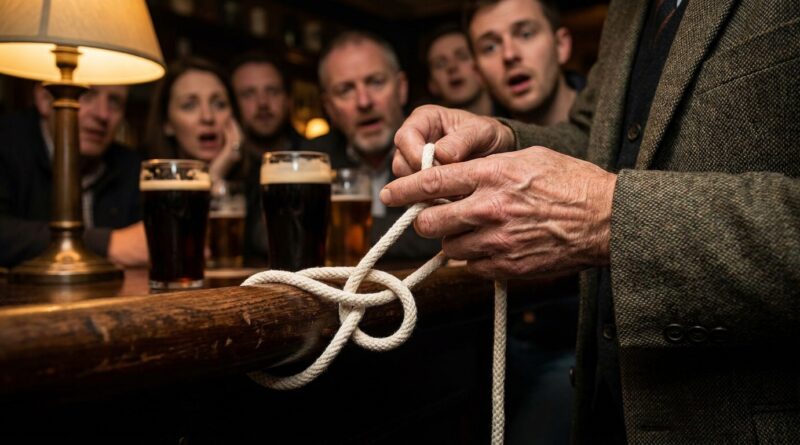
From Math Paper To Miracle: How To Turn A ‘Knot Trick’ Into Your Next Signature String Routine
You can feel it when a string routine is getting old. The spectators lean in, but not because they are amazed. They are scanning your fingers, waiting for the same pull-through they saw on TikTok, YouTube, or from the last magician at the restaurant. That is frustrating, especially if you work close-up and want something small, visual, and strong enough to stop a table cold. The good news is there is a fresh lane opening right now. A recent math paper on a new impossible knot sleight of hand with string takes a classic fake-trefoil idea and expands it into a whole family of convincing impossible knot displays. On paper, it looks academic and dry. In real life, it is a gift. If you strip away the jargon, you get a practical, ungimmicked structure for a signature moment that feels new, fools hard, and fits in a pocket.
⚡ In a Hurry? Key Takeaways
- A new impossible knot sleight of hand with string can give you a visual knot sequence that feels genuinely unfamiliar to spectators.
- Start by turning the academic idea into one clean phase, not a full routine. Learn one false knot display, one reveal, and one reset.
- Keep it ungimmicked and use soft cord with visible contrast, so the effect reads clearly in bars, walk-around, and social clips.
Why this matters right now
String magic is having a funny moment.
Online, visual knot clips are getting attention because they are fast, clear, and easy to understand with the sound off. In live work, though, many performers are still cycling through the same ring-and-string beats, shoelace bits, and old knot vanishes. There is nothing wrong with the classics. The problem is that too many audiences have learned the rhythm of those tricks, even if they do not know the method.
That is why this math-paper idea matters. It gives you a shape and sequence spectators probably have not seen before. Not a new prop. Not a new gimmick. A new-looking impossibility.
What the paper actually gives magicians
The paper is not trying to teach magicians a routine. It is studying a fake knot idea in a formal, topological way and showing that the basic stunt can be expanded into many different impossible-looking knot forms.
Translated into normal human language, here is the useful part.
It gives you variety
Most string workers know one or two convincing false-knot pictures. This research suggests a wider menu of knot appearances that can be shown, tightened, transformed, or dissolved while still secretly living in a controllable structure.
It gives you a reason to stop repeating the old beats
If your current routine is “knot appears, knot slides, knot vanishes,” this lets you start from a stranger visual. That alone helps. People cannot backtrack a sequence if they do not recognize the sequence.
It gives you a field advantage
Most performers will skip it because it looks too theoretical. That is your opening. The smart play is to simplify it before the market catches up and someone packages it with moody trailer music.
How to turn theory into a working routine
This is where most good ideas die. They stay in notebook form. To avoid that, build the routine backwards from performance conditions.
Step 1: Pick one impossible picture
Do not try to present a “family of knots” all at once. Choose one display that looks impossible at a glance. Ask one question only. If a drunk spectator saw a freeze-frame photo of this, would they say, “Wait, how is that tied?” If yes, keep it.
Step 2: Make the effect sentence brutally simple
Your script should fit in one line.
For example: “I will tie a knot without ever making a real knot.”
Or: “You will see a knot that should exist, then it won’t.”
That sentence keeps the trick from turning into finger exercise.
Step 3: Build three beats, no more
For walk-around, use this structure:
- Display an impossible knot shape.
- Let the knot seem to tighten or settle.
- Open the string clean, or melt the knot away.
That is enough. You do not need six phases. In fact, too many phases teach the audience where to stare.
Step 4: Work on the “photo moment”
This kind of magic lives or dies on one image. Pause there. Hold the string still. Turn slightly so the knot silhouette reads. If the audience cannot instantly decode what they are looking at, the moment is wasted.
Best materials for this kind of string magic
Material choice matters more than many magicians think.
Use soft cord, not slippery magician’s rope
You want something that bends naturally, holds a shape for a beat, and does not spring open too early. Thick shoelace-style cord often works better than very slick rope for this kind of false-knot picture.
Use contrast
Black cord in a dim bar is a bad idea. White, cream, or bright red reads better. The knot has to be visible from a casual standing distance.
Keep the length short
About shoelace to forearm length is usually enough. Too long, and the handling starts looking procedural. Too short, and you lose the visual frame.
What makes this stronger than standard knot effects
The real strength is not just novelty. It is timing.
Traditional knot tricks often announce their method rhythm by accident. The performer folds, adjusts, pulls, and then reveals. Spectators may not know how it works, but they know when the sneaky part probably happened.
With this new impossible knot sleight of hand with string, the visible shape itself becomes the attack point. The audience is busy trying to understand the geometry. That buys you a wonderful thing in magic. Delay.
Delay is gold. If they spend their first second decoding what they are seeing, they are already behind.
Common mistakes when adapting academic ideas
Making it too clever
You are not defending a thesis. You are trying to create a gasp. Trim everything that does not help the image.
Talking too much
Do not explain knots, topology, or mathematical curiosities unless that is part of your character. For most performers, mystery beats explanation.
Ignoring angles
Some false-knot shapes look miraculous head-on and weak from the side. Test this in a mirror, then on your phone camera, then on a real person.
Not planning the exit
A cool display is not enough. You need a clean finish. Either the knot becomes real, becomes impossible to untie, or vanishes entirely. The ending decides whether the audience remembers “a neat shape” or “real magic.”
A practical routine skeleton you can use
Here is a simple, worker-friendly outline.
Phase 1: Introduce ordinary string
Let them tug it. Keep this casual. The more normal the cord feels, the stronger the next image becomes.
Phase 2: Form the impossible knot display
Bring the string into the false structure with relaxed handling. No suspense music energy. The less you seem to care, the more impossible it feels.
Phase 3: Freeze and frame it
Hold the shape chest-high. Say one short line. “This is the part that should not exist.” Then let them look.
Phase 4: Resolve
Either pull the string open into a straight length, or convert into a genuine overhand knot and hand it out. Both endings are strong. The best choice depends on your style.
Phase 5: Reset instantly
If this is going into paid walk-around, your reset should be automatic. That is one more reason to keep the routine short and ungimmicked.
Where this fits in a real set
This is not a closer. It is a sharp middle piece or a fast opener.
Why? Because it is visual, compact, and easy to understand. It can also bridge nicely between borrowed-object magic and something more impossible. For example, you can do this after a coin effect to change texture, or before ring-and-string so the audience thinks, “Okay, this person does weird things with ordinary objects.”
That frame helps the rest of your set.
Who should jump on this first
Not everyone.
If your style is heavily verbal, comedy-first, or story-based, this may be a quick aside rather than a full feature. But if you work loud rooms, bars, casual jams, restaurants, or short-form video, this is a very good fit.
It is direct. It is portable. And because it grows out of an unfamiliar structure, it does not scream “old magic prop.”
At a Glance: Comparison
| Feature/Aspect | Details | Verdict |
|---|---|---|
| Novelty | The knot image comes from a less familiar structure than standard false knots and pull-throughs. | Excellent if you want spectators to feel they have seen something new. |
| Practicality | Ungimmicked, pocketable, and adaptable for bars, walk-around, and casual performances. | Very strong, as long as you simplify the handling and choose the right cord. |
| Learning Curve | The source idea may look dense, but the performance version can be reduced to one clean display and one reveal. | Worth the effort. Most of the work is editing, not finger-breaking technique. |
Conclusion
This is one of those rare moments where a smart idea exists in plain sight, but most performers will walk right past it because it arrived wearing academic clothes. That is good news for you. There is fresh heat right now around visual string and knot magic thanks to a new academic sleight-of-hand paper that expands a classic fake-trefoil stunt into a whole family of impossible knots. If you take that concept, strip out the theory, and turn it into one clean, field-ready sequence, you can own a genuinely fresh piece before the market catches on. In bars, walk-around sets, and casual jams, that matters. Audiences do not care that the seed came from topology. They care that they saw a knot that seemed impossible, right in front of them, on an ordinary string. And right now, that can still feel brand new.