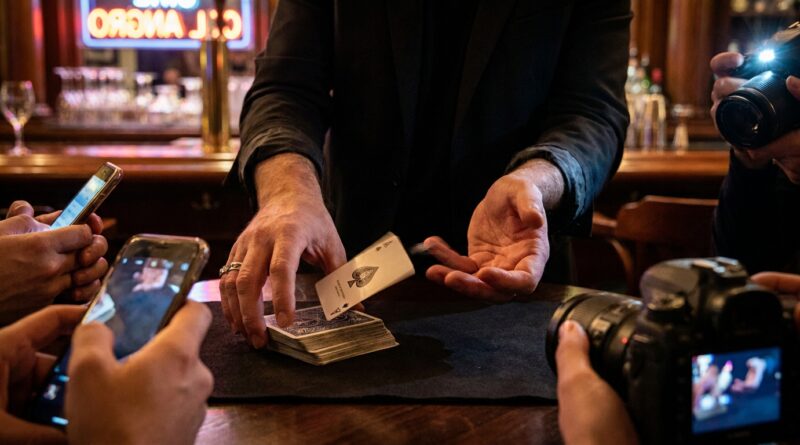
From Film-Style Flash Cuts To Real-Time Heat: How To Build One ‘Now You See Me’‑Proof Card Steal For Live Crowds
You are not imagining it. A lot of the flashiest card steals people now call “clean” only look that way because the edit does half the job. The camera punches in, the frame shakes, the clip cuts, and suddenly a selection has teleported. If you work for real people, in real light, with no mercy from the front row, that can feel maddening. You put years into timing, touch, and nerve, then get compared to a highlight reel built in post.
The good news is you do not need to copy fake pacing to compete with modern expectations. You need one steal that reads fast, looks bold, and survives a live stare. The best route is not “do the movie version for real.” It is to build a now you see me style card steal sleight of hand sequence around real-time heat management. That means one moment of visual compression, one reason for the audience to track the wrong beat, and one load or palm that happens while their brain is still finishing the last picture.
⚡ In a Hurry? Key Takeaways
- Build your steal around timing and attention, not speed alone. Real audiences burn sudden moves.
- Use a two-beat structure. Show a clear condition, trigger a small off-beat, then complete the steal under that reaction window.
- If it cannot survive a live front-row view and a phone replay, it is not ready yet. Test under honest conditions.
Stop trying to beat the camera at its own game
Film cheats with cuts. You cannot. That sounds obvious, but a lot of magicians still practice as if raw hand speed will solve the problem.
It usually does the opposite. The faster and more nervous the hand action gets, the more an audience senses that “something happened there.” They may not know what. They just know where to distrust you.
A real crowd does not need to catch the exact steal. They only need to feel the steal.
So the goal is different. You are not hiding motion. You are hiding importance.
What a live, modern card steal actually needs
If you want a steal that feels current, especially for spectators raised on slick social clips, it needs four things.
1. A sharp picture before the move
The audience needs a simple memory. The card is here. Your hands look fair. Nothing is muddy.
If the picture is vague, the effect feels vague.
2. A reason for their mind to move first
Not their eyes. Their mind.
This can be a question, a confirmation, a joke hit, a spectator action, or a moment of apparent cleanup. The audience mentally shifts gears for a fraction of a second. That is where the steal lives.
3. A short physical path
Big travel kills steals. The card should not have to journey across the county. Every extra inch is extra risk.
4. A believable aftermath
After the steal, your hands must behave like innocent hands. No freezing. No “look how empty this is” acting. Just normal use.
The field-tested pathway: build one ‘flash cut’ steal without the cut
Here is the practical structure.
Phase 1: Lock the audience on a clean image
Spread or display the condition clearly. If a card is going into the center, make that picture undeniable. If it is under a packet, let them register it.
Do not rush this part. Ironically, a modern-looking steal starts with patience.
Phase 2: Create a tiny moment of compression
This is the closest thing to a cinematic “blink,” but it happens in the spectator’s attention, not on the timeline.
Examples:
- You ask, “You saw it go in, yes?” while making eye contact.
- You square the deck as if the dirty work is already over.
- You shift the deck to hand a marker, point to a spectator, or invite them to clamp the cards.
The mistake many magicians make is trying to steal during the biggest gesture. Better is to steal during the emotional reset right after the effect seems to be over.
Phase 3: Do the steal on the exhale
Think of this as the “afterbeat.” The audience has just accepted the condition. Their brain relaxes. Your hands make the smallest necessary action.
This is where a top palm, side steal, clip steal, or packet extraction can work beautifully, depending on your material. The method matters less than the timing pattern.
If you can do the move while appearing to simply square, turn, or transfer the deck, you are in business.
Phase 4: Immediately give the stolen card a job
A stolen card sitting in a tense hand is suspicious. A stolen card that is already part of the next action feels invisible.
That job might be:
- loading to pocket
- adding to another packet
- holding out for a reveal
- positioning for a color change or impossible location
Do not steal and then wonder what to do with it. Build the destination first.
The simplest working model for live crowds
If you want one practical model, start here: center placement, relaxed square-up, side steal or top palm on the off-beat, immediate body turn, then reveal from a location that was in view the whole time.
Why does this work?
Because the audience remembers the impossible condition, not the square-up. To them, the steal happens nowhere. That is the feeling social clips fake with editing. You are creating it honestly with structure.
A sample live sequence
1. A card is returned and pushed flush by the spectator.
2. You out-jog or briefly show that it is genuinely lost.
3. You square slowly and say, “If this were a movie, this is where they would cut.”
4. They laugh. Eye contact lands. You complete the steal in the square-up or as the deck relaxes to dealing grip.
5. You immediately hand the deck out or set it down.
6. The card appears from pocket, wallet, card box, or under an object already on the table.
That little line is not filler. It gives context, gets a reaction, and creates the exact mental blink you need.
Why “heat” matters more than misdirection
A lot of magicians hear “misdirection” and think turning heads. Real heat management is more specific.
Heat is where the audience feels the method must be.
Your job is not always to make them look away. It is often to make them stop caring about the wrong moment.
That is a huge difference.
When the card goes in, heat is high. Once the condition is accepted, heat drops for a beat. Then it rises again at the reveal. Your steal should sit in that dip.
If you do it under peak heat, you are fighting the room. If you do it in the dip, the room helps you.
Three mistakes that make a steal look “edited” in the bad way
Moving too fast too soon
Fast hands can look guilty. Calm hands look impossible.
Over-proving fairness
The more you insist that nothing happened, the more people wonder what happened.
Pausing after the move
This is a killer. A dead stop after a steal acts like a red circle around the method. Keep flowing.
How to practice for both live eyes and phone cameras
Do not just rehearse in the mirror. That is comfort food.
Use three tests.
The chair test
Set a chair slightly lower and to your weak side. That is your problem spectator. If the steal flashes there, fix body angle or hand path.
The phone test
Record at normal speed from chest height, then from too close. Not because spectators see that way, but because modern audiences trust replay more than memory.
The conversation test
Run the move while speaking full sentences. If your hands only work in silence, the steal is not performance-ready.
If phones in the audience are becoming part of your working reality, it also helps to think about how methods read when people expect hidden tech. That is where pieces like From Smart Glasses To Street Miracles: How To Build One Invisible ‘Tech‑Camouflage’ Switch That Looks 100 Percent Sleight Of Hand are useful. The core idea is the same. Build honesty into the look of the effect so the method does not feel outsourced to gadgets.
Choosing the right steal for this style
Not every classic steal fits a modern visual frame equally well.
Top palm
Great if you already own it. Strong for standing work. Best when covered by natural deck handling, not ceremonial squaring.
Side steal
Excellent for “nothing happened” energy. It can feel very filmic because the card seems to vanish from importance before it vanishes from location.
Clip or packet steals
Very visual in the right routine, especially in two-packet sequences. They can read beautifully to live crowds if angles are controlled.
Gimmick-based steals
Sometimes useful, often overbought. If your main reason for using one is “the audience watches too much TikTok,” slow down. Better timing may solve more than more gear.
How to make it feel current without becoming fake
The audience does not actually want edits. They want clarity, surprise, and confidence.
You can give them all three with honest sleight of hand if you clean up the framing.
- Use shorter effect plots.
- Get to the impossible condition early.
- Cut extra shuffling and proving.
- Make the reveal immediate and visual.
That is how you match the pace people are used to without pretending live magic is cinema.
At a Glance: Comparison
| Feature/Aspect | Details | Verdict |
|---|---|---|
| Speed vs timing | Raw speed can fool a camera glance, but live crowds catch tension. Good timing hides the move inside a natural reaction beat. | Timing wins |
| Big motion vs short path | Large gestures draw heat. A short, efficient card path keeps the method small and forgettable. | Short path is safer |
| Gimmick chase vs real handling | Gimmicks may help a specific routine, but a field-tested steal survives scrutiny, reset issues, and repeat performances. | Real handling has better long-term value |
Conclusion
Movie franchises and streaming clips really are resetting what laypeople think great sleight of hand should look like. That is the pressure. But it does not mean you have to chase fake edits, load up on gadgets, or retreat into safer tricks that never risk a visual punch. One solid, modern card steal built around honest heat management gives you a better answer. You keep the technique pure, update the feel to match what audiences are used to seeing, and step in front of a live crowd with something that can hold up under direct eyes and slow-motion replay. That is the sweet spot. Not “just like the movies.” Better. Because it is real.