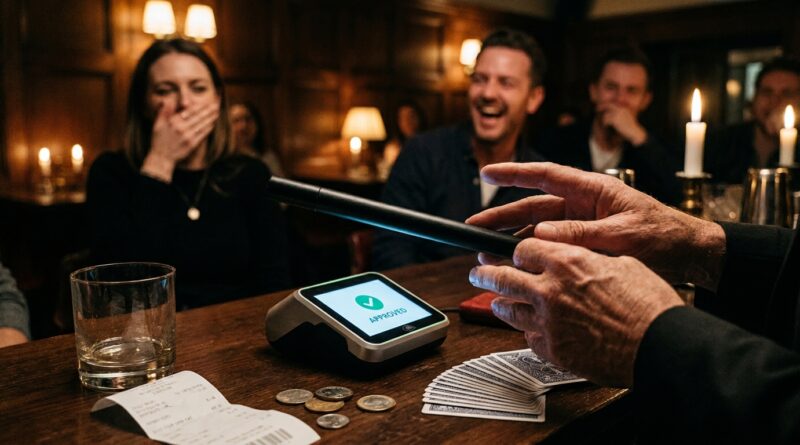
From Viral ‘Pay By Wand’ Clips To Real-World Deception: How To Build One Invisible Tap‑To‑Pay Switch That Looks Like Pure Sleight of Hand
You have probably seen the clips. A magician waves a wand, taps a terminal, and somehow pays for a drink like they are fresh out of wizard school. It looks great on a phone screen. Then you imagine doing it for real people at a bar, with bad angles, bright light, grabby spectators, and no chance to reset the camera. That is where most of these bits die. The good news is the basic idea is solid. The bad news is the internet version is usually built backwards. It starts with the visual and ignores the conditions. If you want a real tap to pay magic wand sleight of hand routine, start with one goal only. Make the payment method invisible before you make it magical. Once the method survives real-world heat, the wand becomes the story beat, not the secret. That one shift turns a social clip into a routine you can actually trust in walk-around work.
⚡ In a Hurry? Key Takeaways
- Build the routine around a hidden, reliable tap source first. The wand is the disguise, not the engine.
- Use one clean moment of magic. Do not add extra displays that invite spectators to inspect the wrong prop.
- Test with real terminals and low-stakes purchases only, and keep your banking security and venue rules in mind.
The problem with most viral wand payment clips
Most of them are not designed for live performance. They are designed for framing.
That sounds harsh, but it matters. A camera lets you hide one side, cut around dead time, and control where people look. A live audience does the opposite. They drift. They stare at the wrong object. They ask to hold things. They stand behind you.
So if your method depends on one perfect angle or a terminal hidden just out of frame, you do not have a routine. You have a clip.
For close-up workers, the fix is simple in theory and a little annoying in practice. You need to remove every condition that only works online. That means no suspicious loading, no awkward fishing for the right side of the prop, and no ending where the spectators naturally want to inspect the exact object that cannot be touched.
What a real-world routine needs
1. An invisible tap source
The contactless payment method has to read as absent. Not hidden badly. Absent.
That usually means the active payment source cannot feel like the star object. If the audience thinks, “It must be in the wand,” you have already weakened the effect. Better if the wand looks too thin, too innocent, or too theatrical to seem practical.
The strongest thinking is to let the audience assume the wand is impossible while the real working area stays psychologically boring.
2. A reason to approach the terminal
Do not just poke the machine because that is what the method needs. Give the wand a job. Maybe it “activates modern magic.” Maybe it finds money. Maybe it turns a chosen object into a payment token.
People forgive motion if the motion has a story.
3. One beat of confirmation
The terminal beep or approval screen is your applause cue. Do not step on it by talking too much. Let the machine prove the point.
A lot of performers rush past the strongest moment. Pause. Look as shocked as they are. Then move on.
4. A clean exit
This is where the good routines separate from the clever ones. After the payment lands, can you casually pocket the wand, hand over the receipt, take the drink, and continue? Or do you suddenly become protective of one prop?
If you tense up after the effect, the audience feels it.
The best construction principle: method in one object, attention on another
If you only take one thing from this piece, make it this.
For a bulletproof tap to pay magic wand sleight of hand routine, the secret and the focus should not live in the same place.
That is why the strongest version often feels like sleight of hand even when hidden tech is involved. Your audience tracks the flourish, the joke, the wand twirl, the impossible premise. Meanwhile the real business happens where no one emotionally cares to stare.
It is the same logic card workers use when they make the wrong hand interesting.
A practical routine shape that works
Here is the skeleton.
Phase 1. Introduce the premise fast
“Everyone has seen those fake videos where people pay with random objects. Let me show you the version that works in real life.”
This line helps a lot. It frames the effect as a correction of the trend, not an imitation of it. That gives your routine authority.
Phase 2. Establish the wand as a magical tool, not a gadget
Use it for a quick throwaway beat first. Make a sugar packet jump, cause a straw wrapper to twitch, or do any tiny magical punctuation. Nothing big. Just enough so the wand enters the story as a prop with theatrical meaning.
Now when it comes near the payment terminal, it feels like a continuation, not a sudden suspicious move.
Phase 3. Create a small obstacle
Ask the spectator if a wand can buy anything in 2026. Smile. Act like you are testing a ridiculous theory. People love effects more when there is a chance they might fail.
Phase 4. Trigger the payment cleanly
This should be one motion. No fiddling. No second attempt if you can help it. Rehearse until your success rate is boring.
Magic should look impossible. Method should feel routine to you.
Phase 5. Let the machine speak
When the confirmation happens, stop. Let the beep or screen land. Then tag it with one short line, like “Good. I did not want to use actual money.”
Phase 6. Get out
Take the item, move the group, pocket the prop, and go into your next piece or your closer line. Do not invite a forensic investigation.
Why this feels stronger than a TikTok gag
Because it solves the audience’s hidden question.
When people see these stunts online, they already suspect camera trickery. In person, your job is not just to fool them. It is to remove the easy explanation they brought with them.
A real-life payment at a real terminal does that immediately. It turns a meme into an event.
That is why this trend matters right now. Audiences are already primed to connect contactless payments with something weird and futuristic. If you show them a version that survives live conditions, it feels current and impossible at the same time.
Common mistakes that weaken the effect
Making the wand too interesting
If it looks like a tech product, they will reverse-engineer the plot in seconds. Keep it theatrical, ordinary, or even slightly silly.
Overproving fairness
You do not need to show every side of every object. That kind of handling often screams, “Please notice how innocent this is,” which has the exact opposite effect.
Building around one specific terminal
Different readers behave differently. If your handling only works on one machine at one café, it is not roadworthy yet. Test across multiple locations.
Ignoring transaction friction
Amounts, terminal prompts, and wallet settings can all affect smoothness. Keep the purchase low, predictable, and simple.
Forgetting your persona
If you are a technician, present it like impossible precision. If you are comic, play it as absurd modern wizardry. Do not let the prop force you into a character that is not yours.
How to keep the tech from swallowing the magic
This is the big artistic worry, and it is a fair one.
A lot of magicians are happy to use hidden tech until the audience stops seeing them as skilled and starts seeing them as someone who bought a clever toy. The fix is not to avoid technology. The fix is to frame technology as one texture in a larger performance.
Use classical timing. Use audience management. Use conviction. Use off-beats. In short, make the routine feel like it belongs in your set, not like a sponsored demo.
The audience should leave thinking you made modern life behave strangely. Not that you found a new gadget online.
Safety and ethics matter here
This should go without saying, but say it anyway. Use your own payment method. Get venue permission when needed. Keep purchases low value while testing. Make sure your phone or wearable wallet security is set the way you want it. And never build a routine that risks accidental charges, spectator confusion, or a messy conversation with staff.
If a method is clever but creates payment disputes, it is not clever enough.
The sweet spot for this trend
The sweet spot is not “look, I can pay with a wand.”
The sweet spot is, “You have seen the internet version. Here is the impossible live version.”
That line gives you context, relevance, and an instant hook. It also lets older methods and newer tech mix naturally. The wand gives shape to the effect. Your handling gives it credibility.
At a Glance: Comparison
| Feature/Aspect | Details | Verdict |
|---|---|---|
| Camera-first viral version | Strong visual, weak angles, often depends on framing and low scrutiny | Fine for content. Risky for live work. |
| Live routine with hidden tap source | Built for real terminals, natural handling, and a clean post-effect exit | Best path for walk-around and bar sets. |
| Tech-heavy prop demo | Can be reliable, but often feels like a gadget puzzle instead of magic | Use only if your presentation keeps the mystery on you. |
Conclusion
The smart move is not to chase the latest clip beat for beat. It is to build the version that works when there is no camera to save you. That is why this moment is useful for the community. Tap-to-pay wand stunts have jumped from niche corners to mainstream attention, so audiences already arrive half-prepared to believe payment tech can look like magic. If you can meet that expectation with one strong, angle-proof routine, you get more than a novelty. You get a current talking point, a practical closer, and a good example of how hidden tech and classic sleight of hand can mix without turning you into a gadget demonstrator. Done right, this does not replace your identity as a technician. It proves it.