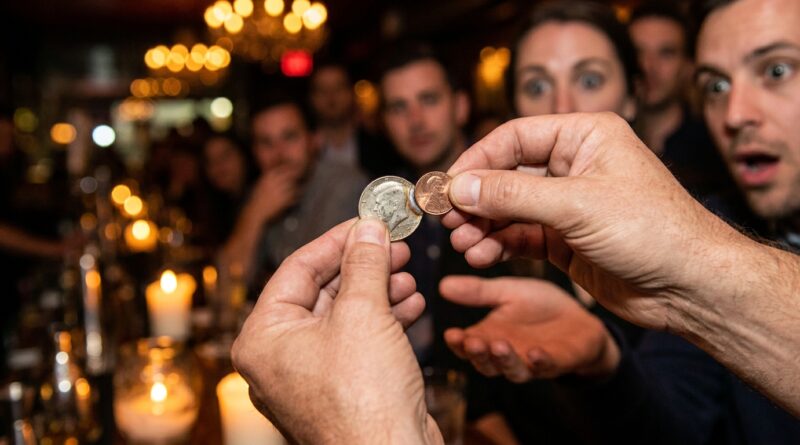
From Viral Quick Cuts To Live Heat: How To Build One Invisible ‘Coin Fusion’ Switch You Can Use Surrounded
You have probably seen the clips. Two coins touch, melt, fuse, split, restore. It looks savage on a phone screen. Then you try to do something like it for real people at a bar or in a tight circle, and the whole thing falls apart. The ditch needs a camera cut. The flash shows from one bad seat. The prop works only if nobody breathes on it. That is the gap worth fixing. If you want a real coin fusion sleight of hand switch, the answer is not buying a fussier gimmick. It is building one invisible moment that hides the dirty work inside a natural heat beat, right when spectators expect to stare at the coins. Done right, this gives you a visual fusion feel that survives live angles, bad lighting, and people burning your hands from both sides. Better yet, it fits in a pocket and can close a working set tonight.
⚡ In a Hurry? Key Takeaways
- Use a timed retention-style switch during the “heat” moment, not during the reveal.
- Keep both coins in play visually before and after the action, then let body turn and eye contact cover the transfer.
- A simple, durable setup beats fragile social-media gimmicks if you want this to work surrounded.
Why most coin fusion demos die in the real world
The camera is very forgiving. Real humans are not.
Most viral fusion pieces are built around one of three crutches. A clipped frame. A perfect front angle. Or a gimmick that looks amazing for thirty seconds and then becomes a headache in your pocket. None of that helps if you work tables, cocktail hours, street pitches, or casual sets where people stand at your shoulders.
The good news is the crowd does not actually need a literal metal-melting miracle. They need a clean story in their head. “I saw two separate coins. You heated them. Now they are one thing.” If you can protect that story, the switch does the rest.
The core idea: build the switch into the heat beat
A strong coin fusion sleight of hand switch happens before they think it does.
Do not wait until the supposed fusion. That is when all eyes narrow and shoulders lean in. Make the secret change during the moment of rubbing, warming, breathing, squeezing, or tapping. That is the beat spectators label as process, not result.
The structure
Use this simple frame:
1. Show two ordinary-looking coins clearly.
2. Set a reason for contact. Heat, pressure, static, magnetism, luck, whatever fits your style.
3. As attention locks onto the rubbing action, execute the switch.
4. Freeze for one beat.
5. Reveal the fused outcome slowly.
That freeze matters. It separates method from effect. If the reveal comes too fast, people backtrack. If you pause, their mind says, “The magic happened in the squeeze.”
What the switch should actually feel like
You want invisible, not clever.
The best handling usually has these traits:
- The hands stay close together.
- The objects remain near the same height.
- No finger looks like it suddenly got a job to do.
- Your wrists do not jerk or dip.
- Your eyes leave the hands for a split second, which tells them they can too.
If you need a big cover action, it is probably the wrong switch for surrounded work.
A practical live-working model
Start with two display coins and one fused piece in easy access. The visible pair goes fingertips to palm-level contact. As you begin the “heat” rub, the lower hand takes over the audience’s picture of the pair while the upper hand relaxes and trades out what needs to go. The fused piece arrives not as a production, but as the natural end state of the squeeze.
That is the whole philosophy. Keep the image continuous. Let one hand carry the movie while the other hand edits a frame.
How to stay angle-tight when people crowd you
Surrounded does not mean every angle is equal. It means your weak side cannot look weak.
Use your chest as a soft wall
Turn ten to fifteen degrees, not ninety. A tiny body shade is enough to protect a finger palm, edge grip, or nested object without screaming “I am hiding something.”
Keep the dirty hand in motion, but not busy
Motion covers, busy attracts. There is a difference.
A hand that rubs, rotates a coin, or lightly points can disappear. A hand that claws, pinches, and re-grips says, “Watch me.”
Bring the action up
Waist-high coin work gets murdered by side angles. Bring fusion sequences to lower chest height. People read better there, and your natural body line does more of the defensive work.
If you enjoy this kind of staging thinking, the article From Cruise Ship Parlors To Your Close‑Up Set: How To Build Shadow‑Play Sleights That Feel Like Real Voodoo gets into that same idea from a different direction. The move is only half the trick. The picture you create around it does the heavy lifting.
A field-tested handling script
Phase 1: Clean display
Show each coin separately. Let them register as different objects. Do not rush this. If they never fully clocked “two,” your “one” has no punch.
Phase 2: Reason for fusion
Say something simple. “Coins are just pressure and heat waiting for a bad decision.” Or, “If metal gets enough friction, weird things happen.” It does not need to be true. It needs to justify contact.
Phase 3: The hidden moment
Bring the coins together. Rub. Breathe on them. Ask one spectator, “Do you see the edges lining up?” That question pulls their mind toward the seam, not the transfer. Execute the switch during that answer beat.
Phase 4: Lock the frame
Stop moving. This is where many magicians panic and keep fidgeting. Do less. Let the audience process.
Phase 5: Slow reveal
Separate fingers gradually and show the fused result as though you are seeing it with them. If possible, let one edge appear first. Full flashes of the final object are less interesting than a slow realization.
Common mistakes that expose the method
Switching on the reveal
This is the classic error. If the audience can point to the exact second your hands changed position, they will camp there mentally.
Over-proving the coins
You do not need ten displays, clinks, tosses, and spins. Overproof usually means fear. Show enough to set the image, then move on.
Using props that cannot survive your pocket
If the gimmick bends, sticks, flakes, separates, or needs a perfect reset, leave it at home. A worker needs repeatability, not optimism.
Forgetting the aftermath
The trick does not end at the reveal. You need a next beat. Either hand the object out, ring in a switch for examination, or move directly into a restore, vanish, or transposition. Dead air after a fusion invites bad questions.
How to practice this without fooling yourself
Do not practice only in a mirror. Mirrors flatter timing because you know where the move is.
Use three checkpoints
Front view: Can the image stay constant?
Low side view: Does anything flash from a seated spectator angle?
Conversation test: Can you say the script while doing the move without your voice changing?
If your sentence tightens up during the switch, your body probably does too.
Film ugly, not pretty
Use a phone on bad room lighting from slightly off-center. Social clips are made under ideal conditions. You want the opposite. If it survives ugly practice, it will survive live work.
How to turn it into a closer, not just a move
A fusion switch by itself is a moment. To make it a closer, give it a shape.
- Start with a transposition, then explain you want to stop them traveling.
- Move into the fusion so the ending feels motivated.
- Finish by restoring the coins apart, or impossible-location one of them.
That gives you beginning, middle, and end. Spectators remember routines, not isolated stunts.
For many performers, the smart play is to borrow the mood of a darker piece without becoming theatrical about it. That is another reason the shadow-play approach works so well with metal effects. It adds a sense of ritual without slowing the set to a crawl.
When a gimmick is worth using, and when it is not
Not all gimmicks are bad. Some are excellent. The test is simple.
Use it if:
- It resets in seconds.
- It survives normal pocket carry.
- It can be managed with people on your sides.
- It does not demand perfect lighting.
Skip it if:
- You need a table every time.
- The handling depends on a camera crop.
- The reveal is stronger online than in a human hand.
- You are scared to let the prop touch your keys.
If that sounds harsh, good. Working material should earn its pocket space.
At a Glance: Comparison
| Feature/Aspect | Details | Verdict |
|---|---|---|
| Best switch timing | During the rubbing or “heat” action, before the audience thinks the effect happens | Strongest for live work |
| Angle management | Small body turn, chest-high handling, continuous object picture, no large cover gestures | Reliable surrounded |
| Gimmick vs pure handling | Simple durable setup can help, but fragile promo-reel gear usually fails under pocket and reset pressure | Choose practical over flashy |
Conclusion
The buzz right now is full of hyper-visual coin fusions, metal restorations, and “new concepts” that look wild for a lens and shaky everywhere else. That is exactly why a field-tested, angle-tight coin fusion sleight of hand switch matters. It lets you take the trend without inheriting the weakness. Instead of chasing another fragile gimmick, you build one invisible action into a natural heat beat and get something you can actually use. That means a pocket-size closer for bars, cocktail hours, and street sets. It means less promo-reel fantasy and more real-world reactions. Most of all, it gives you one concrete structure you can start rehearsing tonight, then put in front of humans tomorrow. That is the kind of magic news translation that is worth your time.