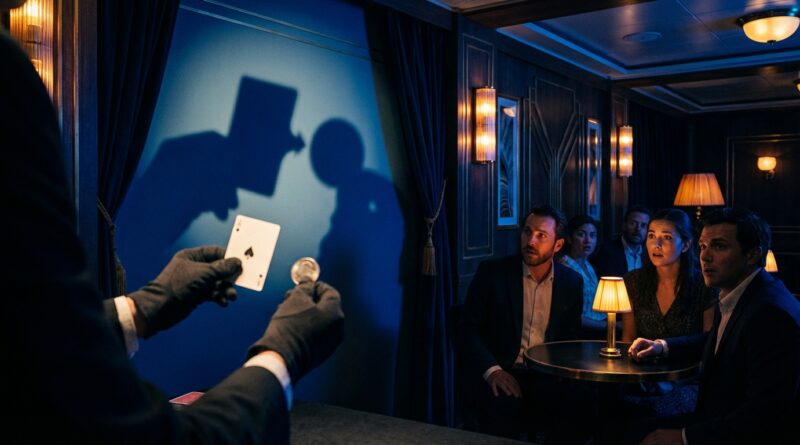
From Cruise Ship Parlors To Your Close‑Up Set: How To Build Shadow‑Play Sleights That Feel Like Real Voodoo
You can feel it the second a set starts to die. The move is good. Your handling is clean. The lighting is moody and expensive. And still the trick lands like a social clip that wandered into a real room by mistake. That is the frustration a lot of close-up workers are running into right now. Audiences have seen polished card changes under perfect light a thousand times on their phones. What still jolts them is something stranger. A vanish that happens in the wall shadow. A coin that seems to crawl from one silhouette to another. A hand that looks empty in the light, then guilty in the dark. That is where shadow play sleight of hand for low light magic starts to matter. It is not about hiding bad technique. It is about building effects that belong in dim parlors, cruise lounges, themed rooms and candlelit corners, so the magic feels like it came from the room itself.
⚡ In a Hurry? Key Takeaways
- Shadow play works best when the audience is meant to watch a shape, not inspect a grip. Build effects around silhouettes, timing and light position.
- Start by reworking simple vanishes, transfers and appearances you already do, then test them with one fixed light source and a plain wall.
- Low light can make magic stronger, but only if safety, sightlines and audience focus stay under control. Do not turn atmosphere into confusion.
Why bright-light sleight of hand often feels weak in moody rooms
A lot of magicians are still performing as if every venue were a trade show floor at noon. Hard, direct proof. Crisp displays. Front-on handling. That style can work. But in a dark room with side lighting, it often feels oddly small.
The reason is simple. The room is already doing part of the storytelling. If your magic ignores that, the effect and the space fight each other.
Low light changes what an audience trusts. In bright light, they believe what they can inspect. In low light, they believe what they can sense. Shape matters more. Rhythm matters more. The moment before and after the move matters more.
That is your opening.
The core idea behind shadow play sleight of hand for low light magic
Think less about “doing a move in the dark” and more about “designing an effect for partial visibility.” That shift fixes a lot.
What the audience should see
In shadow play, the audience does not need every finger position. They need a clear visual story. A coin is here. The shadow shows it. The hand closes. The shadow opens. It is gone.
If the story is clean, the method can be softer and simpler than you might think.
What the audience should not try to do
They should not be trying to burn your knuckles from two feet away. If your routine invites that kind of inspection, it is probably still a bright-light trick wearing dark-room clothes.
Shadow play routines should direct attention to contrast, shape and impossible transitions. Not to challenge-style scrutiny.
Start with the right kinds of sleights
You do not need a new toolbox. You need better casting.
The best moves for low light are usually the oldest and simplest ones. False transfers. Retentions with a strong before-picture. Loads that happen on a body turn. Ditches covered by motivated movement. Switches timed to gaze shifts.
What changes is the frame around them.
Best categories to adapt
Vanishes. These are usually the easiest win. A vanish becomes stronger when the audience sees the object in silhouette one beat before it disappears.
Appearances. Producing an object from a dark edge, sleeve line or table shadow can feel eerie in a way a standard production does not.
Transpositions. If one hand is in light and the other is represented mainly by shadow, the travel can feel less like a move and more like a haunting.
Penetrations. Rings, cords and fingers play especially well because the outlines read clearly at a distance. If you already perform visual ring material, you may also like How to Turn Viral Ring‑Through‑Finger Clips into a Real‑World Worker You Can Perform Anywhere, because the same idea applies here. A clip move becomes a worker when you shape it for a real audience and a real room.
Build around one light source, not five
This is where many performers get lost. They think “theatrical” means complicated. It usually means controlled.
One practical light source is enough to start. A table lamp. A wall sconce. A single warm spotlight from the side. The goal is a readable shadow, not a fancy plot from the lighting desk.
Good beginner setup
Use one light placed slightly behind and to the side of you. Stand near a plain wall, curtain or booth panel. Keep the audience in a loose front arc. Now test a basic false transfer.
You are looking for three things:
- A strong shadow edge, so the object reads clearly.
- Enough front light that your face is still visible.
- No second light creating a muddy double shadow.
If the shadow looks fuzzy or split, simplify the environment before you blame the move.
The three-layer method for designing a shadow routine
Here is a framework that keeps this practical.
Layer 1: The light picture
Freeze the moment at the supposed point of magic. What does the audience see first? A coin between fingers. A ring on a silhouette. A hand empty against the wall.
If you paused the action and took a still photo, would the image be readable? If not, the effect is not ready.
Layer 2: The physical method
Now fit a method under that picture. Usually this means choosing a sleight that does not require tiny displays or angle-sensitive cleanups. Keep the action broad and natural.
In low light, less finger activity often looks more convincing.
Layer 3: The dramatic beat
Do not rush the reveal. Shadow effects need one beat of setup and one beat of aftermath. Show the shape. Let them register it. Then let the impossible change happen. Then stay still.
That stillness is where the room gasps.
Moves that become stronger in silhouette
False transfer with delayed proof
Show the object openly, then let the shadow confirm it. Do the transfer before the audience expects the magic. After that, let the receiving hand’s shadow “hold” the object for one extra beat before opening empty.
That delay makes the vanish feel less mechanical.
Thumb palm or finger palm as shadow camouflage
In bright light, some palms need careful management. In shadow, the hand shape often matters more than the exact finger spacing. That does not excuse sloppy work, but it does mean some classic palms suddenly become much more useful.
Shuttle pass with split attention
If one object is tracked mainly in actual light and the other mainly in shadow, the audience can feel a transfer without being sure where it happened. This is ideal for eerie transpositions.
Body turns and head turns as cover
A slight turn toward the light can sharpen one hand’s outline while letting the other fall away. That is not cheating. That is staging. Actors use it. Dancers use it. Magicians should too.
What props read best in low light
Not every close-up prop survives dim conditions.
Best choices
Coins. Especially larger coins or contrasting tokens. Their edges read well in silhouette.
Rings. Circular shapes are instantly readable, and penetrations feel strong.
Keys. They have a spooky, story-friendly outline and sound good too.
Cords and thread loops. Useful if backlit correctly. The shadow can often be stronger than the real object.
Small candles, matchbooks, folded billets. Great for mood, if venue rules allow them. Many times an LED substitute is safer and still effective.
Harder choices
Standard playing cards. They can work, but indexes disappear and flat shapes can look dead unless you use broader effects.
Tiny sponge items. Often too soft in outline.
Busy gaffs. If the method depends on small visual details, it may vanish for the wrong reason.
How to rehearse without guessing
Do not just run the routine in your bedroom and hope it scales.
Use your phone the boring way
Set your phone where an audience member would sit. Record wide. Then record from a bad seat too. Shadow magic fails when it only works from your own eyes.
Rehearse in half speed
Many moves that feel smooth in normal tempo look muddy in low light. Slowing down shows whether the shadow picture stays clean.
Watch with the sound off
This is a handy test. If the effect still makes visual sense with no script, your staging is probably solid.
How to script shadow magic so it does not feel cheesy
You do not need to start talking about spirits unless that is truly your character.
The strongest presentations are usually light on claims and heavy on atmosphere. Talk about memory. Old rooms. Bad luck. Missing objects. A habit of the hands. The way shadows lie. The way they tell the truth.
Keep it grounded.
If your persona is playful, go playful. “In daylight this is a coin trick. In this corner of the room, it behaves differently.” That line alone can set the rules without trying too hard.
Common mistakes that kill the effect
Making it too dark
If they cannot tell what happened, it is not mysterious. It is just unclear.
Using low light to cover weak basics
Audiences may not see every detail, but they still feel awkward handling. Shadow work rewards confidence. It does not replace it.
Ignoring audience sightlines
The best shadow may be on the wall to your left. Great. If half the crowd is on your right, you still have a problem.
Forgetting your face
Your expression is part of the magic. If your hands are eerie but your face disappears, the whole piece can feel emotionally flat.
Safety and venue reality matter more than mood
This is especially true in cruise ship parlors, cocktail rooms and pop-up venues.
Do not block exits with your audience shape. Do not use open flame where the venue hates it. Do not create dark patches where people trip over bags or chair legs. If a trick needs a knife-edge lighting cue to function, have a backup version for when the room changes five minutes before showtime.
The strongest workers are not the ones with the most precious setup. They are the ones who can keep the feeling even when conditions shift.
Quick routine ideas you can test this week
The shadow coin vanish
Show a coin at fingertips. Angle the hand so the coin appears clearly in shadow on the wall. Close the hand, execute a simple vanish, then open the real hand first and the shadow second. Let the audience process both emptinesses.
The haunted ring
Borrow a ring. Display it on one finger in silhouette. Stroke the shadow with the other hand while the real work happens lower and closer to the body. Reveal the ring in an impossible new place.
The key that will not stay put
Use a key because the outline is distinct. The key appears to hang from the shadow of one hand, falls away, then is found in the other hand or pocket. Add a sound cue and it gets stronger fast.
At a Glance: Comparison
| Feature/Aspect | Details | Verdict |
|---|---|---|
| Lighting setup | One controlled side or rear-side light usually creates the cleanest shadow and easiest blocking. | Best starting point for reliable low light magic. |
| Sleight selection | Simple vanishes, transfers and palms beat detail-heavy card handling or tiny visual gaff work. | Use broad, readable methods first. |
| Audience impact | When the shadow tells the story, effects feel more theatrical, immersive and less like social media practice footage. | Excellent fit for cruise parlors, boutique shows and character rooms. |
Conclusion
Right now, the rooms getting attention are not all bright banquet spaces and straight-ahead close-up tables. They are immersive venues, cruise ship parlors, boutique shows and character-driven sets that already use light as part of the experience. Most workers are still dropping bright-light material into those rooms and then wondering why it feels thin. A better answer is not to throw away your skill set. It is to reshape it. Use shadow play sleight of hand for low light magic as a working framework. Take moves you already trust, stage them for silhouettes and contrast, and build effects that feel born from the room. Do that well, and you will stand apart from both clip magicians and old-school parlor acts very quickly. That is not a small upgrade. That is a whole new lane.