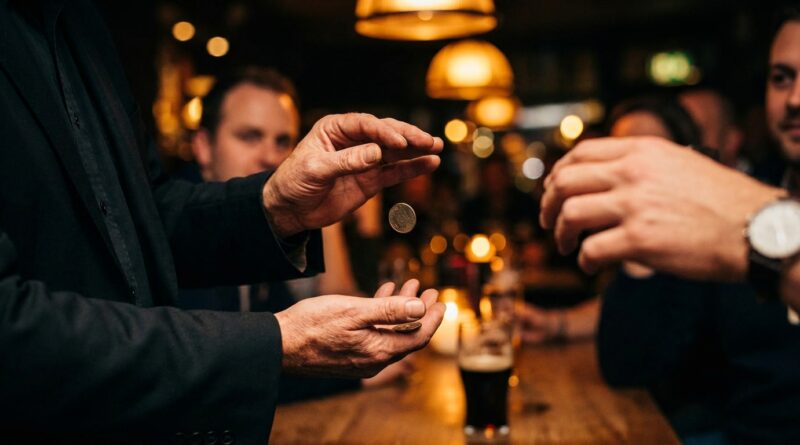
From TikTok Flourishes To Real-World Weapons: How To Build One Invisible, Repeatable ‘Table Hop Switch’ For Any Small Object
You have probably felt this yourself. A switch looks killer on TikTok, then dies the second you try it at a real table. The angle is wrong. The lighting is harsh. Somebody reaches in too soon. And suddenly that “invisible” move turns into a fumble. That is the gap a lot of magicians are dealing with right now. They do not need another one-shot flourish for a phone camera. They need an invisible object switch sleight of hand that works while standing, chatting, resetting, and handling pressure from people who are inches away. The good news is you do not need a new gimmick drawer to get there. You need one repeatable table hop switch built around timing, object placement, and natural actions. Once you have that, coins, rings, folded bills, small charms, sugar packets, and prediction items all become stronger. Better yet, your old routines get better without getting more complicated.
⚡ In a Hurry? Key Takeaways
- A reliable invisible object switch sleight of hand is built on a natural pick-up and put-down action, not a flashy secret move.
- Start with small flat objects and rehearse under bad angles, bright light, and spectator interruption so the switch survives real work.
- The safest, most useful version uses ordinary objects and simple body cover, which makes it stronger for paid close-up than camera-only gimmicks.
What a real-world “table hop switch” actually needs to do
A good switch at a table is not just invisible. It is repeatable.
That means it has to work when you are tired, when the music is loud, when a drink is in the way, and when one spectator is filming from a weird angle. It also has to reset fast. Ideally, instantly.
For table hopping, the best switch has five traits:
- It uses a normal reason to touch the object.
- It happens during a larger action, not as a separate “move.”
- It keeps the dirty moment low and brief.
- It ends clean enough that people can burn your hands after the fact.
- It works with more than one object type.
If your current switch only works when the phone is locked off and your hands stay in one tiny performance box, it is not ready for live work.
The basic structure of the invisible switch
Think of this as a framework, not a single named move.
1. Show object A clearly
Do not over-prove it. Just let them register what it is. A coin, a folded note, a ring, a small token, a sugar packet. The more casual the display, the less heat you create.
2. Create a reason to move it
This is where many social media clips go wrong. They switch because the method needs it. In real life, the audience needs a reason. You are moving the object to the table edge, placing it on a spectator’s palm, sliding it under a glass, or picking it up to “mark the moment.”
3. Borrow cover from a bigger action
The actual swap should happen while something else makes perfect sense. Reaching for a pen. Straightening a napkin. Turning your body to include the next spectator. Picking up another item. The switch is hidden inside ordinary traffic.
4. Let the audience remember the effect, not the handling
After the switch, do not freeze. Continue. Ask a question. Look at them, not your hands. The audience should feel like the moment of magic is still coming. That slight delay helps erase the method.
The best working version for most performers
If you want one version you can plug into a lot of routines, use this model:
The shuttle-and-set switch
You apparently transfer or place object A. In the same rhythm, object B is the one that actually gets left or shown. The strength comes from continuity. Your hand never announces, “Here comes the move.” It simply carries on.
This is useful because it is flexible. You can do it:
- Hand to hand
- Hand to table
- Table to spectator
- Under a cover object like a card, coaster, or receipt
The key is sameness. The path, speed, and grip of both objects should match as closely as possible. If object A is handled delicately but object B is handled stiffly, people may not know why it looked odd, but they will feel it.
Why viral switches often fail in the wild
Most flashy feed moves are built around one thing: the viewer does not get to choose where to look.
Live audiences do.
That changes everything. They can lean. They can interrupt. They can ask to hold the item early. They can stand on your bad side. They can watch your off hand because they do not know they are “supposed” to stare at the pretty hand.
That is why a worker should care less about visual flourish and more about traffic flow. Where are both hands before the switch? Where do they go after? Does the action fit the room?
If you are trying to build material that fools both lenses and real people, it is worth reading From Viral ‘AI Magic’ Clips To Real Workers: How To Build Human-Only Sleights That Fool Both Cameras And Crowds. It hits the same nerve. The trick is not making something look impossible in perfect conditions. It is making it survive human attention.
How to build your own switch for any small object
Here is the practical part.
Start with object families, not individual props
Do not build a switch only for one exact coin or one exact gimmicked token. Build by category:
- Flat and rigid, like coins or poker chips
- Soft and foldable, like bills, billets, receipts
- Round and delicate, like rings or bands
- Light utility items, like sugar packets or paper tabs
Each family wants a slightly different grip, but the same switch structure can still work. This is what makes the move bankable. You are learning a system, not collecting isolated stunts.
Match the object to the environment
Bars are noisy and dim. Restaurants can be bright and crowded. Pop-up rooms may have people on multiple sides.
Choose objects that behave well in those spaces. A tiny bead may be impossible. A folded bill may be perfect. A ring switch can be strong, but only if you can control the pace and avoid drops.
Design the “why now?” beat
This matters more than the fingers.
Ask yourself: why am I touching the object at this exact second? Good reasons include:
- To isolate it
- To make the conditions fairer
- To let a spectator guard it
- To compare it with another object
- To get it out of the way before the next phase
Bad reasons sound like magician business. “Let me just square this.” “I’ll place it here for no reason.” “Watch carefully.” Those lines put a spotlight on your method.
Use the table as a friend, not a crutch
A table gives you texture, edges, and temporary cover. It also gives spectators a place to stare. So use it wisely.
The strongest table moments are usually:
- Setting an object down while talking to a spectator
- Picking up one thing while apparently moving another
- Using a coaster, card, or napkin as a natural cover item
- Shifting focus from center table to a person’s hand
Do not rely on the table to hide sloppy timing. If the switch only works because the audience momentarily loses sight of the object, it is fragile. The audience should feel they have followed everything.
Misdirection that does not feel like misdirection
Non-magicians hate the feeling of being “handled.” They may not know the method, but they know when your face suddenly gets theatrical and your script turns into traffic control.
Better misdirection is simple:
Ask a real question
“Which hand would you trust more?” gets a person to think and respond. That tiny mental task buys clean time without looking suspicious.
Use eye contact at the right moment
People follow people. If you make eye contact while their brain is processing a question or joke, your hands can complete a routine action quietly.
Move on the offbeat
The offbeat is the little exhale after a laugh, answer, or reveal setup. That is where real workers live. Not on the dramatic beat. Right after it.
Keep both hands innocent-looking
If one hand becomes a statue and the other becomes “the active hand,” spectators will tag the inactive hand as suspicious. Soft, normal motion wins.
A simple rehearsal plan that actually prepares you
Mirror practice is fine for the first hour. After that, it can fool you.
Use this four-step test:
1. Bright light test
Practice under ugly overhead lighting. If it only works in moody shadows, it is not ready.
2. Side-angle test
Set your phone off to the side, not directly in front. That is closer to how a real spectator burns your hands.
3. Interruption test
Speak your script and deliberately stop halfway. Can you freeze safely? Can you continue naturally? Real spectators interrupt all the time.
4. Speed test
Do not just do it slowly. Do it at performance speed, then slightly slower than performance speed. A good switch survives both.
If a move feels good only when rushed, that is a warning sign.
Common mistakes that make a switch visible
These are the usual culprits.
Too much proving
If you keep showing the object before the switch, you are telling people it matters. Show it once, clearly, then move on.
Changing your grip during the dirty moment
The audience may not catch the exact method, but they will notice that your hand suddenly looks “careful.” Build grips that start innocent and end innocent.
Looking at the move
If your eyes dip to your hands at the wrong time, the audience’s eyes go there too.
Switching without dramatic purpose
A switch is not an effect. It is a tool. If the outcome is not stronger after the switch, do not do it.
Using an object that sounds wrong
Coins click. Rings scrape. Folded paper whispers. Sound can expose a switch even when the visual looks clean. Rehearse for your ears too.
Best uses for this kind of switch
Once you have a dependable invisible object switch sleight of hand, you can add it to routines you already perform.
- Coin transpositions
- Signed object to impossible location setups
- Ring duplications or substitutions
- Bill changes with a more casual lead-in
- Prediction reveals using folded paper or tokens
- Multiple phase routines where a “same object” quietly becomes a prepared one
That is the real value. You are not learning one trick. You are adding a hidden joint to many tricks.
How to know your switch is ready for paid work
Use this checklist:
- You can do it while talking.
- You can do it after walking up cold to a table.
- You can do it with a spectator on your weak side.
- You can recover if someone speaks or reaches in early.
- You do not need a special surface.
- You can reset before leaving the group.
If you cannot tick most of those boxes yet, keep it in rehearsal. There is no shame in that. The pros you admire are often using simpler methods than you think, just with better timing and better audience management.
At a Glance: Comparison
| Feature/Aspect | Details | Verdict |
|---|---|---|
| Camera-first switch | Looks flashy from one controlled angle, often depends on framing, timing edits, or narrow sight lines. | Fine for clips, weak for live table work. |
| Table hop switch | Built around natural object handling, offbeat timing, quick reset, and tolerance for messy audience conditions. | Best choice for workers and repeat bookings. |
| Prop-heavy gimmick switch | Can be strong, but often adds pocket space, setup time, and failure points if grabbed or examined early. | Useful in spots, but less flexible than a solid ungimmicked method. |
Conclusion
The strongest switch is usually the one nobody clocks as a switch at all. It just feels like you handled a normal object in a normal way, then something impossible happened later. That is why this matters so much right now. Close-up is booming again in bars, pop-up venues and immersive rooms, which means more magicians are performing inches from phones and skeptical friends, not studio cameras. The community wants techniques that travel from social clips to paying gigs without adding props or risk, and a dependable object switch is one of the most useful tools you can own. Build one that fits your hands, your objects, and your real venues. Test it under pressure. Then drop it into material you already do. You will get more from your current set, tighten your structure, and stop leaning on single-use, camera-only gimmicks.