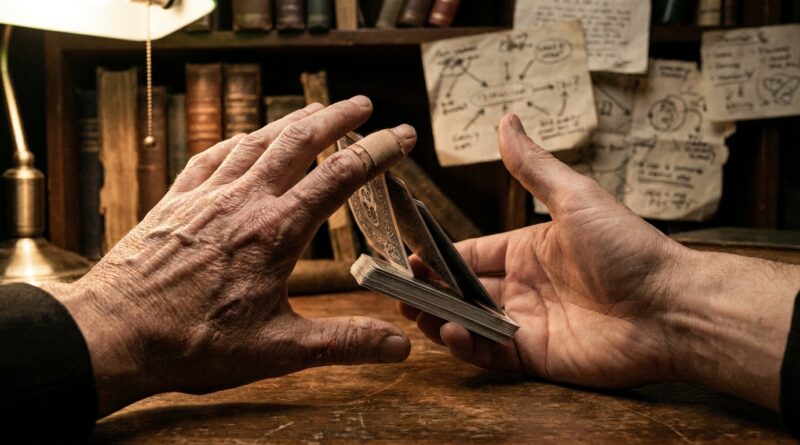
From One-Hand Limits To Signature Miracles: Build One ‘Adaptive Grip Switch’ Sleight That Works Even If Your Hands Aren’t Perfect
If you have ever watched a tutorial, tried the move, and felt your hand simply say “no,” you are not broken. A lot of magicians carry that frustration in silence. Stiff fingers, old injuries, arthritis, tendon pain, hypermobility, small hands, large hands, missing range in one thumb, all of it can make classic sleights feel like they were designed for somebody else. After a while, practice stops feeling exciting and starts feeling like proof that you are failing. That is the part worth pushing back on.
The fix is not forcing your hand to copy an ideal model. The fix is building one adaptable switch that fits your actual grip, your actual tension, and your actual limits. Think of it as custom tailoring for technique. Done right, an adaptive grip switch can give you a clean object transfer, card switch, billet exchange, or packet change without asking your weakest fingers to do the hardest work. Spectators do not grade finger positions. They remember clarity, timing, and impossibility. That is good news, because those are skills you can still build even when your hands are not “perfect.”
⚡ In a Hurry? Key Takeaways
- Start with what your hand can do comfortably, then build the switch around that, not around a famous sleight.
- Use stronger contact points like the base of the thumb, first finger curl, palm edge, and body turn to replace fine fingertip work.
- If a move causes pain, numbness, or lingering strain, stop and redesign it. Good technique should feel sustainable.
First, stop blaming your hands
The biggest mistake here is moral, not technical. Too many magicians treat hand limits like laziness or lack of dedication. That is nonsense. Some moves really do depend on a narrow set of physical traits. Long fingers help. Loose joints help. A mobile thumb helps. So does having no pain.
If you do not have those things, your job is not to “try harder.” Your job is to become a designer. You are building adaptive sleight of hand for magicians with hand problems, not chasing a museum-perfect grip nobody in the audience will ever see.
A switch is a great place to start because it sits at the heart of so much magic. Cards. Coins. Billets. Small packets. Business cards. Predictions. If you can build one reliable switch shape that works for your hands, you can use that thinking in a lot of routines.
What an adaptive grip switch actually is
An adaptive grip switch is not one named move. It is a method for changing one item for another while using your strongest hand positions and avoiding your weakest ones.
Classic versions often depend on tiny fingertip clips, deep finger curls, or momentary separations that are easy only if your hand opens and closes in a very specific way. An adaptive version changes the route.
The basic idea
You keep one object in a secure, low-stress holding point. You bring another object into play under cover of a natural action. Then you use timing, gaze, and body movement to make the change feel invisible.
That means the secret is not “faster fingers.” It is a better path.
Map your real biomechanics before you practice anything
This part matters more than the move itself. Sit down with the object you want to switch and check what your hand actually likes doing.
Test these four things
1. Pinch comfort. Can you hold a card corner, coin edge, or folded billet between thumb and first finger without strain? For how long?
2. Curl strength. Which finger curls naturally with power? For many people, the first and second fingers are useful while the fourth finger is unreliable.
3. Thumb travel. Can your thumb cross the palm easily, or does it lock, shake, or hurt?
4. Palm stability. Can you keep an item lightly trapped against the base of the thumb, palm edge, or curled fingers while the hand looks relaxed?
Make notes. Really. “Good at thumb-base clip.” “Bad at ring finger isolation.” “Can rotate wrist smoothly.” “Cannot flatten hand without dropping coin.” This is not overthinking. It is how you stop wasting months on the wrong mechanics.
Pick the right object path for your hand
Most switches use one of three paths. Your hand will usually prefer one.
1. The palm-to-fingers path
This works well if you can comfortably hold something in classic palm, thumb palm, finger palm, or a loose curl at the base of the fingers. You begin hidden, then let the object ride outward when the hand closes around something else.
Best for: people with decent palm retention but poor fingertip dexterity.
2. The fingers-to-palm path
This is useful if your fingertips can briefly guide an item but cannot maintain a precise display for long. You show one thing, then let it settle into a secure palm position during a take, a fold, or a pointing action.
Best for: people who can start clean but tire quickly.
3. The hand-to-hand path
This often helps most. One hand does less. The other hand does more. The dirty work is split between both hands during a natural transfer, adjustment, or body turn.
Best for: magicians with one stronger hand, reduced motion on one side, or pain under load.
Build one adaptive switch in layers
Here is a simple framework you can use with a card, billet, packet, or similarly sized object.
Layer 1: Choose the display grip
Pick the most relaxed open grip that still reads clearly to an audience. That might be a card held by the short edges. It might be a folded billet pinched near the top. It might be a packet resting on open fingers.
The key question is simple. Can I talk in this grip? If the answer is no, it is too tense to perform with.
Layer 2: Choose the secret holding point
This is the hidden parking space for the incoming or outgoing item. Pick the spot your hand can maintain with almost no effort.
Common good options include:
- Base of thumb against the side of the hand
- Loose finger palm against curled second and third fingers
- Palm edge held by slight inward pressure
- Between two objects already squared together
If classic palm feels like a wrestling match, skip it. If thumb palm feels stable, use that. There is no prize for suffering.
Layer 3: Add a motivated cover action
This is where most adaptive work becomes deceptive. Instead of hiding the switch inside a hard knuckle-buster, hide it inside a reason.
Good cover actions include:
- Turning the object to show the other side
- Folding or unfolding a billet
- Squaring a packet
- Placing something into a spectator’s hand
- Reaching for a pen, envelope, or card box
- Looking at the spectator while asking a question
The hands should seem busy for a reason the audience understands. That is what lowers scrutiny.
Layer 4: Shift the work to your strongest moment
Many magicians try to do the whole switch during the display. Bad idea. Instead, ask when your hand is naturally strongest and least watched.
Maybe your fingers close strongly during a taking action. Maybe your thumb works best when the wrist turns inward. Maybe your weak side becomes steadier when it supports from underneath. Put the secret move there.
A practical example with a folded billet
Let’s make this concrete.
Say your ring finger is stiff and classic fingertip steals feel awful. But you can hold a folded billet securely at the base of the thumb while your fingers look loose.
The setup
You openly hold billet A at the fingertips. Billet B sits hidden at the base of the thumb, lightly trapped by natural hand shape.
The action
You bring the other hand over as if to help fold, point, or take the billet. During that beat, the display billet relaxes backward into finger curl or is taken away, while the hidden billet rides forward into the display position.
Why this works
The audience reads one continuous action. “He adjusted the billet.” They do not read micro-events like “the thumb loaded from the thenar area while the visible item dropped into second-finger retention.” That is magician language, not spectator language.
Your goal is to create a switch the audience experiences as one ordinary beat.
How to hide compromise so it still looks clean
This is the part many tutorials skip. If your mechanics are adapted, the move may not look textbook from two inches away. That is fine. Performance is where you clean it up.
Use timing, not speed
Fast can look guilty. Well-timed looks invisible. Make the switch happen right before attention moves, not while attention is burning your fingertips.
Use framing
Frame the effect around what matters. The written prediction. The signed card. The spectator’s closed fist. Once the audience cares about the destination, they care less about the exact finger route.
Use body turns and eye contact
A small shoulder turn can do more than six extra hours of finger drills. Looking up at the spectator at the right moment can soften heat on the hands without looking dodgy.
Keep the dirty grip brief
You do not need a perfect concealment if the position exists for half a second during a motivated action. Design for transit, not for posing.
What to avoid if your hands are already struggling
Some bad habits make hand problems worse.
- Practicing through pain because “that’s what real workers do”
- Copying the exact finger placement of a performer with different anatomy
- Using death grip tension to stop drops
- Judging a move by how it looks on camera inches from the lens
- Ignoring reset and repetition load in real performance
If a move leaves your hand shaky, numb, or inflamed, that is feedback, not weakness.
Drills that help without wrecking your hands
Micro reps
Do five perfect repetitions. Stop. Reset. Shake out the hand. Then do five more. Small clean sets beat a hundred ugly forced reps.
Silent holds
Practice getting into the secret holding point and simply breathing there for ten seconds. If you cannot look relaxed while doing nothing, the switch needs redesign.
Mirror plus side angle
Front view can flatter you. Side angle tells the truth. Check both, but do not obsess over impossible camera angles spectators will never have.
Script with the move
Talk while doing it. Many adaptive switches fall apart only when speech changes breathing and tension. Better to learn that early.
When to change the effect, not just the move
Sometimes the smartest fix is upstream. If a signed card switch is too painful, maybe the routine becomes a transposition using a folded corner, a business card, or a wallet load. If a coin vanish demands pressure your hand hates, maybe a shuttle pass with a tabled beat gets you the same effect.
This is not settling. It is arranging the routine so the method fits your body. That is what working performers do all the time.
The mindset shift that keeps people in magic
There is a real split right now. A lot of modern teaching rewards ultra-clean, finger-perfect technique built for ideal hands and close camera angles. At the same time, many magicians quietly feel pushed out because their hands do not match that model.
The answer is not lower standards. It is smarter standards. The test is not “Can I copy this exactly?” The test is “Can I create the same impossibility with mechanics my body can repeat safely?”
That is a much healthier way to grow.
At a Glance: Comparison
| Feature/Aspect | Details | Verdict |
|---|---|---|
| Classic knacky switch | Often depends on precise fingertip strength, deep curls, and ideal thumb mobility | Great if it fits your body. Skip it if it causes strain. |
| Adaptive grip switch | Built around your strongest contact points, natural tension, and motivated cover actions | Best long-term choice for consistency and comfort |
| Performance deception | Uses timing, framing, eye contact, and body movement to make the switch read as ordinary action | Often matters more than tiny mechanical differences |
Conclusion
If your hands have been making you feel like sleight of hand is slowly closing its doors, take that as a design problem, not a verdict. Right now there is a sharp split in the community. New downloads keep pushing ultra-knacky, finger-perfect sleights, while a growing wave of performers quietly admit that physical limits, pain, or hand differences are pushing them out. Building one adaptive grip switch gives you a concrete way back in. You map your real biomechanics, choose switch mechanics that fit your natural tensions instead of somebody else’s fingers, and then hide every compromise behind timing and framing so the audience just sees impossible magic. That kind of permission matters. So does the method. You do not need perfect hands to look skillful. You need honest mechanics, smart structure, and the confidence to build around the hands you actually have.