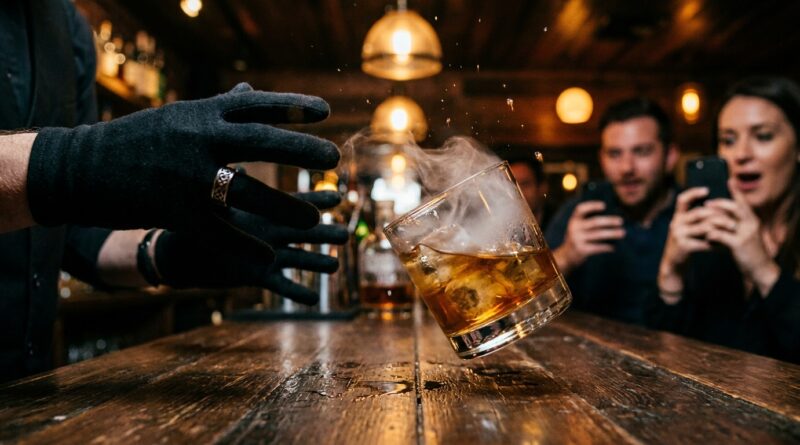
From Borrowed Drinks To Liquid Ghosts: Build One ‘Glass-Shift Vanish’ That Turns Any Cocktail Into Pure Sleight Of Hand
You can feel the sameness in a busy bar set. Someone does coins. Someone else does ambitious card. Maybe a borrowed ring ends up somewhere impossible. It works, sure, but the real theater is sitting right there in plain sight. Glasses, ice, condensation, a half-finished cocktail that everybody thinks is too ordinary to matter. That is exactly why a strong glass vanish sleight of hand with borrowed drink hits so hard. It feels impossible because the object already belongs in the moment.
The good news is you do not need a trick glass, a servante, or a weird prop pouch hanging off your belt. You need one worker-friendly sequence. One that uses timing, body position, and audience focus, not expensive gimmicks. If you perform in restaurants, at weddings, in cocktail hours, or just for friends around a kitchen island, a practical glass vanish gives you something visual and fresh that still feels natural. The goal is not to “do a trick with a glass.” The goal is to make the drink everyone forgot to question become the most impossible thing they saw all night.
⚡ In a Hurry? Key Takeaways
- Build the vanish around a real glass-shift to the lap, chair, or soft catch point, not a gimmicked prop.
- Use a borrowed or casually introduced drink, then control sightlines with your torso, off-beat timing, and a reason for the hand movement.
- Practice with water and sturdy glassware first. Safety, spills, and audience position matter as much as deception.
Why this hits harder than another card reveal
People expect cards to do strange things. They do not expect their drink to disappear.
That difference matters. In close-up magic, surprise is not just about method. It is about category. When you vanish a coin, people think, “I know magic happens with coins.” When you vanish a glass they were just watching someone sip from, their brain has to catch up.
It also fits the room. In a bar or cocktail setting, glassware is not suspicious. It belongs there. That makes this kind of effect feel less like “showing a prop” and more like bending reality for a second.
The core idea of the “Glass-Shift Vanish”
Here is the simple version. You openly display a glass. You apparently keep it in view. Then, under cover of a natural action, you shift the glass out of the audience’s live sightline and ditch it into a safe offstage location while the audience believes it is still in play for one more beat.
That is the whole game. Not speed. Not fancy finger work. A well-timed belief gap.
What makes it worker friendly
- It can be done with normal glassware.
- It can be rehearsed at home with water.
- It works in social environments where a drink already exists.
- It does not ask you to carry a gimmick that can break or flash.
The “shift” in the name is important. You are not trying to make a glass vanish from dead center under perfect scrutiny. You are shifting where the audience thinks the glass is, then erasing it from that expectation.
Pick the right conditions first
This is the part magicians often skip, then blame the move.
A glass vanish lives or dies on conditions. You want a setting that helps you, not fights you.
Best glass choices
- Short tumblers or rocks glasses
- Stemless wine glasses
- Plastic cups for early practice
Avoid tall, top-heavy glasses at first. Avoid anything fragile you cannot safely control. Skip martini glasses until you know exactly what you are doing.
Best drink level
Half full or less is ideal. Too full, and the drink becomes a spill problem. Too empty, and it may look oddly weightless. You want it to feel real.
Best audience layout
Front and slight sides are fine. A full circle is not. If people are directly behind you, do something else. That is not cowardice. That is good judgment.
This is the same kind of thinking that helps in projection-heavy venues too. If your work has to survive enlarged sightlines and harsher viewing conditions, it is worth reading From Live Streams To Real Shows: Build One ‘Projection‑Proof’ Close‑Up Routine That Survives The Big Screen. Different setting, same lesson. Design for what people can actually see.
The method structure, without turning this into reckless advice
Let’s keep this practical and responsible. I am not going to tell you to fling a real glass into your lap and hope for the best. The smart version is controlled, soft, and built around a known landing place.
Phase 1: Establish the glass as ordinary
Do not over-prove it. Just use it naturally. Set it down. Pick it up. Maybe have the owner take a sip. The point is to make the glass part of the scene, not the star yet.
Phase 2: Create a reason to regrip
This is where many vanishes look suspicious. If you suddenly handle the glass like it is made of secrets, people notice.
Your regrip should come from a normal action:
- Moving the drink out of the way
- Making room on the table
- Using your other hand to gesture or point
- Turning slightly to include another spectator
That is your cover. Not speed. Motivation.
Phase 3: The shift
As attention follows your face, words, or a secondary object, the glass moves from “clearly seen object” to “assumed still present object.” This is the secret moment. It may be lowered below table edge, moved behind a close body line, or carried into a hidden resting point under natural cover.
The audience does not need to see the glass the whole time. They only need to feel they still know where it is.
Phase 4: The vanish beat
Do not rush the reveal. Let the audience lock in the false memory first. Then show the hand empty or the space empty. One beat later is often stronger than immediate proof.
That tiny delay is what makes them rewrite the last few seconds in their head.
A safe practice path that actually works
Start with a plastic cup and water over a towel. Seriously. That is not glamorous, but it is how you build a real move instead of a mess.
Practice checklist
- Work seated first.
- Use a soft landing zone, like a folded towel on your lap or chair side.
- Film from front, left, and right.
- Practice the regrip more than the ditch.
- Add speech only after the mechanics feel boring.
If the move feels exciting to you while practicing, it is probably still too tense. Good sleight of hand often feels almost disappointingly ordinary when you finally get it right.
Common mistakes that expose the vanish
Looking at the glass during the secret action
Your eyes are a spotlight. If you glance at the glass when you should not, the audience glances too.
Moving too carefully
Careful handling reads as suspicious handling. Natural is better than delicate.
No reason for the body turn
If you shift your torso for no social reason, it looks like covering. Turn because you are addressing someone, making room, or changing focus.
Trying it surrounded too soon
Some tricks are built for 360 degrees. This usually is not one of them. Be honest about that.
Using bad glassware
Thin, expensive, slippery, or oversized glass is asking for trouble.
How to script it so it feels like a moment, not a stunt
The best patter here is light. Do not talk like a puzzle host. Talk like a person noticing something odd.
Good frames include:
- “Keep an eye on your drink. That is usually good life advice.”
- “Everybody watches the hands. Nobody watches the obvious thing.”
- “If this works, I owe the bar an explanation.”
That kind of line fits the room. It keeps the mood social. It also buys you the off-beat you need.
Where this belongs in a real set
Do not open with it cold unless the room is already calm. A glass vanish asks for a bit of trust and a bit of space.
Best placement
- Second effect in a cocktail set
- Mid-set reset point after cards or coins
- Final beat before moving to a bigger impossible location effect
It pairs especially well after something small and technical. The contrast makes it feel even larger.
Can it be truly borrowed?
Yes, but with judgment.
Borrowed is stronger, but it adds variables. Some glasses are slick. Some drinks are overfilled. Some spectators grip the glass in a way that makes the handoff awkward. If the conditions are wrong, use a nearby house glass instead and keep the language casual. “Let’s use this one for a second” can feel just as clean if the moment is natural.
The effect is not ruined because the exact glass came from the table instead of a spectator’s fingers. What matters is that it feels ordinary and in-the-moment.
Angle management in the phone-camera era
This is the real pressure now. It is not just the people at the table. It is the person slightly back and to the right, filming.
So build for that reality.
Simple rules
- Keep the secret action below the strongest line of sight.
- Use your body as shade, not as a wall.
- Do not announce the effect before the method is already in motion.
- If someone raises a phone to a bad angle, pivot the performance, not just your hands.
That last point matters. Most angle problems are body problems, not hand problems.
At a Glance: Comparison
| Feature/Aspect | Details | Verdict |
|---|---|---|
| Props needed | Ordinary glass or drink, safe ditch point, good timing | Excellent for workers who want less gear |
| Angle sensitivity | Strong from the front and slight sides, weak when fully surrounded | Manageable if you control audience position |
| Practice curve | More about timing and body language than finger skill | Very learnable with careful rehearsal |
Conclusion
Right now, a lot of the talk around immersive table shows and close-up cocktail magic sounds exciting, but the actual material can still feel recycled. That is why a practical, ungimmicked glass vanish matters. It gives professionals a fresh weapon for bar work, gives hobbyists something real to drill at home with water and a towel, and reminds all of us that everyday objects still have unexplored magic in them.
If you build one good Glass-Shift Vanish, with honest angle control and safe handling, you do more than add a trick. You add a new texture to your set. And in a room full of cards, coins, and rings, that can be the thing people talk about on the way home.