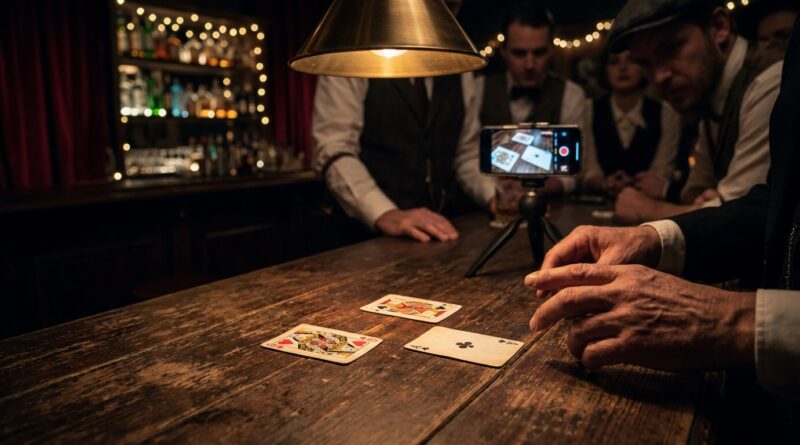
From Live Streams To Living Rooms: Build One ‘Table‑Camera Monte’ Sleight That Turns Any Three‑Card Routine Into An Interactive Close‑Up Event
You can do a solid three card monte in real life and still watch it die the second a camera gets involved. That is the annoying part. On a phone screen, the same handling that fools people at a bar can look cramped, suspicious, or worse, boring. Viewers do not feel the heat of the moment. They just see cards moving around in a rectangle, then they scroll away before the surprise lands. The fix is not buying more gear or adding ten fancy phases. It is building one table-camera version of the routine around a single idea. Make every switch, display, and pause read clearly from above and from the front. Once you do that, your monte stops feeling like a gambling demo and starts feeling like an interactive close-up event. That is the sweet spot for three card monte sleight of hand for live stream close up magic, and it is far more practical than many performers think.
⚡ In a Hurry? Key Takeaways
- Build your routine around one camera-friendly “table-camera monte” sequence so the effect reads clearly live and on screen.
- Use wider displays, cleaner pauses, and spectator choices that happen before the move, not during it.
- If a sleight only fools from one angle, it is not ready for livestream work. Test it on your phone before showing real people.
The real problem is not your technique
Most performers blame the camera too quickly, but the bigger issue is blocking. Three card monte was born in a noisy, human, eye-to-eye setting. It lives on tension. People lean in. They track your fingers. They second-guess themselves. A livestream flattens all of that.
So when your monte feels like a puzzle online, it usually means one of three things is happening. The audience cannot tell where to look. The cards are too small in frame. Or the key moment happens while the hands cover everything.
That is why a table-camera monte matters. It is not a different trick. It is a different arrangement of the same trick so both a live spectator and a lens can follow the action without feeling guided by editing or camera tricks.
What “table-camera monte” actually means
Think of it like staging a play for two audiences at once. One audience is sitting across from the table. The other is looking through a phone from slightly above or straight on. Your handling has to satisfy both.
In practice, that means:
- The money card must be visible before and after each phase.
- The dirty action must happen in motion the camera can read, not hidden under a hand mountain.
- The audience should make simple choices that feel fair and easy to follow.
- Every phase needs a visual “receipt” so viewers know what just happened.
If you get those four things right, the routine feels more interactive. People stop trying to solve camera framing and start reacting to the magic.
The one sleight to build around
If I were helping a working magician rebuild a monte for social video, lounge work, and close-up gigs, I would center it on a clean, repeatable hype-style action. Not because it is the only move in monte, but because it gives you something useful. It creates the memory of a fair throw while letting you control where the audience believes the card goes.
The key for camera work is not speed. It is shape.
What the move needs to look like
Your throw should create a clear picture. One card appears to travel. One card stays. The hands separate enough for the camera to see the result. Then you freeze for half a beat. That pause is gold. It tells the viewer, “You saw that.”
Without that beat, livestream viewers often miss the effect even if the move is technically perfect.
What the move should not look like
Do not do a tiny, knuckly switch tight to the chest. Do not let the fingers curl over the indexes like you are protecting a secret. And do not rush into the next line before the image lands.
If the camera cannot read the throw, your audience will assume the trick happened somewhere in the blur. That kills wonder fast.
How to re-block your routine for humans and lenses
This is where the upgrade really happens. You are not just choosing a sleight. You are choosing where moments live.
1. Start with a larger performance box
Imagine a rectangle on the mat about the size of a tablet. Keep the important action inside that space. If your cards drift all over the table, the phone viewer works too hard. A compact but open working area looks more professional and reads better on small screens.
2. Show less, but show it cleaner
Many monte routines have too many displays. You prove the queen, prove the losers, prove the count, prove the fairness, then prove it all again. Online, that can feel defensive.
Instead, show the money card clearly. Square. Toss. Pause. Ask. Reveal. Repeat with variation.
That rhythm is easy to follow and easy to enjoy.
3. Put audience participation before the secret moment
This is huge for three card monte sleight of hand for live stream close up magic. Ask for the guess before the throw, or set a condition before the move. For example, “Watch the queen. If she lands on the left, type left in the chat.”
Now the viewer has a job. They are involved before the method matters. That feels interactive instead of passive.
4. Build in a “camera confirmation” beat
After each phase, spread the cards wider than you would in walk-around. Give the camera a neat, flat image. You are creating certainty. Certainty is what makes the next impossibility hit harder.
A practical three-phase structure that works
You do not need a twenty-minute monte act. For livestream and intimate lounge work, three strong beats are enough.
Phase one: Establish the game
Show one distinct money card and two indifferent cards. Use your cleanest, most readable throw. Let them lose. Keep this simple. The point is not to crush them yet. The point is to teach them how to watch.
Phase two: Let them feel smarter
Slow down. Make the conditions seem easier. Maybe openly isolate one loser or let them eliminate a card verbally. Then beat them anyway with the same core action dressed differently.
This creates confidence, then takes it away. That is entertaining.
Phase three: Change the frame
Do not just repeat the same guess. End with a kicker. The queen appears where it should not. The tabled card changes. Or all three become the money card for a final visual hit. This is where the routine stops feeling like a demo and starts feeling like a showpiece.
Simple gear matters, but only a little
You can do this with one phone, a small tripod, and decent light. That is enough. The trick is placement.
Best camera angle for monte
Use a slightly high front angle, not pure overhead and not dead eye-level. Overhead can look too instructional, like a tutorial. Straight-on can hide too much table action. A mild downward angle gives depth and still shows the card positions clearly.
Light the mat, not your face
For this routine, the cards are the stars. Make sure the table is brighter than your shirt. A simple desk lamp bounced off a wall can work better than a harsh ring light pointed straight down.
Use contrast
If your cards and mat are similar colors, the image gets muddy fast on mobile screens. White borders on a darker surface usually read best.
Common mistakes that make monte look fake online
Some habits that pass in live work become glaring on video.
- Hovering over the cards after the throw.
- Talking through the reveal instead of letting the picture speak.
- Keeping the cards too close together.
- Using a camera angle that only flatters one move.
- Relying on speed instead of conviction.
The cure is simple. Record ten practice runs on your phone. Watch with the sound off. If the effect is not clear silently, it is not clear enough.
How to make it feel interactive, not just visible
A good table-camera monte should invite decisions. Small ones are best.
For livestreams
Ask viewers to call left, middle, or right in the chat. Have one person act as the “banker” who keeps score. Bring the reveal close to the camera for the winning moment.
For in-person lounge work with a screen
Use the monitor as proof, not as a crutch. Perform to the people in front of you first. Let the screen magnify the fairness. That keeps the energy in the room rather than making it feel like everyone is watching a sports replay.
For corporate or private gigs
Brand the money card. A logo sticker, a signed business card face, or a custom queen substitute can turn the routine into a memorable moment without changing the method.
Why this old scam still hits so hard
Three card monte works because people think they understand it. They believe the challenge is attention. Then the effect flips that belief. In close-up settings, especially the intimate kind people are talking about in Chicago lounges, speakeasies, and tiny immersive rooms, that feeling is electric.
The camera does not ruin that. Bad staging does. Once you restage the routine for both sets of eyes, monte becomes one of the best pieces you can do on a small table.
At a Glance: Comparison
| Feature/Aspect | Details | Verdict |
|---|---|---|
| Traditional bar-style handling | Tight actions, fast tosses, lots of heat on the hands, built for people standing close | Strong live, often muddy on a phone screen |
| Table-camera monte handling | Wider spacing, clearer pauses, camera-readable throw, built-in audience choices | Best all-around option for live and streamed close-up work |
| Gear requirements | One phone, stable mount, decent light, contrasting mat | Low cost and worth setting up properly |
Conclusion
You do not need to throw out your monte and start over. You just need one practical sleight and a smarter layout for the table and camera. That is the real upgrade. The buzz in magic right now is all about intimate, front-row sleight of hand where audiences sit practically in your lap and watch every twitch of the fingers on a big screen. A table-camera monte lets you match that from home or on the road. It turns a simple three-card sequence into a modular routine that can play in a lounge, at a corporate gig, or on a one-phone Instagram Live. Re-block the handling so human eyes and camera lenses both get a fair view, and an old street scam becomes a modern fooler that feels immersive, fair, and repeatable for real audiences today.