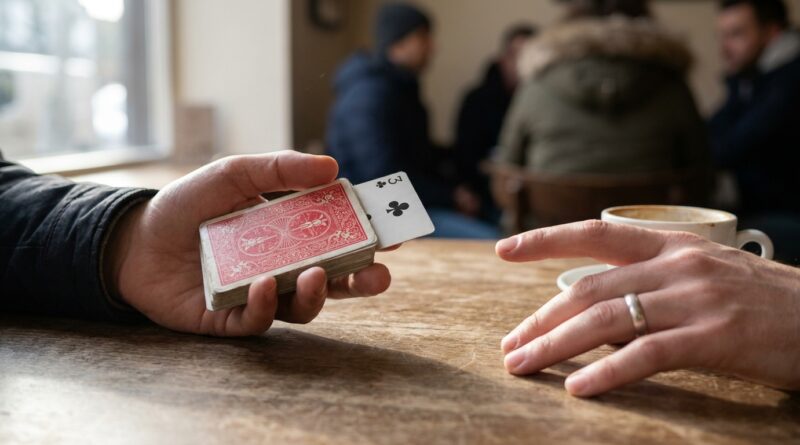
From Marked Decks To Invisible Forces: Build One ‘Borrowed Force’ Sleight That Lets Any Deck Choose Its Own Card
You can feel the fatigue in card magic right now. Every week there is another “revolutionary” force that turns out to need a marked deck, a roughing setup, a 3D-printed holder, or a wallet that costs more than your shoes. That is fine for a trailer. It is not much help when someone hands you a battered deck at a table and says, “Show us something.” What many magicians actually want is simpler. A new ungimmicked card force sleight of hand that feels fresh, looks fair, and survives the rude reality of real people burning your hands from two feet away. The good news is you do not need to start over. One well-built “borrowed force” can give you that modern, hands-off look while still being practical enough to use tonight. The trick is not finger gymnastics. It is structure, timing, and making the deck seem like it made the choice by itself.
⚡ In a Hurry? Key Takeaways
- A strong borrowed-deck force should hide inside normal handling, not depend on gimmicks or speed.
- Start with a dribble or spread timing cue, then use a soft verbal stop point so the spectator feels in control.
- If the force fails, build in an out. The best real-world sleights are not just deceptive. They are durable.
What “Borrowed Force” really means
Let’s clear up the idea first. A borrowed force is not just “a force with a borrowed deck.” It is a selection procedure designed to feel impossible because nothing looks prepared, precious, or protected.
That changes the job.
With your own deck, you can secretly rely on condition. With a borrowed one, the cards may be sticky, bowed, clumped, old, or shuffled into chaos. So the force has to work under ugly conditions. It has to look casual. It also has to survive close-up heat.
That is why the best answer is usually not a knuckle-busting move. It is a controlled moment disguised as fairness.
The core idea: let the deck “choose”
If you want a new ungimmicked card force sleight of hand that feels current, stop thinking about forcing as a grab. Think of it as guided timing.
The effect you want in the spectator’s mind is this: they stopped you whenever they liked, saw a random card, and that was that.
The method underneath can be very simple:
1. Keep one known card near a natural stopping zone
This can be top, bottom, or a known position you can reach without fuss. In real work, top or bottom is best because you can get there with almost no strain.
2. Offer a normal action
Dribble. Riffle. Spread. Run cards from hand to hand. The action has to look like something people have seen before. If the handling screams “move incoming,” you are already in trouble.
3. Use a verbal cue that creates the stop for you
“Just say stop as I go.”
“Touch one as they pass.”
“Take whichever one feels right.”
Those lines sound innocent. They are not filler. They shape timing.
4. Make the force happen in the transition, not the display
This is the part many newer magicians miss. The force should be completed before the audience thinks the choice has even begun. Once they believe the card is already theirs, the heat drops fast.
A practical version you can build tonight
Here is the sort of structure that works well with a borrowed, shuffled deck and does not ask for circus-level fingers.
The soft stop force
Control your force card to the top. Hold the deck for a relaxed thumb riffle or light dribble. Ask the spectator to say stop. As they do, break the action a fraction late, then lift or outjog at a point that frames the next card as the obvious selection.
That description sounds almost too plain, and that is the point.
The secret sauce is not in “beating” their stop. It is in the pause after it. A tiny beat of confirmation makes people remember that they stopped you first and you reacted second, even if the real control was more subtle than that.
If you do this with a calm rhythm, they will swear the deck was in motion and they froze it.
Why this feels new even though it uses old bones
Because the look is modern.
A lot of older forces are good but look a little too magician-proofed. A lot of newer online forces look great but only from one angle, one take, and one distance from the lens. This middle path matters. It keeps the honesty of classic card work but trims away the fussy parts.
That same tension shows up in routines beyond forces too. If you like methods that survive real audiences instead of only social clips, the piece From Viral ‘Angle Exposures’ To Real Crowds: How To Build One Honest-Looking Any‑Card‑At‑Any‑Dice Miracle You Can Repeat All Night hits that exact nerve.
Why timing beats technique here
Most failed forces do not fail because the fingers were weak. They fail because the performer treated the move like a mechanical challenge instead of a social one.
People do not experience a force in slow motion. They experience it as a small conversation.
Use these timing rules
Start casually. If your hands tense up right before the selection, spectators can smell it.
Do not rush the stop. The instinct is to hurry because you know a move is coming. Bad idea. A controlled, easy pace looks cleaner.
Confirm their freedom out loud. “Right there?” or “Happy with that one?” sounds fair and locks in memory.
Move on immediately. Once the card is taken or shown, shift focus to the next beat. Heat grows when nothing happens after the selection.
What makes this useful in brutal close-up conditions
Three things.
It works with imperfect cards
A borrowed deck is rarely silky. Good forcing structure should not depend on perfect faros, bevels, or exact spread pressure. If your handling needs a fresh deck from the box, it is not really a worker.
It gives the spectator a memory of control
This is huge. In close-up, people forgive less. But they also remember less precisely than magicians think. If the sequence feels open, they fill in the rest in your favor.
It leaves room for outs
The best practical force is not one that hits 100 percent in fantasy. It is one that still leaves you standing when a real human does something weird.
Build in a safety net
This part is not glamorous, but it is important.
If you are going to use a borrowed-deck force in the wild, have a second route ready. If they truly take the wrong card, you should be able to turn that card into:
- a thought-of card revelation
- a location effect
- a prediction with a dual out
- an ambitious card phase
That is what makes a sleight usable every night. Not just “can it fool magicians,” but “can it recover without drama?”
How to practice without becoming robotic
Do not stand in front of a mirror doing 500 reps with dead eyes. That builds finger memory, sure, but it often kills rhythm.
Better practice plan
First, drill the action alone. Make the dribble, riffle, or spread look identical whether you force or not.
Next, add speech. Say your lines out loud. Most sleights change once breath and timing enter the room.
Then, vary conditions. Try old cards. Sticky cards. Soft cards. Borrowed cards from a game drawer.
Finally, test with one person at a time. You are not just checking if the method works. You are learning where their eyes go.
Where this force upgrades your existing routines
This is the nice part. You do not need to build a whole new act around it.
A clean force slips neatly into routines you already do:
Predictions
If the force looks hands-off, your prediction feels stronger without changing the reveal.
Ambitious Card
Forcing the opening selection can save time and let you stack later phases more cleanly.
Card to pocket or wallet
Even if the final load uses a prop, the beginning can still feel borrowed and fair.
Mental-style card effects
This is where the “deck chose it” feeling really shines. The less magiciany the selection looks, the stronger the mind-reading frame becomes.
What to avoid
Some mistakes are common, especially when trying to make a classic idea feel new.
Do not oversell fairness
If you keep saying “totally free” and “genuinely any card,” people start listening like prosecutors.
Do not make the handling prettier than it is natural
Instagram fingers are not the same as real-world fingers. Simple beats polished, every time.
Do not confuse novelty with usefulness
A force can be technically original and still be a bad choice in performance. The test is not whether magicians have seen it. The test is whether laypeople believe it.
At a Glance: Comparison
| Feature/Aspect | Details | Verdict |
|---|---|---|
| Props needed | Uses a normal borrowed deck with no printing, roughing, wallets, or add-ons. | Best for real-world use |
| Skill demand | Moderate finger control, but heavy on timing, verbal framing, and confidence. | Accessible with practice |
| Audience impact | Feels fair on camera and in person because the selection appears to happen by the spectator’s choice. | High if kept casual |
Conclusion
The smart play right now is not chasing every new gadget that promises impossible card magic in one clean trailer shot. It is finding one solid, ungimmicked force you can trust when the deck is borrowed, the angles are ugly, and the audience is close enough to hear your thumb hit the pasteboards. That is where this kind of sleight earns its keep. It sits right between flashy camera-first miracles and old-school moves that only card nerds enjoy practicing. And that is exactly why it matters. A force built on timing and psychology gives you something you can actually use every night. It upgrades your predictions, your ambitious sequences, your mental card plots, and anything else that starts with “pick a card,” without asking you to buy more props or rebuild your whole style. Quiet upgrades like this are often the ones that make everything else look stronger. That is the sort of progress serious performers are really after.