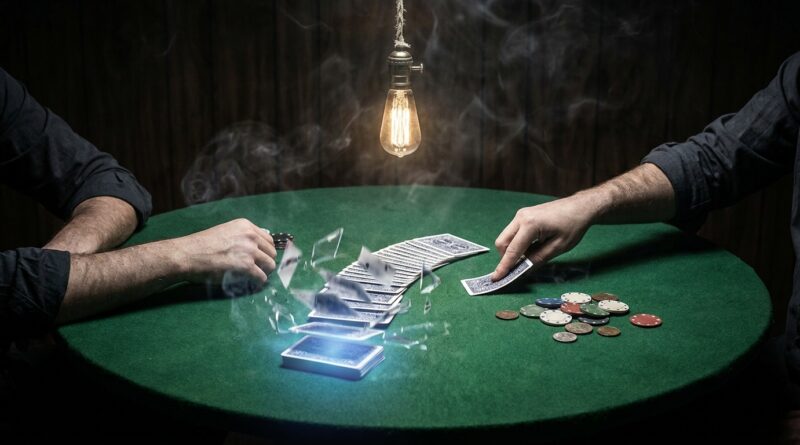
From Table Tosses To Weaponized Dealing: Build One ‘Reality Fracture Bottom Deal’ That Turns Any Card Game Into A Live Demo Of Cheating
You can feel it in the room now. A clean control and a double lift used to be enough. Then your spectators started watching poker clips, scam documentaries, heist movies, and pack-opening streams where everyone talks about stacked odds and cracked luck. Suddenly, “I found your card” does not feel like cheating. It feels like homework. That is frustrating, especially if you want something sharper but every bottom deal lesson you find either turns into a history lecture or expects hands forged in a casino basement. The good news is you do not need a deadly gambling move. You need a bottom deal sleight for magicians that is safe, readable, and built for performance. The goal here is simple. Make one reality-glitch demo where the table seems fair, the spectators burn your hands, and you still deal yourself the win in slow motion.
⚡ In a Hurry? Key Takeaways
- Use a stripped-down bottom deal as a demonstration piece, not as a fake casino stunt.
- Build the routine around one visible “glitch” moment, a spectator burn test, and a rewind ending.
- Keep it audience safe by using open pacing, clear table etiquette, and angles that survive phones and close scrutiny.
Why this works right now
The presentational frame matters as much as the move.
People already understand the idea of a game being broken. They know what a rigged draft, a stacked deck, or a suspicious lucky pull looks like. So instead of introducing bottom dealing as a dusty gambling relic, treat it like a live bug in reality. You are not saying, “Here is an old cheating move.” You are saying, “Watch what happens when the game stops behaving.”
That shift helps newer performers a lot. It gives the move a reason to exist in your set. It also keeps the audience from comparing you to a real card mechanic, which is usually a losing battle.
What kind of bottom deal you actually need
You do not need speed. You do not need a perfect strike deal. You do not need to sound like a card table historian.
You need three things.
1. A consistent get-ready
The audience should believe all the cards are being dealt from the same place, with the same rhythm. Your setup has to happen before attention sharpens, not during the hot moment.
2. A believable top deal rhythm
Your normal deal needs to look calm and boring. That is good. Fancy dealing is the enemy here. If your regular deal already looks showy, the switch to a bottom deal will feel suspicious.
3. One safe bottom extraction
For performance, “safe” beats “pure.” A bottom deal sleight for magicians should survive a real audience, not win a move session online. If it works at conversational speed and holds up from chest-high viewing, that is enough.
The performance frame: “Reality Fracture”
Here is the hook.
You tell the audience that some games do not get cheated by skill alone. They get cheated when one moment at the table seems to split in two. Everyone remembers seeing the same fair deal, yet one person somehow gets the winning hand. You call that a reality fracture.
That language is playful, modern, and useful. It lets you show the move without claiming criminal authenticity. It also gives you permission to slow down, isolate one moment, and then “rewind” it in their minds.
The routine structure you can use tonight
Phase 1: Establish fairness
Use a simple game frame. Three players is enough. You, spectator A, and spectator B. Deal a few rounds honestly. Let them see your rhythm. Keep your hands low and relaxed.
Say something like, “Nothing clever yet. I want you to get used to the sound and look of a fair game.”
Phase 2: The burn test
Now invite them in.
Ask them to watch one hand only. Not the whole deck. Not your face. Not your story. Just your dealing hand. This is important because it creates a challenge without turning the room hostile.
If you perform in phone-heavy environments, it is worth studying audience sightlines the same way you would for a control. From Phone Screens To Live Hands: Build One ‘Hybrid Angle’ Phone‑Proof Card Control For 2026 Festivals And Conventions covers the kind of camera-aware thinking that helps here too.
Phase 3: The fracture
Deal the key round. One bottom deal to yourself is enough. Two if your handling is very secure. More than that and the effect starts turning into a challenge exhibition instead of a clean demonstration.
Do not rush after the steal. Finish the hand as if nothing happened. Then reveal that you received the impossible card or winning combination.
Pause.
Let them react before you explain anything.
Phase 4: The rewind
This is the part many magicians skip, and it is the part that makes the routine feel special.
Recap the exact moment. “You watched this hand. You watched this thumb. You watched that card come off the top. But that is not what happened.”
Then repeat the deal in exaggerated slow motion. This time, either openly expose the idea of the bottom steal or mime the action with a face-up packet to show where their memory broke. You are not teaching method in a tutorial sense. You are staging the glitch.
How to make the move look cleaner without chasing perfection
Use a friendly grip
A death grip screams tension. Hold the deck like you trust it. Your fingers should look like they are dealing cards, not doing surgery.
Match the sound
A bad bottom deal often flashes in the ears before it flashes in the eyes. Work on the sound of your top deal and your bottom deal until they live in the same neighborhood. They do not need to be twins. They just cannot be strangers.
Shrink the moment
The steal should not be a major event in your body. No shoulder hitch. No chin dip. No sudden breath hold. If your body marks the move as important, the audience will too.
Practice in performance chunks
Do not only drill twenty bottom deals in a row. Practice six fair deals, one bottom, two fair deals, a look-up, a line of patter, then a reveal. That is how the move will actually live.
Table etiquette matters more than most tutorials admit
If you want this to feel like a real cheating demonstration, your table manners do half the work.
Keep the dealing area tidy. Do not sprawl. Do not drag cards around like you are searching for a parking spot. Set positions for each player and stay consistent. Audiences read neatness as control.
Also, be careful with your language. Present this as theater. A demonstration. A puzzle about trust and perception. Not a how-to lesson on beating friendly games.
Common mistakes that kill the effect
Calling the move too early
If you say “Watch for the bottom deal” before the audience cares, you turn the routine into a test. Better to frame it as a fairness challenge first, then reveal the kind of cheat after the fact.
Doing too many deals
One impossible hand is stronger than a long parade of cleverness. The more times you repeat the move, the more likely someone catches the rhythm change.
Using a gambling script that sounds borrowed
If your patter sounds like it came from a VHS tape called Dirty Seconds from the Riverboat Boys, people feel the costume. Speak like yourself. Modern crowd, modern voice.
Ignoring phones
A move that works for live eyes may fail for a raised phone two feet away. Test your handling from slightly higher angles and from your weak side.
Who this routine is best for
This is ideal for close-up workers who want one cheating demonstration that feels current without becoming a full gambling act.
It also fits performers who are tired of proving technical skill and would rather create a memory. That is the real target. Not “He can bottom deal.” More like, “We stared at his hands and the game still broke.”
At a Glance: Comparison
| Feature/Aspect | Details | Verdict |
|---|---|---|
| Technical demand | Uses a streamlined, performance-first bottom deal instead of a casino-pure mechanic’s version. | Best for working magicians, not move collectors. |
| Audience impact | The burn challenge and rewind phase turn one steal into a strong “memory glitch” moment. | High impact with minimal procedure. |
| Real-world practicality | Built for close-up tables, casual game framing, and camera-aware handling. | Very usable if you keep the routine short and clean. |
Conclusion
Bottom dealing has always lived in that strange middle ground between legend and real cheating, and that is exactly why it still hits so hard. The trick is not to bury it under history or turn it into a knuckle-busting badge of honor. A good bottom deal sleight for magicians should give you something you can actually perform. This “reality fracture” frame does that. It lets you exploit a game in slow motion, invite people to burn your hands, and then rewind the moment where the table seemed to glitch. It also updates the move for the way people watch now, with better framing, better etiquette, and better awareness of phones and angles. If you keep it short, fair-looking, and human, you do not need years of underground card work to make this land. You just need one honest-seeming deal, one impossible moment, and the nerve to let the room sit in it.