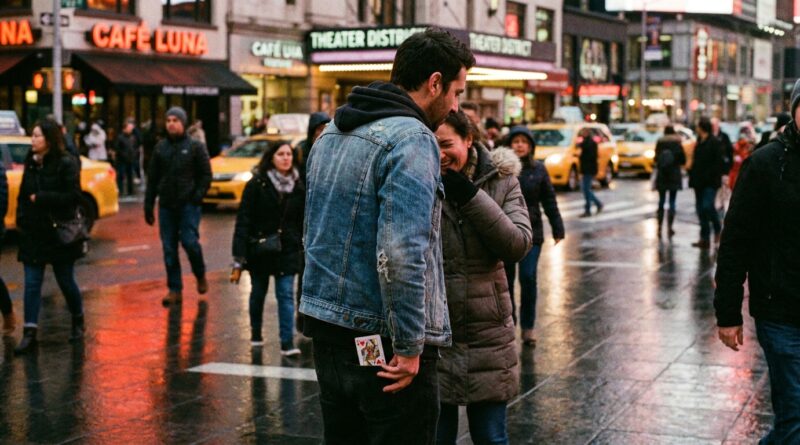
From Movie Pickpockets To Real-World Miracles: Build One ‘Crowd‑Blind Lift’ Sleight That Works In Moving, Noisy Environments
Most sleight dies the second real life shows up. A crowded bar is loud. A queue lurches forward. Someone bumps your elbow. Another person is half behind you, half beside you, seeing exactly the angle you hoped nobody would get. That is why so many beautiful steals stay trapped in demos and studio clips. They look great on camera and fall apart the moment people start moving.
The fix is not a fancier move. It is a tougher one. If you want usable pickpocket style crowd sleight of hand, build a single “crowd-blind lift.” Think of it as a soft, motivated object removal that hides inside natural crowd behavior. It is not about stealing wallets or doing anything shady. It is a magician’s training piece for borrowed safe items like a pen, paper wristband, badge, napkin, or clipped prediction. Done right, it survives noise, motion, bad sightlines, and the extra attention people now bring after all the movie pickpocket chatter.
⚡ In a Hurry? Key Takeaways
- The best crowd steal is not fast. It is motivated, soft, and timed to movement that would happen anyway.
- Start with safe, non-sensitive objects like pens, badges, napkins, or wristbands. Build the move around touch, body position, and verbal focus.
- Never use this on valuables or without clear performance ethics. The goal is astonishment, not risk.
Why movie-style pickpocketing usually fails in real crowds
Film gives you clean framing, controlled blocking, and retakes. Real crowds give you none of that.
In the wild, three things break most sleight. First, your angles keep changing. Second, your spectator keeps changing pace. Third, your own nerves make your hands speed up. That last one is a killer. People think they need to be quicker when they really need to be calmer.
This is the same problem social media magicians hit when a trick gets replayed from every possible viewpoint. If you want a useful companion read, From Camera Tricks To Crowd Killers: Build One ‘Angle‑Proof Social Media Sleight’ That Survives Any Replay gets at the same basic truth. A move that depends on one perfect view is fragile.
What a “crowd-blind lift” actually is
A crowd-blind lift is one simple removal of an object that stays invisible because the audience reads the whole moment as normal social contact.
You are not hiding with speed. You are hiding inside expectation.
The three ingredients
1. A reason to touch. You adjust someone’s sleeve, pin a badge, hand them a marker, straighten a folded note, or guide where they stand.
2. A reason for their attention to move. You ask a question, point out another spectator, or cue a laugh line.
3. A reason for the crowd to shift. People step forward in a queue, turn to a friend, or react to a beat in your routine.
When those three line up, the object leaves almost by itself.
The safest version to build first
Forget wallets. Forget watches. Forget phones. Those carry trust, risk, and legal problems you do not need.
Start with one of these:
- A pen from a shirt or jacket pocket
- A paper wristband
- A clip-on name badge
- A folded prediction tucked into an outer pocket by you earlier in the routine
- A napkin or receipt protruding visibly from a pocket
These give you the same training value without crossing a line.
Build the move: The crowd-blind lift in five steps
1. Frame a tiny job
Give your hand a boring mission. “Let me clip this here.” “Hold this for a second.” “You’ve got something sticking out.”
If your hand arrives with purpose, people relax. If it arrives like a thief’s hand, even non-magicians feel that.
2. Use the back of the moment, not the front
Most beginners strike at the exact point they want the steal. Bad idea.
The better time is a half-second after the audience thinks the important action has already happened. For example, after you hand them a card to sign. After the laugh. After the head turn. The mind has already filed the touch away as old news.
3. Keep the contact broad, then isolate
Do not peck at the object with finger tips. That reads as suspicious.
Make contact with the area first. Adjust the lapel. Flatten the badge. Tap the pocket edge. Then let one finger and thumb isolate the object during that wider contact. Big action hides small action.
4. Remove on movement, not before it
This is the key in moving, noisy environments. Let the object leave as the spectator shifts weight, turns, laughs, or steps. Human awareness drops during self-generated motion. If they are still and squared up to you, wait.
5. Park the object immediately
Never hover with the thing you just took. Transfer it at once.
Good parking spots are simple and repeatable. Jacket pocket. Servante. Back pocket if your staging allows it. Under a pad. Into the hand that is already holding another prop. The worst place is a guilty hand floating in open space.
A sample routine for bars, festivals, and queues
Here is a practical structure using a pen. It is safe, visual, and easy to script.
Phase 1. Make the pen matter
Ask for a pen to sign a card, receipt, or coaster. Use it openly. Let the owner remember where it came from.
Phase 2. Return attention, not the pen
As you finish the first beat, point to another spectator and ask them to verify a choice. The pen owner turns a little. You step in to “put the cap back on” or “help clip that there.”
Phase 3. Lift during the social reset
As the group reacts to the second person, your broad contact hits the shirt or jacket area. The pen comes free during their turn or laugh, not before.
Phase 4. Delay the reveal
Do not announce the steal right away. Let a second effect happen. This is what makes it feel impossible later. They stop tracking the pen as an active prop.
Phase 5. Reveal cleanly
Produce the pen from a sealed envelope, inside your notebook, clipped to your own shirt, or from a spectator across the circle if you have a handoff system.
That structure feels like cinema to the audience because the object disappears in plain life, not in “magic pose” mode.
What makes this work in noisy places
Noise is annoying if your method depends on patter precision. It is useful if your method depends on attention drift.
In a loud room, people rely more on visual shortcuts. They do not inspect every micro-action. They read the scene in chunks. “He gave her a pen.” “He turned to the other guy.” “Everybody laughed.” If your steal matches those chunks, it vanishes into the memory of the moment.
Motion helps too. A moving crowd creates natural cover. Not secret cover. Normal cover. The trick is to stop fighting the environment and start using it.
Common mistakes that expose the move
Touching too lightly
This sounds odd, but nervous magicians often get dainty. That feels wrong. Normal social contact is clearer and more confident.
Staring at the object
Your eyes are a giant arrow. Look where their attention should go, not where your fingers are working.
Trying to “beat” the audience
This turns your body tense. You rush. Your shoulders lift. Your breath changes. Slow down.
Choosing bad spectators
Skip people who are very guarded, intoxicated, upset, or physically closed off. Pick someone relaxed and socially engaged.
Revealing too soon
A steal shown instantly can feel like “he must have grabbed it.” A delayed reveal creates the miracle.
Practice drills that actually help
You do not need ten hours of mirror work. You need ugly, practical reps.
The jacket hem drill
Hang a jacket on a chair with a pen or badge attached. Practice broad contact first, then extraction during your own body turn. Ten smooth reps beat fifty frantic ones.
The conversation drill
Talk out loud while doing the move. Real steals happen while your brain is busy. Silent practice can give you false confidence.
The moving-feet drill
Practice while taking one side-step, one half-turn, or one forward step. Static rehearsal creates stage hands. Crowds need walking hands.
The delay drill
Steal the object, then force yourself to continue another thirty seconds before reveal. This teaches composure.
Ethics matter more than ever
With all the fresh public chatter about pickpockets, some spectators will be excited and some will be wary. That means your ethics need to be obvious.
Use only safe objects. Keep the mood playful. Return things fast. Never touch valuables. Never perform in a way that makes someone feel tested or embarrassed. You want astonishment followed by relief and laughter.
The best performers in this space are not proving they can take something. They are proving they can create impossible moments while people still feel comfortable.
At a Glance: Comparison
| Feature/Aspect | Details | Verdict |
|---|---|---|
| Best training object | Pen, badge, wristband, napkin, or planted prediction. Visible, harmless, and easy to return. | Start here |
| Core method | Motivated touch plus attention shift plus spectator movement. Broad contact first, extraction second. | Most reliable in crowds |
| Biggest risk | Using valuables, rushing the timing, or revealing the steal before the moment has cooled. | Avoid completely |
Conclusion
The nice thing about a crowd-blind lift is that it respects real life. It does not ask for a silent room, a perfect camera angle, or spectators who stand like statues. It asks for one honest bit of choreography, one clear reason to touch, and the patience to let movement do the hiding. That is why this is the right moment to build it. The magic conversation in the last 24 hours has been fuelled by on-screen pickpocket training and real-world sleight mentors, which means laypeople are suddenly more aware of what skilled hands can do. Giving our community a pressure-tested, cinema-level steal they can actually perform in busy bars, queues and festivals lets them ride that wave right now, instead of keeping their work quarantined to quiet tables and perfect angles.