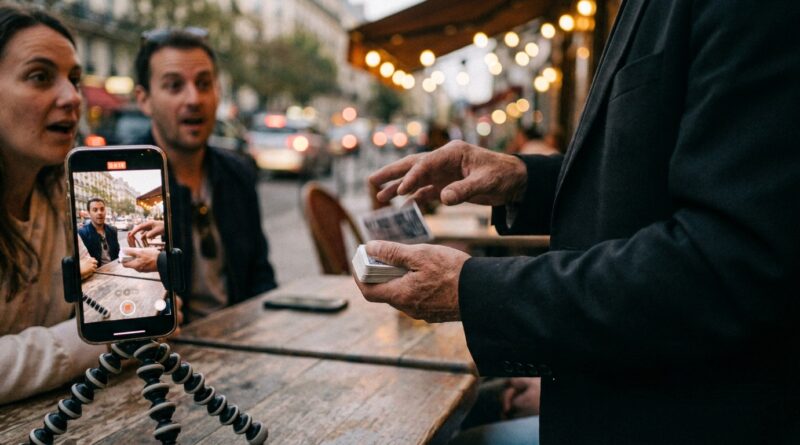
From Live Streams To Loop-Back Miracles: Build One ‘Replay-Proof Top Change’ Sleight That Survives Frame‑By‑Frame Scrutiny
Nothing stings quite like posting a clean card clip, feeling good about it, then watching the comments turn into a crime lab. Someone pauses at the wrong frame. Someone else zooms in. By the third replay, your old reliable top change suddenly looks like a guilty handoff. That is the new reality for close-up magic on TikTok, Instagram, and anywhere a spectator can scrub back with one thumb.
The good news is you do not need to throw out the top change. You need to rebuild it for a camera-first world. A replay proof top change for social media magic is less about faster fingers and more about smarter structure. You want one action that reads as natural live, holds up better on loop, and gives frame-by-frame viewers less to grab onto. That means fixing timing, body angle, eye line, and what the audience thinks matters in the moment. If you get those right, the move stops looking like a move. It starts looking like the moment before the magic happens, which is exactly where you want to hide it.
⚡ In a Hurry? Key Takeaways
- A replay proof top change for social media magic works best when the switch happens during a justified offbeat, not during a “look how fair this is” moment.
- Use face-on framing, eye contact, and a reason for the deck hand to move so the switch blends into a normal action.
- Do not chase speed alone. Slow motion exposes jerky rhythm, tension, and bad angles more than it exposes a well-timed move.
Why the classic top change gets caught online
In a live room, attention is soft. People blink. They laugh. They look at your face, then the card, then their friend. On a phone screen, attention hardens. Viewers can freeze the exact beat where your hands separate, compare before and after, and replay the part you hoped would just wash by.
That is why a top change that kills at a bar can die online. Not because the move is bad, but because the conditions changed.
Most exposed top changes on social media share the same problems. The hands speed up only for the switch. The performer stares at the deck right before the action. The card sits too long in display position, almost begging for a screenshot. Then the deck hand makes a weird little dip that has no reason to exist.
Replay does not forgive that stuff.
What “replay proof” really means
Let’s be honest. Nothing is truly proof against obsessive frame hunters. If someone wants to study a move like game tape, they can usually find the method area. What you are aiming for is stronger than “invisible.” You want the clip to look so motivated and so clean in rhythm that even on replay, the viewer still has trouble pinning down the exact switch.
That is the win.
For social media magic, replay proof means three things:
1. The move has a reason
Your hands do not move “because now the sleight happens.” They move because you are turning, pointing, relaxing, or squaring.
2. The move has cover from meaning, not just motion
The audience is mentally busy with a question, a memory, a choice, or a reveal setup. Their brain is processing significance, not tracking finger positions.
3. The move survives ugly viewing conditions
Phone brightness up. Playback slowed. Comments full of amateur detectives. If your switch still looks like one normal beat among other normal beats, you are in good shape.
The build: one practical top change structure that plays live and on camera
Here is the core idea. Stop treating the top change as a secret event. Treat it as the hidden half of a larger, ordinary action.
The strongest version for camera-facing work is this:
The “ask, look, relax, switch” sequence
Beat 1: Spectator’s card is apparently shown or remembered.
Beat 2: You ask a direct question that matters, like “Lock that in,” “You got it?” or “Would you bet money on that?”
Beat 3: On the question, your eyes come up to the spectator or camera, not down to the deck.
Beat 4: The hand holding the single card relaxes toward the deck as if nothing important is happening anymore.
Beat 5: The top change happens during that relaxation, with the deck hand making a justified micro-action such as squaring or lowering.
That sequence works because the important moment for the audience is the answer to the question. The card itself becomes old news for one beat. That beat is gold.
How to make the mechanics look less guilty
Keep both hands on the same rhythm
The biggest tell in bad top changes is that one hand suddenly “does the move” while the other waits like a nervous accomplice. Practice until both hands seem equally casual. Nothing lunges. Nothing freezes.
Shorten the display window
Do not hold the outjogged or tabled-looking card in the air forever. The longer you display, the stronger the memory of that exact picture becomes. Then the switch feels like a break in continuity. Show it clearly, but move on before the image hardens.
Lose the magician pause
You know the one. That tiny beat where your body says, “Brace yourself, secret thing incoming.” Viewers spot that faster than finger motion. Film yourself with no sound. If you can tell where the move is from body tension alone, fix that first.
Turn your chest, not just your wrist
Many performers overwork the wrist angle and forget the body frame. A slight chest turn can shield more naturally than a fussy hand position. It also reads less suspicious on video because larger body movement feels normal while isolated finger movement feels technical.
Best camera angle for a replay proof top change for social media magic
Most magicians make this harder by filming too high and too close. That angle turns the deck into a surveillance target.
Try this instead:
Use a face-first framing
Frame from mid-chest to just above your head if possible. Let your expression share the shot with the cards. People naturally watch faces. That gives your timing room to breathe.
Keep the lens slightly off-center
Dead-center can be great for some visual moves, but for switches it can become brutal. A slight offset often preserves the feeling of directness while keeping the dirtiest lane out of perfect view.
Do not let the card fill the screen
Bigger is not always better. When every finger crease is visible, replay becomes a microscope. Keep the action readable, but not clinically close.
Timing beats that hold up under replay
If you want one habit to start tonight, start here. Put the top change on the answer, not on the question mark.
What does that mean? The audience expects a move while tension is rising. They expect it during “watch closely.” They expect it when the selected card is held up like evidence. But once the question lands and the attention shifts to thought, memory, or reaction, the method window often opens.
Examples:
- “You remember it?” Switch as they nod.
- “Would that be impossible if it changed?” Switch as they smile or react.
- “Keep your eyes on me for a second.” Switch on the eye contact, not before.
This is the same reason signature work gets so tense in public. The moment meaning goes up, scrutiny goes up. If you play with signed cards or borrowed objects, you may also like From Borrowed Pens To Street Signatures: Build One ‘Public Autograph Switch’ Sleight That Hides Any Signature Change In Plain Sight, because it tackles that same “everybody is hunting now” problem from another angle.
Social media changes the job of misdirection
Some magicians hear “misdirection” and think it means making people look away. That is too small. For camera magic, especially, misdirection is better thought of as attention design.
You are not trying to force viewers to miss the move. You are giving them something more interesting to process right when the move occurs.
Use verbal hooks
A short question. A prediction. A challenge. A joke with a beat. Anything that creates mental load at the right second.
Use emotional hooks
Surprise, mild tension, curiosity. Even a tiny “Wait, what?” can blur the method moment more than hand speed can.
Use spatial hooks
If the important thing seems to be the spectator’s face, the impossible condition, or the upcoming reveal, the audience will not pin all their focus on the deck hand.
Practice for replay, not just for mirrors
Mirror work helps posture. It does not tell you what pause points look guilty on a phone.
Use this simple drill:
The 5-speed test
Record the move and watch it at normal speed, 0.75x, 0.5x, frame-scrub, and muted. Each pass catches a different problem.
- Normal speed: Does the routine flow?
- 0.75x: Does one hand jump in urgency?
- 0.5x: Does the switch have a mechanical hitch?
- Frame-scrub: Is there one catastrophic flash frame?
- Muted: Does your body betray the method without patter?
This sounds harsh, but it is useful. Better you catch it than the comments.
Common mistakes that make the top change look bad online
Looking at your own hands
If you look nervous, viewers get curious. Your eyes are a giant arrow. Use them wisely.
Trying to go too fast
Fast often becomes jerky. Jerky becomes suspicious. Smooth beats fast on video.
Keeping the deck too high
When the deck floats in the center of frame like a product shot, every thumb action gets inspected.
Using the move as the effect
If the clip is just “watch this card switch,” replay will hunt the switch. Wrap the move inside a larger magical event.
Forgetting live spectators still matter
You do not want a move that fools a phone and burns the people in front of you. Build something that works in both worlds.
How to use spectator management without looking bossy
This part matters more than many sleight-heavy magicians want to admit. Good spectator management is not barking orders. It is arranging the moment so people naturally stand, look, and respond in ways that help the magic breathe.
Invite, do not command
“Take a look at this.” “Hold your hand out.” “Remember that.” These feel light and natural.
Place the reveal where you want attention to end up
If the audience knows the magic is about to happen in their hand, their focus starts drifting there early. That can free the switch beat.
Use a real person, not just the camera
Even in content clips, having a spectator or off-camera participant can create natural eye-line changes and reaction beats. Those are useful cover.
At a Glance: Comparison
| Feature/Aspect | Details | Verdict |
|---|---|---|
| Classic fast top change | Relies on speed and broad live attention. Often looks jumpy when slowed down or paused. | Fine live in the right moment, risky for close social clips. |
| Replay-aware top change | Built around justified movement, eye contact, body framing, and offbeat timing. | Best all-around choice for modern performers. |
| Camera-only visual switch | Can look stunning from one angle, but may fail live or surrounded if over-engineered. | Use sparingly unless your work is mostly edited content. |
Conclusion
The bar just got higher, and yes, that can be frustrating. Within the last day, magic community hubs have been pushing creators toward more visual, camera-facing clips, which quietly raises the standard for every old-school switch. But that does not mean the top change is finished. It means it has to grow up a little. If you focus on timing, framing, and spectator management instead of chasing raw speed, you can keep this classic alive in a brutally honest era where every flash gets clipped, memed, and archived. That is the real value of building a replay proof top change for social media magic. It is not a trendy fix. It is a practical upgrade you can use tonight, with any deck, in any venue, whether you are filming for Reels or working a noisy bar with people on all sides.