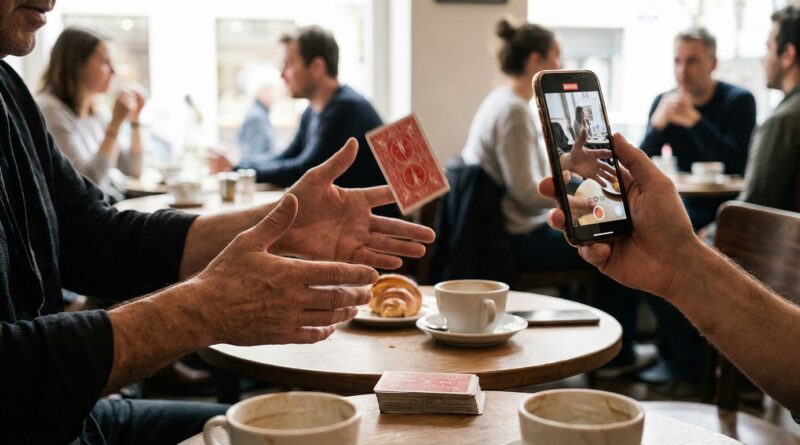
From Camera Tricks To Crowd Killers: Build One ‘Angle‑Proof Social Media Sleight’ That Survives Any Replay
You can feel the problem every time a card clip blows up online. Someone changes a card, vanishes a selection, or produces four aces, and half the comments say the same thing. “Nice edit.” That stings, especially if you actually put in the hours. Real workers are getting squeezed from both sides. If you post something too clean, people assume camera trickery. If you post something too honest, it can look slow, old, or flat next to hyper-cut TikTok magic. So the goal has changed. It is not enough to fool the person in front of you. You also need to survive the side angle, the freeze-frame, the replay, and the cynical scroll. The fix is not more speed. It is better design. Build one angle proof social media sleight of hand sequence that works live first, then looks impossible on camera without needing edits, stooges, or prayer.
⚡ In a Hurry? Key Takeaways
- Use a “dirty moment in motion” structure, where the secret happens during a justified action, not during a suspicious pause.
- Build your sequence to be front-angle strong, side-angle safe, and replay boring. If a freeze-frame reveals something, redesign it.
- The best social-first sleight should still kill in the real world. If it only works for one lens, it is content, not magic.
The Real Problem Is Not Skill. It Is Trust.
Most viewers no longer watch magic with open curiosity. They watch like detectives. They have been trained by jump cuts, gimmick trailers, and camera-only miracles that collapse the second a live human stands too close.
That has changed what “good” looks like.
A move can be technically brilliant and still fail online because it looks like editing. Another move can be crude and still spread because the effect reads clearly in one second. If you want an angle proof social media sleight of hand piece, you need both. Real method. Clear visual. No suspicious dead zones.
Think of it like product design. A phone case is not good just because it looks nice in an ad. It has to survive drops. Your sleight has to survive attention.
The Blueprint: Build One “Angle-Proof Social Media Sleight” Around a Visible Change
If you want one reliable template, start here.
What the audience should see
A card is shown fairly. It goes into the middle or appears isolated. Your hands never seem to hide it. Then, during a natural squaring action or a simple gesture, it visibly changes, appears, or rises to a controlled position.
That gives you a social-friendly effect with a live-friendly structure.
What the method should secretly do
Your secret work should happen during movement that already makes sense. Squaring the deck. Turning the packet. Handing something over. Pointing. Relaxing.
Not during a weird freeze.
That is the core idea. If the secret happens during a moment people expect your hands to move anyway, replay becomes much less useful.
The Three Rules That Make a Sleight Replay-Resistant
1. The dirty moment cannot be the visual moment
This is where many viral clips go wrong. The move and the miracle happen at the exact same beat, so the whole audience knows where to look. On replay, they camp on that frame until they find the method.
Better design separates those beats.
The move happens slightly before the effect registers, or slightly after the audience has emotionally decided what they saw. That timing gap is gold. It gives the brain a false memory.
2. Your hands must have an innocent job
Every motion needs a reason an eight-year-old would accept.
Why did you square the packet? Because it was messy.
Why did you turn the deck? To show the card was still there.
Why did your right hand come over? To point, take, tap, or align.
If the move has no innocent cover story, viewers may not know the method, but they will know the moment smelled funny.
3. Side angles matter more than front angles now
Years ago, you could get away with a trick built for the person directly in front of you. Not now. Someone is always half a step to your left with a phone.
So test every move from three views. Head-on. Left shoulder. Right shoulder. If one side flashes badly, either fix your handling or stop calling it angle-proof.
A Practical Sequence You Can Start Building Today
Here is a simple structure, not a named move. That is on purpose. The goal is a blueprint you can plug your own technique into.
Phase 1: Fair display
Show a single card or selection cleanly. Keep this moment boring and open. Do not rush. Ironically, a calm display reads more honest on camera than a flashy one.
Phase 2: Insertion or isolation
Place the card into the deck, into a spread, or under a small packet. This gives the audience a clear condition. They need to feel they know where the card is.
Phase 3: Justified motion
Square the deck, align the edges, or adjust grip to complete the action. This is where your secret happens. The key is that the action would still make sense if there were no trick at all.
Phase 4: Delayed revelation
Now let the effect appear. Maybe the top card has changed. Maybe the selection rises. Maybe the isolated card is suddenly different. The reveal should happen after the mechanics are over.
Phase 5: Clean punctuation
Do not keep fiddling. Stop. Let the image land. Social clips die when the magician keeps touching the evidence after the miracle already happened.
Why This Works Better Than “Fast Hands”
Speed is overrated. Fast moves look guilty on replay. Smooth, motivated actions look fair.
That is the big shift many magicians need to make. You are not racing the eye anymore. You are designing a memory. The audience is not just seeing your trick once. They are building a story in their head about what happened. Your job is to make that story false, but believable.
The best modern sleight of hand often feels slower than the fake stuff online. That is fine. Clean beats beat frantic fingers.
How to Test Whether Your Sleight Is Actually Social-Proof
Use the “mute replay” test
Record the sequence on your phone. Watch it back with the sound off. If the trick only works because of your patter, your rhythm, or your charm, it may not survive social media.
The effect should still read visually.
Use the “pause anywhere” test
Scrub through the clip and pause on random frames. If several frames expose finger positions, breaks, extra cards, or impossible grips, you have a weak point.
Fix the shape, not just the timing.
Use the “skeptic friend” test
Show the clip to one friend who likes magic and one who does not care about magic at all. Ask one question. “At what exact moment do you think something happened?”
If both point to the same obvious beat, your method is too spotlighted.
What to Avoid If You Want Real Credibility
Do not edit around the method
If your sleight needs a cut to hide the get-ready, that is not a sleight. It is post-production support. Audiences can feel that, even when they cannot prove it.
Do not build for only one camera height
A move that works only with the lens slightly above hand level is fragile. Real spectators are messy. Their phones are worse.
Do not confuse “visual” with “good”
Some changes look amazing for half a second and then collapse under thought. A strong piece should get better after the first shock, not worse.
That is one reason pieces built around thought, memory, and timing often age better than one-note eye candy. If you want a useful contrast, From Bare Palms To Borrowed Miracles: Build One ‘No‑Prop Pickpocket’ Sleight That Steals Anything From Their Mind, Not Their Pocket makes the same point from a different angle. A miracle that lives in the spectator’s mind is much harder to “expose” with a pause button.
How Working Magicians Can Use This in the Real World
This matters beyond Instagram.
If you build one angle proof social media sleight of hand sequence well, it becomes a utility tool. You can use it at a bar, in strolling sets, at weddings, and in short-form clips. That kind of crossover value is rare.
It also protects your reputation. People who see you live and then find your clip later should have the same reaction both times. “That looked impossible.” Not, “Oh, the online version was the fake one.”
That consistency is what separates a worker from a content factory.
At a Glance: Comparison
| Feature/Aspect | Details | Verdict |
|---|---|---|
| Visual clarity | The audience can describe the effect in one sentence, even on mute and on first watch. | Essential for social media and live impact. |
| Angle safety | The method survives head-on and casual side views without obvious flashing or grip strain. | More important now than raw speed. |
| Replay resistance | The secret happens during motivated action, while the visual effect lands on a separate beat. | Best way to reduce “just a camera trick” comments. |
Conclusion
The future-proof move is not the flashiest flourish or the fastest pass. It is the one that still looks fair when a spectator films from the wrong side, rewatches it three times, and sends it to a group chat full of doubters. That is the standard now. Every spectator is both audience and cameraman, and any throwaway bar trick can end up paused and analyzed by a million strangers. If magicians want to stand out from clip-based pretenders, protect the reputation of real sleight of hand, and still thrive inside the algorithm, they need at least one angle-clean, replay-resistant, social-first sequence in their pocket. Build that one piece carefully. Make it honest live. Make it clear on camera. Then let everyone hit replay.