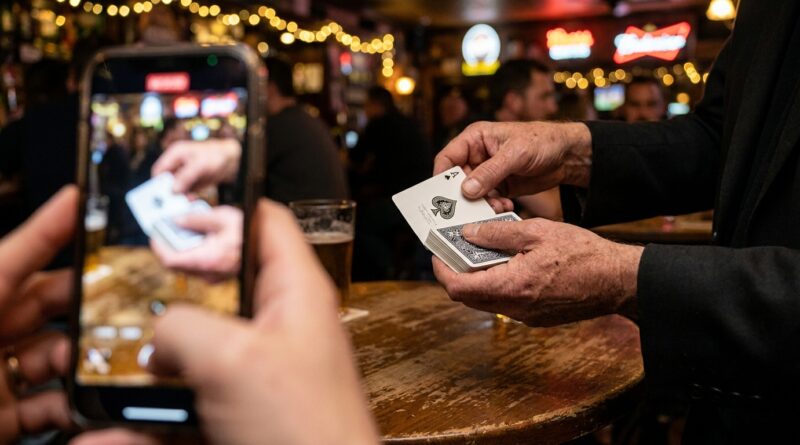
From Table To TikTok: Build One ‘Spectator POV Switch’ That Makes Any Sleight Look Like Real‑Time Camera Trickery
You know the moment. The switch kills in real life, people gasp, and then somebody shows you the phone footage from two feet over your shoulder and it suddenly looks clunky, suspicious, or worse, obvious. That is not because your technique is bad. It is because a lot of classic switches were built for your eyes, not the spectator’s camera. And now every pub set, jam session, and coffee table demo has a second audience. The lens.
The fix is not to scrap your whole repertoire. It is to build one spectator point of view card switch sleight of hand handling that keeps the dirty work hidden from the front and slightly high angles where phones usually live. Think of it as a routing idea, not a brand new move. You keep the effect, keep the texture of real sleight of hand, and quietly change where the cover comes from, when the moment happens, and how the hands frame the action. Once you get that right, your magic stops fighting the camera and starts using it.
⚡ In a Hurry? Key Takeaways
- A spectator point of view card switch sleight of hand works best when the secret action happens during a natural up-beat, with the hands framed for the phone, not for the performer.
- Start with one existing switch you already trust, then rebuild the grip, timing, and body angle so it survives a front-facing phone camera.
- This is not about editing or gimmicks. It is a practical way to make raw, one-take magic look stronger and safer in the real world.
Why old switches fall apart on camera
Most classic table switches were designed around a simple assumption. The audience is in front of you, seated low, and seeing the effect as a flowing whole, not as a replayable clip.
Phones ruin that assumption.
A spectator filming from chest height or slightly above gets a different view from the one you rehearsed for. Tiny finger curls look big. A wrist turn flashes. A packet steals attention at the wrong moment. What felt invisible live becomes a flashing arrow on video.
That is why the answer is not “just be smoother.” Smooth helps, sure. But structure matters more.
What a Spectator POV switch actually is
A Spectator POV switch is less a named move and more a build principle. You take any switch, top change, packet exchange, or tabled card transposition and ask three blunt questions.
1. Where is the phone most likely to be?
Usually in front of you, slightly off-center, and a little high.
2. When does the audience think the magic moment happens?
If the method happens at the same moment the audience expects heat, you are asking for trouble.
3. What shape do my hands make from that angle?
From your view, the move may look covered. From the phone’s view, your fingers may be making a neat little window around the secret.
The best spectator point of view card switch sleight of hand pushes the method into an off-beat, closes those windows, and frames the visible action so the camera sees fairness instead of mechanics.
The core design: one switch, three adjustments
If you want a practical build you can drill tonight, start here. Take one simple switch you already perform. Do not choose the most knuckle-busting thing in your toolbox. Choose the one you can hit ten times in a row without thinking.
Adjustment 1: Raise the moment slightly
Old-school table work often happens flat on the surface. That is exactly where over-the-shoulder and high phone angles become dangerous.
Bring the action just off the table. Not high. Just enough that your fingers and the object itself create a cleaner front frame. This tiny lift often removes the flash point that shows up on video.
Adjustment 2: Turn the cover into a reason
Bad cover looks like cover. Good cover looks like procedure.
Examples include squaring the packet, rotating a selection toward the spectator, sliding a tabled card forward for emphasis, or briefly showing a clean fingertip display before the switch happens on the return.
The key is that the visible action must make sense without any secret attached to it.
Adjustment 3: Move the heat, not just the card
This is the part many magicians skip. They obsess over finger positions and forget attention flow.
If the audience believes the important thing is your right hand, do the work in the left on the way back. If they believe the moment is when two cards touch, do the secret one beat before or one beat after. If the phone is burning the packet, let your eyes and words pull the viewer toward the signed face or the impossible condition, not the mechanics.
A simple build you can test tonight
Here is a clean template. It is not an exposure of a proprietary move. It is a rehearsal model for building your own handling.
The setup
Use two cards or a selection and an indifferent card. Work at chest-to-table height, not flat on the mat. Place your phone where a spectator would. Slightly right or left of center. Then film.
The display
Show the visible card openly. Keep the edges of the packet aligned. This is not the moment for flourishy spreads. You want the camera to read “single, fair object.”
The reason to move
Rotate the card or packet to point at a signature, face, or corner. That turn gives you natural motion. Natural motion is where this style of switch lives.
The secret beat
Do the switch while the object is in transit, not when it arrives. Arrival is where the phone tends to pause visually. Mid-journey is blurrier, softer, and feels less suspicious if the frame remains tidy.
The freeze
Once the switch is done, stop. Let the camera drink in the clean picture. This matters more than people think. A convincing still image after the move often sells the whole sequence.
What makes this look like camera trickery, even though it is not
The irony is that the more honest the handling is, the more impossible it can look.
Why? Because social audiences have become used to edits, cuts, and suspicious timing. When they see a raw one-take switch survive a nasty close angle, their brain reaches for the wrong explanation. They assume camera trick. That is a gift. You are doing real sleight of hand, but the image reads stronger than the method feels.
That is also why there is growing interest in fingertip-level work right now. People are tired of over-produced miracle clips. They want something they can stare at and still fail to solve.
Practice for the spectator’s eye, not your own
This is the part that separates a good idea from a useful one.
Film from three ugly angles
Do not film only the flattering angle. Film from front center, front right high, and over-shoulder left. If the move survives the ugly angles, it will sing in the wild.
Watch with no sound
Sound can hide awkwardness because your patter gives actions a reason. Silent playback tells the truth. If something looks strange muted, fix the visual grammar.
Use half speed, then full speed
Half speed shows flashes. Full speed shows suspicion. You need both tests.
Check your “rest picture”
How your hands look before and after the move matters almost as much as the move itself. If your fingers tense up only during the method, the camera catches that even when it misses the secret.
Common mistakes that kill a spectator POV switch
Too much finger motion
Big finger adjustments scream handling. Trim them down.
Doing the switch on the beat of emphasis
If your voice, eyes, and hands all spike at once, the viewer knows where to look. Spread those moments apart.
Working too flat
Flat on the table often helps the magician and hurts the camera.
Chasing visual speed
Fast is not always deceptive. Organized is deceptive. Slow-looking fairness before and after the switch is often stronger than a blur in the middle.
Where this fits in a real set
This is not just for TikTok clips. It is useful in walkaround, bars, casual sessions, and small parlour situations where phones come out without warning.
A good spectator point of view card switch sleight of hand can plug into card-to-card changes, sandwich effects, transpositions, signed card moments, and even simple two-card demonstrations. The trick does not need to change. The plumbing does.
If you also work with everyday objects on camera-facing sets, you will probably enjoy From Table Noise To TV-Ready Moments: Build One ‘Desk Object Transpo’ Sleight That Steals Any Zoom Or Fringe Stage. It tackles a similar problem from the object-transposition side. Same idea. Real-world handling that reads clearly through a lens.
How to choose the right switch to adapt
Not every move is worth rebuilding.
Best candidates
Switches with natural in-and-out motion, compact grip changes, and a clean freeze after the secret. Packet actions with a reason to square or rotate are especially good.
Poor candidates
Moves that depend on a deep body shade from your own torso, sharp wrist turns that only work from one seat, or heavy finger palm exposure during a tabled action.
If your favorite switch only works from your chair, keep it for live conditions where you control the room. For phone-heavy environments, use the version that plays nice with the lens.
At a Glance: Comparison
| Feature/Aspect | Details | Verdict |
|---|---|---|
| Classic performer-angle switch | Often strong live from your preferred seat, but can flash from raised front phone angles and replay badly on video. | Good for controlled conditions, risky for casual filming. |
| Spectator POV switch build | Uses off-beat timing, tighter hand framing, and small height changes so the method stays hidden from common spectator camera positions. | Best all-around choice for modern close-up work. |
| Edited social-media handling | Can look stunning, but viewers are quick to suspect cuts, stooges, or digital help if the clip feels too perfect. | Useful for promo, weaker for trust and long-term credibility. |
Conclusion
The sweet spot right now is obvious. People want ultra-close, fingertip-level card work that still looks impossible when they replay it. At the same time, there is real fatigue around formula TV scripting and clipped-up social magic that feels too neat to be true. That leaves a huge opening for raw, one-take miracles that can survive scrutiny. A spectator point of view card switch sleight of hand meets that moment perfectly. It helps you adapt the material you already do to a world where any table set, bar set, or casual session can become an unplanned broadcast. Better still, it keeps the method where many of us want it. In your hands, not in software, edits, or gadgets. Build one good version, drill it from ugly phone angles, and you will futureproof a big part of your repertoire without having to reinvent your act.