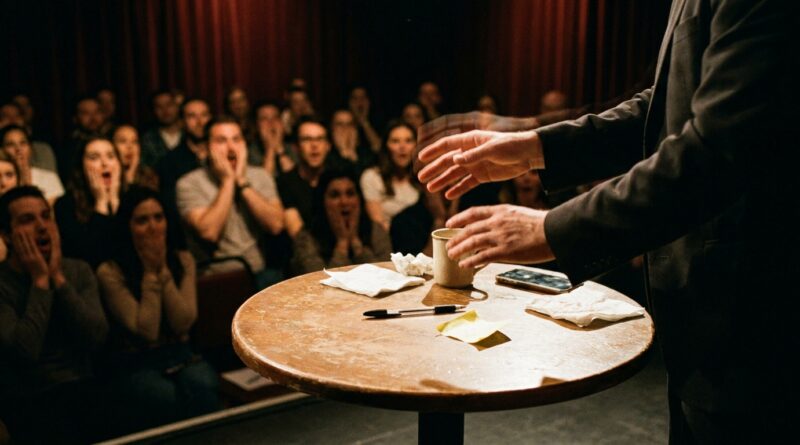
From Table Noise To TV-Ready Moments: Build One ‘Desk Object Transpo’ Sleight That Steals Any Zoom Or Fringe Stage
You know this feeling. Your card work is sharp, your coin control is clean, and your false shuffles could pass in a mirror test. Then you sit at an actual table. Suddenly there is a notebook, a borrowed pen, a coffee cup, a phone, maybe a set of keys, and all that polish seems to disappear. Nothing connects. Nothing feels built for real life. That is the gap a good table object transposition sleight of hand closes. It gives you one dependable miracle with ordinary things already in view, so you stop looking like “the card person who got stranded at lunch” and start looking like someone who can create magic anywhere. Better still, a strong transposition reads big on Zoom, kills in close-up, and plays beautifully in fringe rooms where people are staring from a few feet away. This is not about carrying more props. It is about building one routine that turns table noise into a TV-ready moment.
⚡ In a Hurry? Key Takeaways
- A strong table object transposition sleight of hand needs only two ordinary objects, clear positions, and one impossible moment the audience can retell in a sentence.
- Start with a pen and a folded note or business card. Fix the objects in the audience’s mind, then build a clean switch around a natural reason to touch them.
- Keep it safe and practical. Use objects that will not spill, roll, break, or make you fight angles when people are close or on camera.
Why this kind of routine matters now
The best modern magic does not always look like “magic shop magic.” It often looks like somebody picked up whatever was lying around and did something impossible with it.
That matters because audiences are trained differently now. They watch talent shows, social clips, intimate theatre pieces, and festival acts where the setting looks normal. So when a magician can only function after producing a special deck, people feel the gears turning.
A table object transposition sleight of hand fixes that. It says, “Fine. Give me what is already here.” That attitude is powerful.
The simplest version to build first
Do not start with four objects, a cup load, and three phases. Start with two objects that contrast clearly.
Good beginner pairings
A pen and a folded business card. A sugar packet and a key. A marker cap and a coin. A napkin ring and a thumb drive.
You want objects that are easy to name, easy to track, and different enough that nobody can blur them together in memory.
What the audience should believe
Object A is here. Object B is there. You barely touch them. They change places.
That is the whole plot. If you cannot say the effect that simply, it is too muddy.
Build the routine around positions, not moves
This is where many skilled sleight-of-hand performers get stuck. They think, “What move can I do with this pen?” The better question is, “What picture do I want the audience to remember?”
For a transposition, the remembered picture is everything.
The three pictures you need
Picture one: Both objects are shown clearly in separate places.
Picture two: There is a moment of fairness. Hands away, or one hand clearly occupied.
Picture three: The objects are now impossibly reversed.
If those pictures are strong, the method can be quite simple.
A practical structure that works on Zoom and live
Phase 1. Set the map
Place the pen on top of the notebook. Put the folded card under the coffee cup, or under the spectator’s hand if the setting allows it. Name the locations out loud.
“Pen on the notebook. Folded card under the cup.”
You are not filling time. You are locking the map into their heads.
Phase 2. Add a reason to touch
This is where your secret work hides. Maybe you square the notebook. Maybe you ask them to sign the folded card before it is folded again. Maybe you move the cup “so the camera can see.”
The reason matters because naked handling looks suspicious. Motivated handling looks normal.
Phase 3. Pause before the magic
Do not rush. A transposition gets stronger when there is a beat of stillness right before the reveal. Let them freeze the image in their mind.
Phase 4. Reveal in order
Show the first location empty or wrong first. Then reveal the impossible arrival second. This builds surprise into a wallop.
For example, lift the notebook to show the folded card where the pen should be. Then have them lift the cup and find the pen.
Choose objects that help you, not hurt you
Not every everyday object is your friend.
Best object traits
Flat or stable. Silent or nearly silent. Easy to grip. Easy to see at a glance. No sharp edges. No liquid. No unpredictable rolling.
Objects to avoid at first
Full coffee cups, glass items, tiny paper clips, glossy black objects on dark tables, and anything that needs a long cleanup if dropped.
Your routine should survive nerves, bad lighting, and a spectator leaning in too close.
The secret ingredient is not the steal
It is conviction.
If you handle the pen like a suspicious item and the folded card like a suspicious item, people smell that instantly. But if you treat them like office clutter, spectators relax. The miracle lands harder because nothing looked precious.
This is one reason object magic can hit harder than card magic. The props do not announce themselves.
One script line that helps a lot
Use a line that frames the effect as a test of attention, not a challenge.
Try this: “Do not watch my hands. Watch where things are meant to be.”
That line quietly pushes people to remember locations. Which is exactly what makes the transposition feel impossible.
How to practice without becoming stiff
Run the routine on three different surfaces. A kitchen table, a desk, and a small café-style table. Then try it seated and standing.
You are not just practicing the move. You are practicing the geography.
Use this simple rehearsal checklist
Can the objects be seen clearly from one meter away? Do they stay put? Can you name the locations simply? Is there any moment where your hands hover for no reason? Can the reveal be understood instantly without explanation?
If the answer to any of those is no, fix that before you polish the handling.
Make it feel bigger than a puzzle
A transposition becomes memorable when it says something. Not in a grand, fake-poetic way. Just enough to give it shape.
You might frame it as distraction versus attention. Or habit versus memory. Or the weird fact that people trust tables too much. “We think once an object lands, its story is over.” That is a nice line because it sounds casual but gives the effect a point.
Where this fits in a real set
This piece shines early or in the middle. Early, it proves you can do magic with what is already around. In the middle, it breaks up cards and gives the room fresh texture.
If your act already has strong card work, this can be the perfect bridge piece. In fact, if you also want a visual card moment that does not feel fussy, From Pocket Curiosity To Visual Shock: Build One ‘Flexible Wave’ Card Illusion That Practically Performs Itself pairs nicely with this kind of routine because it keeps the same “ordinary object, impossible moment” energy.
Common mistakes that weaken the effect
Too many conditions
If you explain five fairness points, people know there is something to explain. Keep it clean.
Weak contrast between objects
A blue pen and a black marker cap may be too visually similar in low light. Pick bolder differences.
No clear reveal order
If both objects are revealed in a messy scramble, the audience has to do extra mental work. Never make them work that hard.
Handling that screams “method”
If you keep readjusting the cup, patting the notebook, or re-centering the objects, stop. Touch less. Mean more.
How to adapt it for Zoom
Zoom loves clear frames and hates clutter. Tighten your playing area. Use a plain mat or simple desk surface. Keep the two object locations inside one camera shot at all times.
Say the positions out loud more than you think you need to. On video, verbal labeling helps the eye.
Also, rehearse your reveal pacing. Video has a tiny delay in how people process things. Give the first surprise half a beat before the second one lands.
How to adapt it for fringe and small theatre
Scale the objects up slightly. Use a chunky marker instead of a slim pen. Use a folded postcard instead of a tiny billet. You still want “ordinary,” just visible ordinary.
And remember that in a small theatre, body stillness reads as confidence. Once the secret work is done, stop moving. Let the room look.
At a Glance: Comparison
| Feature/Aspect | Details | Verdict |
|---|---|---|
| Best object pairing | Pen plus folded card or note. Clear shapes, easy handling, strong contrast. | Best place to start |
| Performance setting | Works at desks, café tables, Zoom frames, and intimate theatre if the objects are visible enough. | Highly flexible |
| Skill demand | Moderate sleight requirement, but high need for timing, object management, and clear staging. | More about structure than knuckle-busting |
Conclusion
If you build one reliable table object transposition sleight of hand, you stop being trapped by your prop case. That is the real win. Right now the strongest magic in the news is happening in intimate rooms, small theatres and festival shows where spectators sit almost nose-to-nose with the performer, and everything looks painfully ordinary. A practical, table-driven transposition gives our community something they can plug into that reality tonight. No special deck, no stooges, just one well-structured piece that makes you look like you have a new AGT-style miracle every time someone sets a pen down. It closes the gap between practice room sleight junkie and working pro who can fry a crowd with whatever is already on stage.