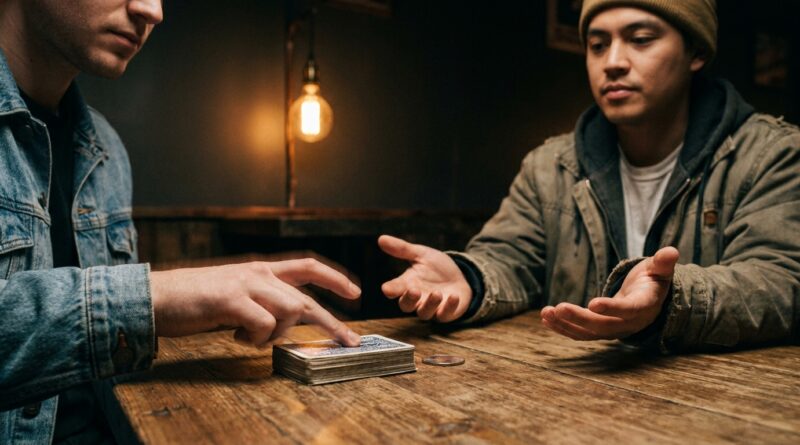
From Hands-On To Hands-Off: Build One ‘Psychological Sleight’ That Feels Like Real Mind Control
Your hands are getting blamed for everything now. That is the modern problem. Spectators have watched enough reels, tutorials, and slow-motion exposures that the second your fingers twitch, they assume “move.” If you are tired of grinding a cleaner double, a softer retention, or one more invisible transfer, you are not imagining the pressure. The heat really is higher on the deck, the coins, and your hands in general.
The good news is that people are not harder to fool across the board. They are just looking in the wrong place, and that gives you an opening. Hands off sleight of hand psychological magic works because it shifts the method from your fingers to their decisions, memory, and timing. Done well, it feels stronger than knuckle-busting technique because they remember that nothing happened when the secret move actually did. Let’s build one simple psychological sleight you can drop into card tricks, coin routines, and almost any close-up set starting tonight.
⚡ In a Hurry? Key Takeaways
- Use a “false moment of decision” so spectators feel they made a free choice before the real secret action matters.
- Build it with three beats: frame the choice, lock their memory with language, then do the simple physical move after the heat has passed.
- This is not instant mind control. It is structured attention management, which makes easy methods hit much harder and safer under scrutiny.
The One Psychological Sleight to Build
Call it the false moment of decision.
That sounds fancy, but it is simple. You create a point in the routine where the spectator feels the important choice has already happened. Once that feeling lands, their brain relaxes. They stop burning your hands for the exact method because, in their mind, the fairness checkpoint has passed.
That is the whole play.
Not invisible fingers. Not speed. Not a weird grip. Just structure.
Why it feels like mind control
People do not remember tricks like cameras do. They remember peaks. They remember the story they told themselves. If you can make them feel, “I could have changed my mind, but I didn’t,” they become attached to the fairness of that moment.
Later, when the effect lands, they trace the impossibility back to that memory.
That is why this kind of hands off sleight of hand psychological magic can feel spooky. You are not controlling their thoughts. You are controlling which moment they label as important.
The 3-Step Framework
Step 1: Frame a clean choice
Start with a simple, understandable decision.
Examples:
- “Touch any card.”
- “Point to one hand.”
- “Slide one coin forward.”
The choice should feel ordinary. No tension. No puzzle language. You do not want, “Choose wisely,” or “This matters.” That makes people defensive.
You want casual fairness.
For cards, this could be a spread and a touch. For coins, it could be left hand or right hand. For small objects, it could be red or black, top or bottom, near or far.
Step 2: Lock the memory with words
This is the part most magicians skip.
Once they make the choice, lightly confirm it out loud.
Say things like:
- “You could have gone for any of them, and you stopped there.”
- “That was your hand, not mine.”
- “You settled on that one.”
Notice what these lines do. They freeze the fairness in place. They turn a passing action into a remembered event.
You are not proving anything yet. You are labeling the moment for their future memory.
Step 3: Do the easy move after the heat moves away
Now, and only now, do the actual secret work. It can be a control, a switch, a load, a ditch, or a simple repositioning.
Because the spectator already feels the important part is done, your small physical move reads like housekeeping. It no longer looks like the cause of the effect.
That is the sneaky part.
The move is still there. It just no longer looks guilty.
A Card Example You Can Use Tonight
Let’s keep this practical.
Basic card version
- Spread the deck casually and ask them to touch any card.
- Outjog it and say, “That’s fair. You could have touched any one, and you stopped on this one.”
- Get them to look at the card.
- As they react to the card and the fairness line is still warm in their head, perform a simple control when replacing it.
- Continue with your reveal.
The secret is not the control itself. The secret is that they emotionally marked the selection as the important event. The control happened after the part they think mattered.
This is also why social-friendly magic works best when the structure is clean. If you perform online as well as live, you may enjoy From Scroll-By To Stop-Dead: Build One ‘Insta-Reality’ Card Reveal That Lives Inside Their Own Feed, because it taps into the same idea of making the effect live in the spectator’s own experience instead of in your fingers.
A Coin Example That Feels Even Stronger
Coins are perfect for this because audiences already stare at hands during coin magic.
Basic coin version
- Show a coin and place your hands apart on the table.
- Ask, “Which hand should the coin go in?”
- Whichever they name, repeat, “Your choice. Left hand.”
- Mime or openly place the coin as framed in your routine.
- After the verbal lock, use a simple vanish, retention substitute, or shuttle timing on the off-beat.
The spectator’s brain anchors to the decision point. “I chose the hand.” That memory can overpower their confidence in catching the move, even when the move itself is technically modest.
What Makes This Different From Plain Misdirection
Misdirection often gets described as “look over there.” That is too small.
This is stronger because it is not just about where they look. It is about when they think the method could have happened.
That is the real game.
If they believe the impossible condition was locked in before your secret action, then the action that follows loses explanatory power.
That is why hands off sleight of hand psychological magic matters right now. Modern audiences are hunting for finger moves. Fewer of them are questioning the timeline you quietly built around those moves.
Common Mistakes That Ruin It
Over-selling the fairness
If you sound like a lawyer, people get suspicious.
Say the fairness line once. Calmly. Move on.
Doing the move too soon
If the secret action happens before their choice feels emotionally complete, the method still points back to your hands.
Let the decision breathe for a beat.
Using a weak effect
This structure boosts method. It does not fix a flat trick. The ending still needs clarity.
One impossible fact is better than three muddy ones.
Confusing freedom with chaos
You do not need a totally open procedure. You need a choice that feels human and fair.
Small freedoms are often stronger than giant messy ones.
How to Practice This Without a Mirror
You do not need to rehearse finger positions for hours. Practice your script and timing instead.
Try this drill
- Write one choice line.
- Write one memory-lock line.
- Mark the exact off-beat where your physical move happens.
- Film yourself once.
- Watch with the sound off, then with the sound on.
If the move looks suspicious with sound off but invisible with sound on, you are on the right track. That means the structure is doing real work.
Where This Fits Best
This psychological sleight works best in routines with:
- Selections
- Transpositions
- Coins across
- Which-hand plots
- Predictions
- Any effect where a spectator choice can be clearly named
It is especially useful for newer magicians because it lowers the technical barrier. But experienced workers should not shrug it off. In tough rooms, this is often what keeps solid technique from looking like “just another move.”
At a Glance: Comparison
| Feature/Aspect | Details | Verdict |
|---|---|---|
| Technical demand | Uses basic controls, switches, or transfers after a spectator’s choice is psychologically locked in. | Low to medium difficulty, high payoff. |
| Audience impact | Feels impossible because they remember the fairness of the decision more than the later hand action. | Very strong when the effect is clear. |
| Best use case | Card selections, which-hand effects, coin placements, and prediction structures. | A practical modern tool for close-up workers. |
Conclusion
If your hands feel over-watched, that is not paranoia. It is the room you are working in now. People have been trained by socials and slow-mo replays to suspect slick fingers first. But they are still wide open to timing, structure, and memory. That is why this one repeatable framework matters. Build a clean choice. Lock it with a simple line. Then let the real move happen after they think the important moment has passed. That is the kind of hands off sleight of hand psychological magic that feels current, helps newer students get stronger results without years of knuckle work, and lets experienced magicians keep genuine deception alive in a world that assumes every secret is hiding in your fingertips.