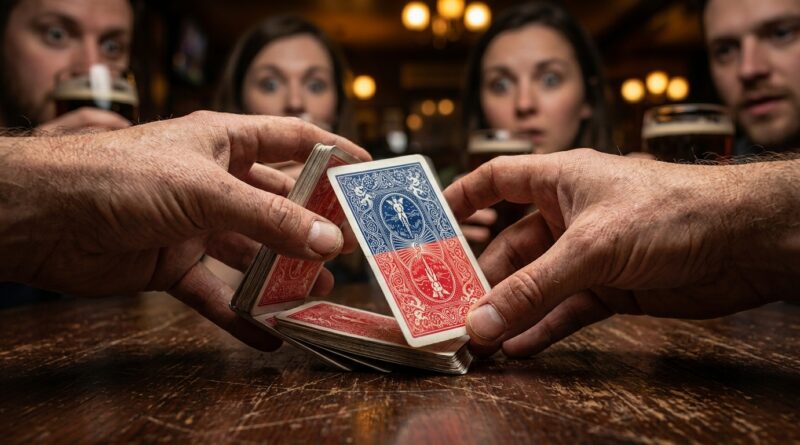
From Fidget To Flash Change: Build One ‘Finger Roll Color Shift’ That Turns Any Casual Shuffle Into Pure Card Sorcery
If your color changes only look good when you stop everything and pose for them, you are not alone. That is the frustration a lot of card workers are feeling right now. The move looks amazing on camera, then oddly suspicious in real life because it arrives like a neon sign saying, “watch my fingers.” The fix is not another stand-alone flourishy change. It is building one finger roll color shift that lives inside the way you already handle a deck. That means the change can happen while you casually shuffle, square, or fidget, instead of feeling like a separate performance mode. Done right, this becomes a practical new card color change sleight of hand technique, not just clip bait. Better still, it gives your restless hands a job. Every idle pickup of the deck becomes useful practice. You stop noodling. You start training timing, softness, cover, and control without looking like you are drilling moves in public.
⚡ In a Hurry? Key Takeaways
- A finger roll color shift works best when it is hidden inside a natural shuffle or squaring action, not presented as a separate stunt.
- Start by matching the rhythm of your normal hands. Learn the roll slowly, then attach it to one casual habit you already do with a deck.
- The real value is repeat use. This move can fit live performance, walk-around, table work, and vertical video while quietly improving your overall touch.
Why this kind of color change matters now
The card world is full of pretty changes. That is not the problem. The problem is that many of them live in a sealed glass case. You bring them out for one moment, everyone stares at your hands, then the magic is over because the handling no longer feels normal.
A finger roll color shift fixes that by making the visual moment look like an accident of ordinary handling. The card changes while your fingers are already doing something believable. That is why it lands harder at a table than a lot of flashier moves. People are already watching your hands there. You do not get bonus points for looking tense.
If that sounds familiar, it connects to a bigger issue in modern magic. Spectators now blame the hands for everything. That is why pieces like From Hands-On To Hands-Off: Build One ‘Psychological Sleight’ That Feels Like Real Mind Control hit such a nerve. The less your technique looks isolated, the stronger the mystery feels.
What a finger roll color shift actually is
Think of it as a controlled turnover disguised as a tiny rolling action of the fingers. The visible card changes during a moment that reads as fidgeting, squaring, or a casual packet adjustment. You are not announcing, “Here comes the move.” You are letting the move hide inside motion spectators already accept.
The best versions share three traits.
1. The hands keep moving at an ordinary speed
No sudden pause. No dramatic squeeze. If your fingers slow down right before the change, people feel the method even if they cannot name it.
2. The deck posture stays relaxed
If your wrist locks or your thumb clamps down, the move starts to look precious. Casual magic needs casual mechanics.
3. The reveal happens on the offbeat
The secret is not just the roll. It is when the audience decides to process what happened. A beat too early and they burn you. A beat too late and the change loses punch.
Build the move into your actual shuffle habit
This is where most people get real value. Do not learn the shift in a vacuum. Attach it to a handling pattern you already use naturally.
Option A: During the square-up
After an overhand or tabled mix, many magicians square the deck with a light roll of the fingers anyway. That is a perfect home for the color shift. The action is justified. The hands are already busy. The audience sees maintenance, not method.
Option B: During a one-hand packet adjustment
If you often lift a small packet, roll it slightly, then replace it, the finger roll change can live there. This works well for walk-around because it does not need much space.
Option C: As a “nothing” moment between phases
This may be the best use of all. Not a climax. Not an opener. Just a quick visual punctuation mark while you seem to be resetting your grip. That makes it feel unguarded, which is exactly why people remember it.
How to practice without becoming the suspicious card fidgeter
There is a big difference between useful repetition and aimless twiddling. One builds touch. The other makes you look like you are waiting for applause from your own hands.
Start with a dead-slow roll
Work on the card mechanics until the visible surfaces stay aligned and the packet does not buckle. Speed comes later. Sloppy speed is what makes new visual sleights look fake.
Match your normal rhythm
Film yourself just shuffling and squaring the deck with no move at all. Then film the finger roll shift. The two rhythms should look like cousins. If the move clip has a different tempo, that is your tell.
Use a three-repetition rule
When you pick up a deck casually, do the move cleanly three times, then stop. This keeps practice focused and prevents the endless loop of unconscious fiddling that trains bad timing.
Practice with speech
Talk while doing it. Count backward. Explain tomorrow’s grocery list. If the move only works in total silence, it is not ready for people.
Common mistakes that kill the illusion
Most failed color changes are not failing because the secret is weak. They fail because the framing is off.
Telegraphing the moment
If your eyes dart to the card right before the change, spectators follow. Your gaze is often more revealing than your grip.
Making the reveal too perfect
Oddly enough, a little mess can help. Real handling has tiny imperfections. If the card snaps into view like a special effect while the rest of your handling is loose and casual, the contrast feels wrong.
Using it as a full trick
This is a utility move. Treating it like an entire routine usually weakens it. It shines when layered into an Ambitious Card phase, a transposition, a sandwich reveal, or a prediction beat.
Where this move plays best
It is especially strong in places where your hands are already under natural attention.
At tables
People are close. They expect deck handling. A casual finger roll change can look impossible because the deck never seems to enter “trick mode.”
In walk-around
You often need a visual beat that resets interest fast. This gives you one without changing your whole routine structure.
In vertical video
This style of change reads beautifully on phone screens. The motion is compact. The reveal is direct. Best of all, it does not require stagey framing if your handling is honest.
How to layer it into real routines
The smartest use is not “look, the card changed.” It is “you thought nothing was happening, and then the card was suddenly different.”
Use it as a proof beat
Show an indifferent card. Roll and square. Now it is the selection. This works because the audience believes they already understood the moment.
Use it after a false explanation
Pretend you are only tidying the deck or correcting a messy shuffle. That lowers defenses. Then the change hits.
Use it before a non-visual payoff
This is a nice contrast. Give them one quick visual moment, then follow with a location or mind-reading phase. The variety makes the set feel bigger without adding much handling.
Why this is better than learning five random flashy changes
Because one useful move in the right spot beats a folder full of disconnected tricks. A good finger roll color shift earns its place because it can be repeated, adapted, and hidden inside the way you already work.
It also trains the stuff that matters everywhere else. Finger pressure. Edge alignment. Timing. Relaxed cover. Audience management. Those are not one-trick skills. They improve almost every card routine you do.
At a Glance: Comparison
| Feature/Aspect | Details | Verdict |
|---|---|---|
| Naturalness | Lives inside a square-up, shuffle, or packet adjustment instead of stopping the action for a separate display. | Best reason to learn it. |
| Learning curve | Moderate. The mechanics are manageable, but timing and relaxed rhythm take real reps. | Worth the effort for workers and serious hobbyists. |
| Real-world use | Fits close-up, walk-around, casual practice, and short-form video without needing a brand-new routine. | High utility move. |
Conclusion
The real win here is not just learning a pretty change. It is giving your hands a better default behavior. Right now the community is obsessed with high-impact visuals that still feel unguarded in casual settings, especially at tables and in walk-around where everyone is already watching your hands. A finger roll color shift fits that moment beautifully. It is modern, repeatable, and useful. You can layer it into routines you already do, use it live, and drop it into vertical video without rebuilding your whole act. More importantly, it solves a very current pain point. It turns random card fidgeting into deliberate practice. Every time you pick up a deck, you are no longer just passing time. You are quietly building real sleight-of-hand chops while making your magic look less posed and far more impossible.