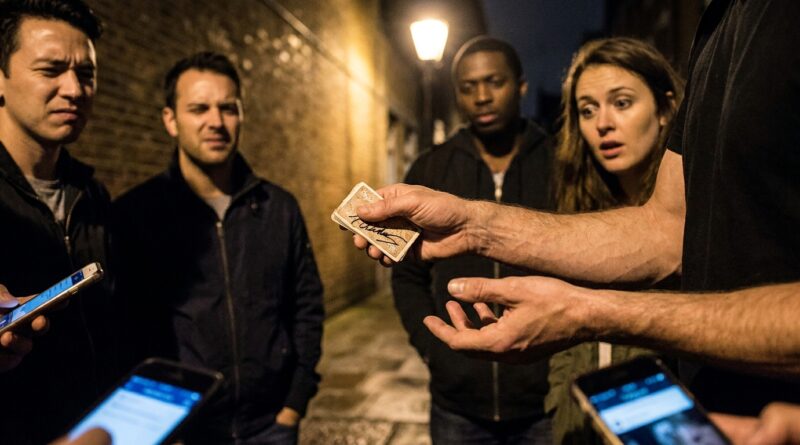
From Empty Sleeves To Streetlight Miracles: Build One ‘Bare-Arms Corner Steal’ Sleight That Lets You Load Any Object In Full 360 View
You know the feeling. You can control a card, vanish a coin, maybe even survive a tough heckler. But the second somebody says, “Show us something with short sleeves,” your brain starts flipping through the same tiny list of safe tricks. That is the real pain point here. Not lack of skill, but lack of confidence when every angle is live, every phone is recording, and every suspicious pause looks worse in slow motion. A good sleeveless card magic corner steal matters because it gives you a secret weapon that does not depend on a jacket, deep pockets, or camera-friendly framing. It gives you one honest, workable load you can build whole routines around. Better still, it solves a very modern problem. People do not watch magic politely anymore. They crowd in, circle you, and film over your shoulder. If your method cannot survive that, it is hard to trust it in the real world.
⚡ In a Hurry? Key Takeaways
- A strong sleeveless card magic corner steal gives you a practical way to load or switch an object in full-view conditions without relying on sleeves or bulky gimmicks.
- Start by building one reliable action path, from hand position to eye contact to body turn, instead of trying to learn five flashy versions at once.
- The safest approach is one designed for real spectators, not just a camera lens. Test it standing, surrounded, and with a phone recording before you trust it in performance.
Why bare-arm magic feels so limiting
Most magicians do not run out of tricks. They run out of tricks they trust.
That is a big difference. A routine can look brilliant in a trailer and still feel unusable the moment you are outdoors in daylight wearing a T-shirt. If the method needs a perfect front view, a table edge, or a pocket that is never examined, it stops being a go-anywhere miracle.
That is why a sleeveless card magic corner steal is such a useful idea. It attacks the exact weak spot. You are not just hiding a card. You are building a secret loading system that can support appearances, transpositions, impossible locations, and visual endings.
What a “bare-arms corner steal” really needs to do
For this move to matter, it has to clear a much higher bar than an ordinary card control.
It has to survive 360 attention
Not “kind of okay from the front.” Full circle attention. That means the steal cannot depend on a big cover action that only works from one side.
It has to look like nothing
The best steals are boring to watch. That sounds odd, but it is true. If the audience can remember the exact moment your hands did something unusual, you are in trouble.
It has to lead somewhere useful
A corner steal is not the effect. It is the engine. The value comes from what it lets you load after the fact. A folded card. A billet. A prediction. A small object. If the move only exists to prove you can do a sneaky move, it will never earn a place in your set.
The smart way to think about the move
Think of this less like a “grab” and more like a transfer of responsibility.
At the start, the deck or packet is responsible for hiding the object. By the end, your hand, timing, posture, and audience focus are doing that job. If you rush that handoff, people feel it. They may not know what they saw, but they know something happened.
That is why the strongest versions are built around natural moments. Squaring. Turning. Relaxing the hands. Looking up to ask a question. Handing something out. Good sleight of hand often works because the secret action rides inside a normal action people already understand.
Why this matters more now than it did ten years ago
Because spectators have changed.
People are bolder. They stand closer. They replay video. They freeze frames. And they have become surprisingly good at spotting “magic body language,” even if they do not know the name of the move. They can smell tension.
That is why angle-proof methods have become such a hot topic. The community keeps asking the same question in different ways. What can I actually perform when people are burning my hands and filming? A practical sleeveless card magic corner steal is one of the cleanest answers because it is not just one trick. It is a platform.
What separates a practical steal from a collector’s move
Practical steals are built for repetition
If you need perfect skin dryness, a lucky grip, and total silence in the room, you do not have a worker. You have a hobby move.
Practical steals forgive pressure
Real-world performance is messy. Your hands may be cold. People may interrupt. Someone may step to your bad side. A useful move still gives you a way out.
Practical steals have a clean “after” picture
This is where many flashy methods fail. Even if the secret part works, the hands look cramped afterward. The body freezes. The performer suddenly protects a side. That is exactly what modern spectators notice.
How to practice this without driving yourself mad
Do not start with speed. Start with landmarks.
1. Build the route
Map the exact travel path of the object. Where is it at the start? When does the stealing hand first make meaningful contact? Where does it rest after the steal? If you cannot describe that path clearly, your fingers will improvise, and improvisation under pressure is where flashing begins.
2. Film the ugly stage
Most people only record once they think the move looks decent. Wrong move. Record when it still looks clumsy. That footage shows where the tension actually lives.
3. Practice standing, not just seated
Standing changes elbow position, wrist angles, and audience sightlines. A move that feels solid over a close-up mat can fall apart instantly at chest height.
4. Add your eyes last
Eye contact is a tool, but fake “look over there” misdirection often reads as guilt. First make the mechanics silent and small. Then add gaze direction that fits the script.
The real secret is not the fingers
It is choreography.
A great steal usually happens because the audience has a simple story in their head. “He squared the cards.” “She handed me the packet.” “He turned to the spectator on his left.” The more ordinary that story is, the safer the method becomes.
This is where many magicians overcomplicate things. They hunt for a miracle grip when what they really need is a better reason for their hands to be where they are.
Best uses for a sleeveless card magic corner steal
Impossible object loads
This is the headline use. A selected or signed item appears somewhere impossible, and because your arms are bare, the audience mentally crosses off the usual hiding spots.
Last-second cleanups
Sometimes the move is not there to create the main effect. It is there to quietly solve the ending so you can show cleaner hands than the audience expects.
Layered routines
One hidden load can power multiple moments. Maybe the first phase is a control. The second is a vanish. The third is an impossible reveal. To spectators, that feels much bigger than “a move.” It feels like real magic building in stages.
Common mistakes that kill the illusion
Trying to make it invisible by moving faster
Speed helps less than people think. Rhythm helps more. If one beat of the routine suddenly goes faster than every other beat, that spike attracts attention.
Holding tension after the steal
This is huge. Many performers survive the dirty moment and then ruin it by looking protective afterward. Relaxation is part of the method.
Ignoring the off-hand
Spectators watch both hands, even if they could not explain why. If one hand becomes weirdly still while the other does “business,” the frame looks suspicious.
Practicing only for the best angle
If your goal is 360 use, you need side views, low views, and that dreaded over-the-shoulder phone angle. Practice for the world you actually perform in.
How to know if the move is ready
Here is a simple test. Can you do it while talking, breathing normally, and asking a spectator a question? If not, it still owns too much of your brain.
A performance-ready steal should leave enough mental space for presentation. If all your attention is trapped in your fingers, the audience will sense that concentration and drift toward the method.
Should you trust a gimmick instead?
Sometimes, yes. Gimmicks are not the enemy. But they should solve a problem, not create three new ones.
The issue with many “angle-proof” releases is that they are only angle-proof in the exact conditions used to demo them. Tight framing. Friendly lighting. No one at your back. That is why a skill-based, sleeveless card magic corner steal has staying power. Once learned, it travels with you. No setup panic. No wardrobe dependency. No fear that the trick dies because you wore the wrong shirt.
At a Glance: Comparison
| Feature/Aspect | Details | Verdict |
|---|---|---|
| Angle Safety | Designed for surrounded or near-surrounded performance, including side and over-the-shoulder heat. | A major advantage over sleeve-based ditches or camera-only methods. |
| Learning Curve | Requires steady drilling, attention to posture, and video review, but does not need exotic props. | Very learnable if you focus on one version and real-world handling. |
| Real-World Value | Can power object loads, impossible reveals, and cleaner endings when wearing short sleeves. | High value for walk-around, street magic, casual performances, and social media clips that need to hold up live. |
Conclusion
A solid sleeveless card magic corner steal is more than a clever move. It is peace of mind. Right now the magic community is obsessed with visuals that work both in real life and on video, yet a lot of methods still dodge the hard part with careful framing or chunky gimmicks. A bare-arms load built for 360 conditions speaks directly to the worry working magicians keep bringing up. How do you create strong close-up moments when people are inches away, staring at your hands, and filming everything? The answer is not always another prop. Sometimes it is one robust, honest technique you can trust. Build that, and you stop saying “let me grab my jacket” or defaulting to tricks that feel safe but uninspiring. You get to say yes on the spot, in daylight, with your sleeves missing and your confidence intact.