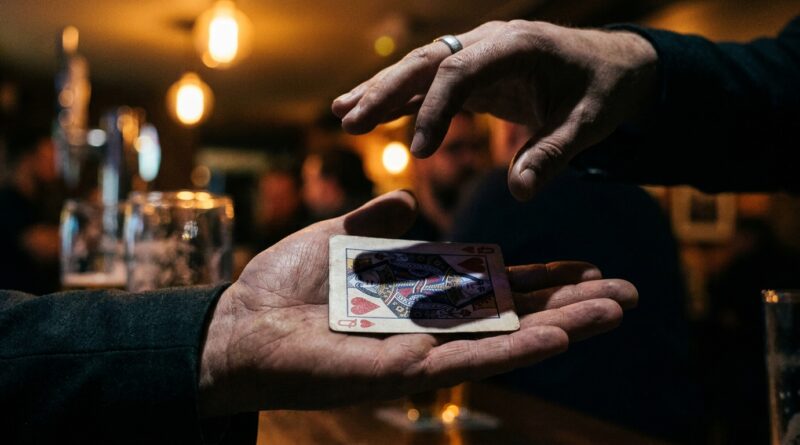
From Empty Air To Borrowed Hands: Build One ‘No-Table Shadow Change’ Sleight That Turns Any Spectator’s Palm Into A Live Switch
You know this pain if you do any real-world card work. At home, your color changes look sharp. At a gig, the table vanishes, the light gets ugly, people crowd in close, and suddenly your favorite move feels too risky to even try. That gap between practice-room magic and working magic is where a lot of strong card handlers get stuck. The fix is not another fancy visual deck or a move that only survives one camera angle. It is one practical, hard-hitting utility sleight you can do standing up, surrounded enough, with the card changing right on a spectator’s palm. A good spectator hand card color change sleight of hand solves a very specific problem. It gives you a switch that feels impossible because the moment of change happens in borrowed space, not yours. That matters. When the miracle lands on their hand, the heat shifts away from method and straight onto effect.
⚡ In a Hurry? Key Takeaways
- Use a spectator-hand change built around timing, cover, and a natural offbeat, not a flashy finger-flinging visual.
- Start with a simple top-change style structure that happens as the spectator reacts to the card being placed on their palm.
- The best version is ungimmicked, no-table, and strong in bad light, but you must rehearse audience management as much as the finger work.
What this move is really for
A no-table change on a spectator’s hand is not just a stunt. It is a utility switch disguised as a visual moment.
That is why it matters so much in walk-around. You are not trying to win a slow-motion replay contest. You are trying to create a clean, memorable event under conditions that are usually working against you.
Think bar sets. Trade shows. House parties. Tight restaurant aisles. Casual jams where everyone is standing and nobody wants to clear space. In those spots, a strong spectator hand card color change sleight of hand gives you something rare. Control without looking controlling.
The core idea: a change that happens on their palm, not in your fingers
The basic structure is simple. One card is shown. That apparent card is placed onto the spectator’s palm. In the action of squaring, turning, or inviting them to cover it, the visible identity changes.
There are a lot of ways to build that structure. Most of the good ones share three things.
1. The display has to be boring in the best way
If your show of the card looks like a challenge move, people lock in. Trouble starts there.
Show the card casually. Not too long. Not too clean. Just enough.
2. The switch happens during a job
The hand should be doing something that makes sense anyway. Squaring the packet. Adjusting the card on their palm. Turning your wrist so they can see better. Asking them to flatten their hand.
If the move has no reason, it gets remembered.
3. The reveal belongs to them
The strongest version is not “Look what I did.” It is “Turn your hand over” or “Did you feel that?”
That tiny shift changes the whole texture of the trick. They become part of the method in their own memory, which makes the method harder to backtrack.
One workable build: the palm-set switch
Let’s build a practical handling, not a museum piece.
The effect: you show a red-backed indifferent card. You place it on the spectator’s open palm. You gesture, rub lightly, or ask them to place their other hand on top. When they look again, it is now the selected card, or the back color has changed, depending on your routine.
Step 1: Start with a double or a controlled pair
The easiest route is to begin with two cards aligned as one. The top visible card is the false card. Under it is the real card you want to appear.
This gives you a clean display up front and a built-in destination for the reveal.
Step 2: Transfer with purpose
As you place the double onto the spectator’s palm, do not freeze. Keep speaking. “Flat hand for me.” “Perfect.” “Keep your eyes on this.”
The placement action itself should feel like setup, not climax.
Step 3: Use the take-back beat
This is the moment many magicians miss. After the card touches their hand, there is often a tiny adjustment. You nudge the edges square, rotate the card slightly, or briefly lift and replace it so it sits centered.
That tiny, motivated correction is where the switch lives.
If you are using a top-card transfer idea, you leave one card and take the other. If you are using a buckle-assisted release, the upper card stays while the lower card is drawn away. Different mechanics, same dramatic point. The card they think has been there from the start is not the card actually there now.
Step 4: Get out
Do not milk the dirty moment. Once the card is settled, your hands should relax and separate. Ask them to cover it, pinch it, or simply stare at it.
Distance after action is what makes the change feel locked in.
Why this fools better than many visual changes
A lot of flashy changes are magician candy. They look amazing on video and shaky in real life. This kind of switch hits different because it borrows conviction from the spectator’s own body.
They felt the card. They saw where it landed. They remember that it never left.
That is a much stronger story than “his fingers moved fast.”
It also gives you the same lesson that applies in From Empty Hands To Borrowed Screens: Build One ‘Spectator Phone Mirage’ Sleight That Turns Any Camera Check Into Real‑Time Magic. The object is borrowed space. A phone screen there. A spectator’s palm here. In both cases, the magic feels bigger because it happens somewhere the audience thinks you control less.
Angles, lighting, and real-world survival
This is where working moves earn their keep.
Bad light
Good. Seriously. Slightly dim conditions often help because people track the effect, not the micro-action. Just make sure card values contrast enough to read quickly.
Tight angles
You do not need to be fully surrounded, but you do need to know your weak side. Practice in a mirror from both front corners. Then record from chest height, not overhead. Real people do not watch from drone level.
Spectators burning your hands
Expect it. Build for it. Give them a reason to shift attention for half a beat.
That reason should be tiny and honest. “Other hand on top.” “Feel if it gets warm.” “Did you see the corner?” You are not trying to distract them into next week. You just need a natural task at the right moment.
Best applications for this sleight
Once you have the switch, you do not have just one trick. You have a tool.
Selected card appearance
The simplest use. An indifferent card changes into their signed or selected card on their palm.
Two-card transposition
One card is on their hand. One is in yours. They switch places. This is especially strong if your hands look empty right after.
Back color change
Face stays the same, back changes. Great for social media clips, but still solid live if you do not rush the reveal.
Prediction kicker
What was apparently a random card turns into the only card that matches a prediction already in play.
What usually goes wrong
Most failed attempts come from performance choices, not raw mechanics.
Problem: You act like the move is the trick
Fix: Treat the move like punctuation. The plot is the trick.
Problem: You hover over the spectator’s hand too long
Fix: Place, adjust if needed, then clear out. If your fingers keep hanging around, suspicion follows them.
Problem: Your display is too careful
Fix: Casual beats careful. A normal person does not handle a single card like it is made of explosives.
Problem: You reveal too soon
Fix: Let the image settle in their mind first. A short pause can make the change feel impossible.
Practice plan for this week
If you want this in repertoire fast, do not practice it like a flourish. Practice it like a conversation.
Day 1: Mechanics only
Work on the transfer and switch in front of a mirror. No patter. No speed. Just smoothness.
Day 2: Add script
Say the exact lines out loud while doing the move. This matters more than people think. Speech changes rhythm.
Day 3: Film from ugly angles
Front left. Front right. Slightly below eye level. Fix what flashes.
Day 4: Rehearse spectator management
Use a cushion or your own open hand as the stand-in. Practice where your hands enter and leave space.
Day 5: Test on one trusted person
Do not ask if they liked it. Ask what they think happened and when they think the card changed.
Day 6 and 7: Put it in a full routine
This is the big one. Utility sleights become deceptive when they are connected to a strong sequence, not shown in isolation.
How to make it feel modern without making it fragile
This is the sweet spot right now. Magicians want material that can play on TikTok and still crush in person.
You can have both, but only if the move survives outside the frame. That means no dependence on perfect overhead shots, no fussy setup, and no need for a close-up pad or quiet studio lighting.
If you want a second piece that follows the same thinking, the borrowed-object philosophy in From Empty Hands To Borrowed Screens: Build One ‘Spectator Phone Mirage’ Sleight That Turns Any Camera Check Into Real‑Time Magic is worth a look. It solves a similar problem from a different angle. How do you create impossible moments when the conditions are messy and the audience is close? You use structure, not just visuals.
At a Glance: Comparison
| Feature/Aspect | Details | Verdict |
|---|---|---|
| Setup needed | Can be done with a normal deck and a simple double or controlled pair. No table required. | Excellent for walk-around |
| Angle safety | Safer than many flashy color changes, but still needs awareness of your weak side and spectator height. | Good if rehearsed properly |
| Audience impact | Very strong because the change happens on the spectator’s palm, which boosts conviction and memory. | High impact, high utility |
Conclusion
The real win here is not that you learn one more clever move. It is that you stop depending on conditions that almost never show up at actual gigs. Right now most of the noise online is about visual decks, gimmicks, and angle-sensitive flourishes. Meanwhile, working magicians are still hunting for tough, ungimmicked sleights that hold up in the real world. A no-table spectator-hand change fits that need perfectly. It looks modern enough for short-form video, hits hard at eye level in loud venues, and gives serious students one practical weapon they can start using this week. For the Magician Book crowd, this is exactly the bridge worth building. It mixes knuckle work with smart structure. And that is what lasts. Not just a move that looks good in practice, but one that survives contact with actual people.