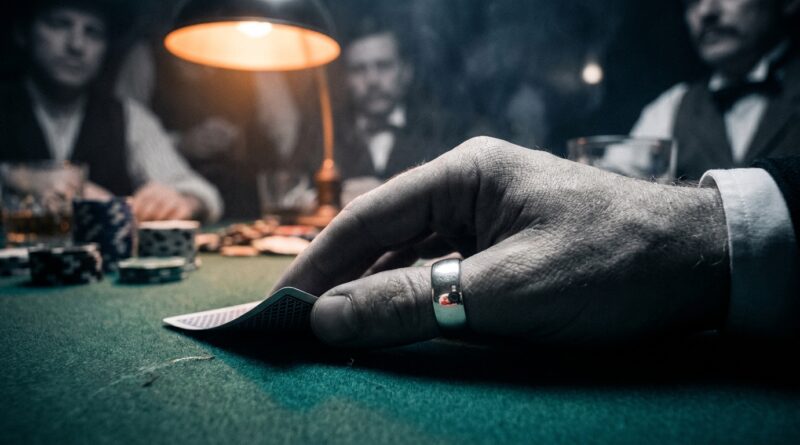
From Honest Hands To Invisible Cheating: Build One ‘Polished Ring Peek’ Using Everyday Jewelry As A Card Scanner
You know the feeling. You want that clean, unfair edge that card cheats and sharp magicians talk about, but the moment a prop looks too clever, the whole game falls apart. A tiny camera ring sounds exciting online. In the real world, it often screams gimmick. A plain polished band, though, gets ignored. That is the sweet spot. If it has been on your hand all night, nobody gives it a second thought, and that makes it far more useful than some bulky gadget from a secret pocket. The polished ring card peek sleight of hand idea is simple. Use a reflective ring as a tiny mirror to catch a flash of index or face information during a natural action. It is not self-working. It takes angle care, body control, and rehearsal. But once it settles into your hands, it can feel modern, invisible, and weirdly believable to an audience already primed to think everyday objects are secretly smart.
⚡ In a Hurry? Key Takeaways
- A polished wedding band or signet-style ring can act as a tiny mirror for a covert card peek when lighting and angles are right.
- Start with ring position, wrist tilt, and eye-line practice before trying to use it in a routine.
- Use this as a performance tool, not for real cheating. The real value is stronger staging, cleaner posture, and better natural misdirection.
Why a Ring Works Better Than a “Magic Gadget”
The best secret tool is often the one that looks painfully normal.
That is why this plot has legs. A polished ring belongs on your hand. It has a reason to be there before the trick starts, during the trick, and after the trick. No awkward introduction. No suspicious ditch. No one wondering why you suddenly put on “that special ring.”
When people watch card work, they usually burn the deck, the dealing hand, and maybe your eyes. They do not usually suspect a soft reflection bouncing off a ring you have worn all evening. That gap in suspicion is what makes the polished ring card peek sleight of hand so attractive.
Also, there is a funny side benefit. Because the method is so stripped down, it forces you to get good at the basics. Hand washing. Timing. Shoulder angle. Chin position. Where you stand relative to the spectator. Those are useful in every trick, not just this one.
What You Are Actually Building
Despite the dramatic title, you are not really “building” a scanner in the electronic sense.
You are building a workflow.
Step 1: Pick the right ring
You want a ring with a smooth, reflective surface. Polished silver, steel, tungsten, white gold, or chrome-like finishes tend to work best. A heavily engraved ring breaks up reflections. Matte finishes are usually poor. Big stones can work, but they add complications and often look flashy in the wrong way.
The easiest starting point is a simple rounded wedding band with a bright polish.
Step 2: Pick the right finger
Most people start with the ring finger of the non-dominant hand if that hand is used to hold or cradle the deck. But there is no law here. The best finger is the one that gives you a believable reflection during a normal action. For some performers, that is the dominant hand during a deal. For others, it is the off hand during a squaring action.
Step 3: Define the peek moment
This is where many people get sloppy. The ring is not the method. The action is the method.
The useful questions are these:
- When does the card information naturally come into view?
- What hand position creates the reflection?
- Where are your eyes supposed to be looking in that exact beat?
- Why is your hand in that position at all?
If you cannot answer those, you do not yet have a method. You just have jewelry.
How the Peek Looks in Practice
A simple version goes like this. You square the deck, slightly bevel or lift the inner edge for a beat, and the polished ring catches a tiny reflection of the index. Your eyes do not dart down like a cartoon thief. They pass through the reflection as part of a larger action, often while talking, gesturing, or turning back to the spectator.
Another version uses a deal frame. As cards are dealt or counted, the ring briefly reflects the lower corner or face of a card during a moment that reads as normal handling. This is one reason card workers get excited about the idea. It sits halfway between sleight and optical principle.
The trick, if you want to call it that, is not “seeing a mirror.” The trick is making your audience believe nothing happened at all.
What Makes This Convincing to Modern Audiences
Right now, people are primed for stories about hidden tech. Smart glasses. AI pins. Secret earbuds. Camera buttons. So if your presentation hints that everyday objects can carry private information, people buy in fast.
That does not mean you need to claim your ring is scanning cards with lasers. In fact, less is usually more. A line about reflective surfaces, observation, or how casino surveillance taught cheats to use whatever was available often lands harder because it feels grounded.
The ring then becomes a believable piece of visual theater. It feels current without needing actual electronics.
The Real Skill Is Eye-Line Management
This is where beginners either make this deceptive or kill it dead.
Don’t “look at the ring”
If your pupils snap to your hand at the important moment, the audience may not know why, but they will feel that something happened. Your gaze has to travel naturally. Think of it like catching a shop-window reflection while still walking forward. A glance through, not a stare at.
Use conversation as cover
Questions help. So do callbacks. “You could have stopped me anywhere, right?” gives you a natural reason to reconnect with the spectator while your hands settle and your eyes pass the needed spot for a fraction of a second.
Keep your chin neutral
A lot of people lower the whole head to force the angle. That reads as sneaky. Better to adjust wrist and forearm position first. Tiny body changes beat obvious head dips every time.
Lighting Matters More Than Most People Expect
This technique lives or dies on reflections. Bright overhead lighting can help, but harsh spotlights can also blow out the reflection. Dim bars may still work if the cards are light enough and your angle is close, but you lose margin for error.
Test in real rooms. Kitchen lights are one thing. Restaurant pendant lights are another. Trade show booths, hotel lobbies, and living rooms all behave differently.
Good rule. If you cannot comfortably read a corner index in the room with your normal eyesight, your ring probably will not magically save you.
Best Ring Styles for This Sleight
Classic wedding band
Probably the strongest all-around choice. Innocent, common, and easy to justify.
Signet ring with polished shoulders
Can work well, especially if the side surfaces throw a stronger reflection. Slightly more character, slightly more risk of drawing attention.
Wide tungsten or steel band
Often very reflective. Good for experimentation. Just be careful that it does not read as “look at my cool ring.”
What to avoid
Black matte finishes, deeply textured rings, oversized novelty jewelry, and anything so shiny and unusual that spectators comment on it before you begin.
Practice Drill That Actually Helps
Forget full routines for the first few sessions. Start with this.
- Wear the ring normally for a day so it feels natural.
- Hold a deck and find one hand position that gives you a clean reflection of a corner index.
- Mark that position mentally. Do not freeze in it. Find the path in and out of it.
- Practice moving through that position while speaking a simple sentence.
- Record yourself from spectator view.
- Check one thing only. Did your eyes or posture betray the moment?
That is how this gets real. Not by admiring the ring. By removing every tell around it.
Common Mistakes
Trying to make the reflection too perfect
You do not need a cinema-screen image. You need a flash. Rank and suit, or enough structure to know what you need to know. Chasing a huge, crisp reflection often creates ugly handling.
Using a ring that is too noticeable
The whole point is that it disappears in plain sight.
Forgetting spectator height
A peek that works for your phone camera may fail with a spectator sitting lower than you, or standing to your side.
Building the whole routine around the gimmick
This is still a card effect, not a jewelry demo. The ring should be an invisible helper, not the star.
Ethics and the Line You Should Not Cross
Let’s be plain about it. This belongs in performance, demonstrations, gambling exposés, and theatrical cheating plots. Not actual cheating.
That matters for two reasons. First, obvious ethics. Second, the skills are genuinely more interesting in a performance setting. You can shape attention, choose conditions, and turn a tiny visual principle into a strong story about perception and control.
Used that way, this becomes a training tool. It teaches restraint. It teaches nerve. It teaches how to hide a moment inside another moment. Those are excellent lessons.
How to Sell the Effect Without Overexplaining
You do not need a speech about nano mirrors and military alloys.
Try lighter framing:
- “Card cheats never use the tools people expect.”
- “If something looks like a prop, it is already a bad secret.”
- “The safest place to hide information is where nobody thinks to look.”
That kind of line gives the audience a hook. It also fits the current cultural mood, where people already suspect ordinary objects can do extraordinary things.
At a Glance: Comparison
| Feature/Aspect | Details | Verdict |
|---|---|---|
| Naturalness | A polished everyday ring blends in far better than a dedicated magic prop or suspicious gadget. | Big win if the ring already suits your style. |
| Difficulty | Needs good angles, relaxed posture, and disciplined eye-lines. Not self-working. | Moderate to advanced in performance feel, simple in concept. |
| Real-world usability | Works best in decent lighting with routines built around natural hand positions. | Very usable for performance, weak for reckless improvisation. |
Conclusion
The polished ring card peek sleight of hand idea is attractive for a reason. It gives you that delicious sense of hidden information without forcing you to carry around something that looks like it came from a spy shop. More important, it trains the parts of your work that audiences really feel, even when they cannot name them. Softer posture. Cleaner timing. Better eye-lines. More honest-looking hands. That is why this matters right now. Low-tech visual cheating methods are all over mainstream feeds, and audiences are ready to believe everyday objects are doing secret work. A simple ring lets you build that modern story in a believable way while quietly sharpening skills that improve every other piece of card handling you do.