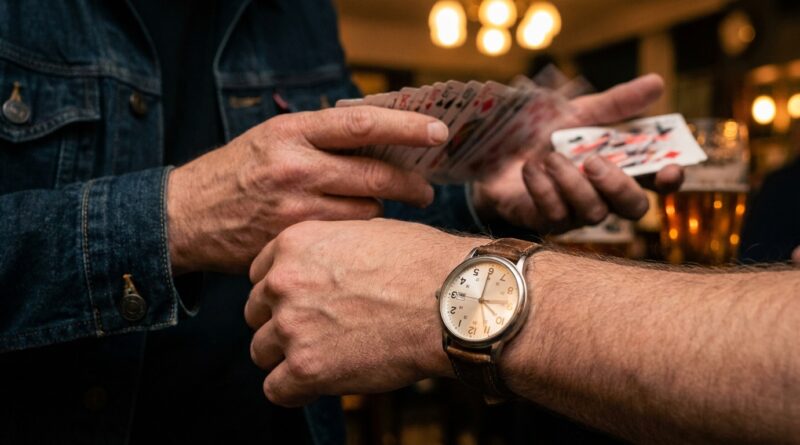
From Live Watches To Looping Time: Build One ‘Time‑Loop Switch’ Sleight That Resets Any Moment In A Spectator’s Hands
You can feel the problem the second you pitch a “time” effect to a modern audience. They love the idea. They are primed for it. They watch shows where timelines fracture, clocks jump, and reality seems to stutter. Then live magic gives them a long speech, a suspicious prop, or a gimmick they cannot touch. The whole thing falls flat. That is why a clean time loop card magic sleight with borrowed watch matters so much right now. If the watch is theirs, the deck looks normal, and the “reset” happens in their hands, you get that rare reaction people usually save for camera tricks. Better still, you do not need to rebuild your act from scratch. What you need is one smart structural switch, hidden inside a simple sequence, that makes one moment seem to happen twice, with a tiny but impossible change.
⚡ In a Hurry? Key Takeaways
- A strong time-loop effect does not need gimmicks. It needs a hidden switch in memory, timing, and card position.
- Use a borrowed watch as the emotional anchor, then let the card sequence create the “same moment again” feeling.
- Keep the handling simple and fair. The less visible skill they notice, the stronger the time-glitch story lands.
Why time magic suddenly feels fresh again
Audiences are not just asking, “How did you do that?” They are asking, “Wait, did that already happen?” That is a different kind of mystery.
A prediction effect answers a puzzle. A time-loop effect messes with memory. It makes people doubt sequence, not just method. That is a lot more powerful.
The good news is you do not need a fancy prop to get there. In fact, props often get in the way. A borrowed watch gives you instant credibility because it starts with something they trust. Their object. Their time. Their wrist.
What a “time-loop switch” really is
Forget the name for a second. A time-loop switch is not just a move. It is a small secret change that lets the audience believe they are revisiting the same moment, when in fact one condition has changed.
That change might be:
- The selected card is no longer where they think it is.
- The identity of a card has shifted.
- The order of actions feels repeated, but the result is different.
- The watch reading becomes the proof that “time reset.”
The trick is that the audience must feel continuity. They should think, “We are doing the exact same thing again.” Your job is to make sure that is not quite true.
The practical build: cards plus a borrowed watch
Phase 1: Lock in a clear first moment
Start with a simple card event. A selection goes into the deck. They remember where. They hold the deck or trap the card between their palms. Keep this plain. No flourishes. No long patter.
Then bring in the watch. Ask to borrow it, or, even better, have them keep it on and simply look at the time. You want a time stamp in their memory. “It’s 8:17. Remember that.”
That does two things. First, it gives the scene a real-world marker. Second, it quietly tells the audience that this effect is about a moment, not just a card.
Phase 2: Repeat the action, secretly alter one condition
This is the heart of the sleight. You repeat the same visible beats. The card goes in. The hands close. The time is named again. But during the replay, one hidden change happens.
That hidden change should be tiny in handling and huge in effect.
For most workers, the smartest version is not a knuckle-busting move. It is a controlled replacement. Use a false insertion, a jog control, or a soft double turnover structure that lets the remembered card identity drift while the audience believes the procedure stayed fixed.
The point is not technical difficulty. The point is narrative honesty. The audience must remember one clean sequence twice.
Phase 3: Let the watch prove the glitch
Now the watch stops being a prop and starts being your receipt.
You can reveal that the hands show the earlier time, that a named minute matters to the final card position, or that the card returns to the condition associated with the first time stamp. If you are using a borrowed analog watch, be careful not to force impossible handling that screams “move.” The watch should confirm the effect, not carry it alone.
For digital watches or phones, use verbal time anchoring instead. “A minute ago you said 8:17. Hold onto that.” That way, the memory of the time becomes the loop trigger.
The sleight philosophy that makes this work
This is why Joshua Jay’s current wave matters. His Particle System thinking pushes magicians to care less about visible finger work and more about impossible structure. That is the real lesson here.
Audience members do not reward difficult moves. They reward impossible experiences.
So if you are building a time loop card magic sleight with borrowed watch, ask these three questions:
- What exact moment do they think is repeating?
- What one condition changes during that replay?
- What object proves the change without looking suspicious?
If you can answer those clearly, you are most of the way there.
A sample routine skeleton you can graft onto your act
Version: “One Minute Ago”
1. A card is selected and apparently lost near the center.
2. Spectator notes the time on their own watch.
3. They hold the deck themselves.
4. You say you want to try the same moment again, but slower.
5. During the repeated insertion sequence, you execute your hidden switch or control.
6. They open their hands. The card is now reversed, on top, or missing, depending on your method.
7. You call back the watch time. “That was the moment before it changed.”
This works because the watch frames the memory, while the cards create the impossible revision.
What to avoid
Do not oversell the plot
Time travel stories get weak fast when the script is longer than the effect. Say less. Let the structure do the work.
Do not ask too much of the borrowed watch
If the watch needs too much touching, adjusting, or suspicious display, people will blame the watch. That kills the illusion.
Do not make the first phase muddy
If the audience cannot remember the original moment clearly, there is nothing to loop back to. The first sequence must be painfully clear.
Why this plays bigger than a normal card ending
A standard ambitious card climax says, “The card beat your expectations.” A time-loop climax says, “Reality cheated.” That hits harder.
It also scales well. Close-up workers can do it with a borrowed watch and a deck. Parlor performers can swap the watch for a visible clock or verbal time marker. Social media performers can still use the same bones without making it feel like a camera edit.
And because the method can be largely non-gimmicked, you are not trapped by one prop or one outfit or one angle.
How to practice it without making it robotic
Practice in layers.
First, drill the secret action until your hands look identical in both the “first pass” and the “loop pass.” If those two moments look different, the whole illusion weakens.
Second, practice the script as memory cues, not patter. Lines like “same spot,” “same time,” and “same hands” help lock in the false continuity.
Third, rehearse spectator management. You want them involved, but not steering. The strongest version happens when they feel in control while you quietly control sequence.
At a Glance: Comparison
| Feature/Aspect | Details | Verdict |
|---|---|---|
| Method style | Mostly non-gimmicked, built on a control, false repeat, or identity switch | Best for real-world workers |
| Use of borrowed watch | Acts as proof and memory anchor, not the whole trick | Stronger and more believable |
| Audience impact | Creates a “did that just happen twice?” feeling instead of a simple reveal | Memorable closer material |
Conclusion
The smart play right now is not chasing bigger props or more complicated gimmicks. It is building one clean, practical time-loop sequence that feels impossible in a spectator’s hands. With Joshua Jay touring and teaching Particle System ideas, card workers are about to think much harder about time, structure, and hidden simplicity. That is a good thing. If you can add a non-gimmicked time-loop sleight to your card and watch work now, you will not be playing catch-up later. You will already have a closer that feels current, strange, and strong, without tearing apart the rest of your set. Start simple. Keep the first moment clear. Hide one change inside a repeated action. Then let their own watch make the memory bend.