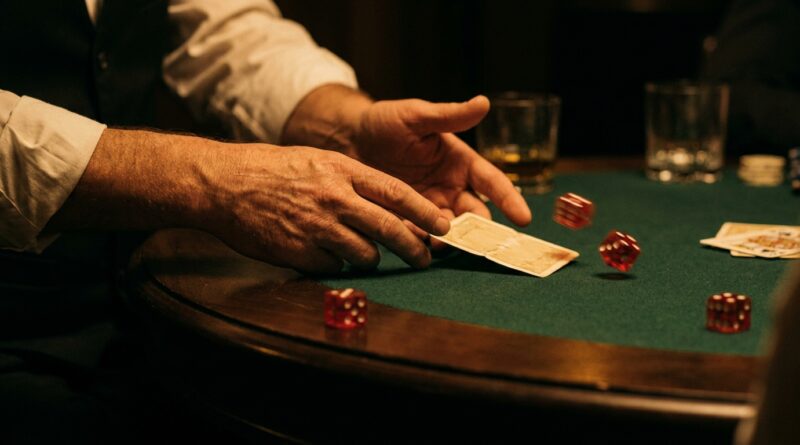
From Viral ‘Lustig For Life’ Reels To Real-World Card Control: How To Build One Under-The-Action Dice‑Stacking Steal You Can Use In Any Game
You have probably seen the reel. Cards get tracked. Dice get handled like they are magnetized. Everything looks clean, impossible, and just a little rude. Then you sit down with a deck and two dice, try to copy the feeling, and suddenly your hands look loud, your timing feels off, and the move only works if nobody is burning your fingers. That is the real problem with a lot of “Lustig For Life” style material. It is thrilling on video, but not always built for a cramped table, bad lighting, chatter, and real people. So let’s strip it down. If you want one practical under-the-action steal inspired by the Lustig for Life Ernest Earick sleight of hand card and dice control craze, start with a side-jogged card, a reason to gather the trick, and a dice-driven beat that lets your hand do one dirty thing while everyone believes they are watching another.
⚡ In a Hurry? Key Takeaways
- Use a simple under-the-action steal built around squaring cards while attention shifts to picking up or setting dice.
- Start with one controlled card and one natural table action. Do not try to stack, switch, and false deal all at once.
- The goal is not to fool slow-motion replay. It is to survive real angles, noise, and heat without looking tense.
Why this move matters right now
The appeal of those viral clips is obvious. They sell control. Not just skill, but dominance. The performer seems to know where everything is, and can move cards and dice around the table without friction.
That feeling is what many magicians are chasing, more than any exact move. The trouble is that a lot of these demos depend on camera framing, repeat takes, or knuckle-heavy handling that gets ugly the second somebody leans in from the side.
If you are performing in bars, at game night, or around a kitchen table, you need a move that hides in normal rhythm. Not a move that announces itself. That is where an under-the-action steal earns its keep.
The core idea: steal while the table thinks you are just tidying up
The best version of this is brutally simple. You are not trying to look fancy. You are trying to make the steal feel like a housekeeping action.
What you are secretly doing
You are pulling one target card, or a small packet, into a known position while everyone reads the moment as:
- squaring the dealt cards
- clearing space for the dice
- picking up the dice
- resetting the packet after a throw
What the audience thinks is happening
You are just being neat. That is the whole game.
The reason this works so well in card-and-dice sequences is that dice naturally create punctuation. People look when they are rolled. They react when they land. They mentally reset while they are picked up. Those beats are gold.
A practical control you can build tonight
Here is the version I would actually recommend to a working magician who wants the flavor of the Lustig for Life Ernest Earick sleight of hand card and dice control aesthetic without needing six months of punishment.
Phase 1: Get the target card outjogged or side-jogged
You need a reason for one card to be imperfectly aligned. That can happen after a peek, a replacement, a brief spread, or a casual deal-and-return sequence.
Do not overcook this. A tiny jog is enough. Big jogs scream method.
Phase 2: Create a real task with the dice
Place or toss two dice near the packet. Ask for a total, predict odd or even, or simply use the dice as a fairness marker. The exact presentation matters less than the fact that the dice belong there.
You want a moment where your hand must naturally move toward the cards and dice together.
Phase 3: Square under the cover of collecting or repositioning
As your dominant hand comes over to square the packet, the thumb contacts the jogged card. The fingers provide cover at the outer edge. During the act of pulling the packet inward or lifting it slightly to make room for the dice, the target card is stolen under or to the rear of the packet into your desired position.
In plain English, the card moves while the packet moves.
Phase 4: Let the dice justify the pause
Once the steal is complete, your hand can continue into a totally innocent action:
- pick up the dice
- slide the dice aside
- tap the packet with the dice
- deal immediately after the roll
This continuation is important. Many magicians freeze after the secret part because they are mentally checking whether they got away with it. That freeze is what gets you caught.
What makes this better than a flashy control
It works in motion.
A lot of sexy controls are designed to look impossible in isolation. This one is designed to disappear inside a sequence. That is a huge difference. In real life, invisibility beats brilliance.
You do not need a bottom deal
Good. Most people do not. If your goal is to control a card for revelation, location, stacking into a small deal, or setting up a later phase, this kind of under-the-action steal does enough work without adding another technical choke point.
You do not need “perfect” fingers
You need timing, relaxed shoulders, and the guts to look ordinary. That is a much more reachable skill set.
How to make it look brutal instead of careful
This is the part many tutorials miss. The move does not just need to be hidden. It needs to look like nothing delicate happened.
Use firmer table actions
Do not pet the cards. Square them like a person who has handled cards before. The action should have a little weight.
Keep the eyes off your hands
If you look at the exact moment of the steal like it matters, everyone else will too. Glance at the dice, the player, or the place where the next action is headed.
Finish the action before the mind catches up
The steal should happen early in the squaring action, not at the end. Then the rest of the motion acts like camouflage.
Common mistakes that make the move feel busted
1. Doing the dirty work in a dead moment
If nothing else is happening, the audience has room to inspect. The dice are there to create a living moment. Use them.
2. Making the packet too small or too precious
Tiny packets can make every finger movement visible. A modest packet often gives you better cover and more natural reason to square.
3. Practicing only from your own angle
Your view is the least useful one. Put your phone low and off to the side. That is where bad news lives.
4. Rushing because you feel guilty
Speed is not safety. Continuity is safety. Move at a pace that matches the table.
A simple rehearsal drill
Here is a real-world way to train it without turning your hands into claws.
The 10-minute bar test drill
- Place one card side-jogged in a packet of 8 to 12 cards.
- Set two dice to the right of the packet.
- Slide the packet left as if making room for the dice.
- During that slide, steal the jogged card under the packet or to top position, depending on your handling.
- Immediately pick up the dice and continue.
Do that slowly for five clean reps. Then do five reps while talking out loud. Then do five while standing. Then do five with background noise on.
If the move only works in silence, it is not ready.
Where Ernest Earick fits into this conversation
When people bring up Ernest Earick, they are often reacting to density. His work has a reputation for being deeply thought through, structurally elegant, and demanding. That is worth respecting. But many performers make the mistake of trying to wear advanced technique before they have built advanced timing.
The smarter path is to steal the lesson, not the exact burden. Earick-level thinking often comes down to economy, layered cover, and action motivated by structure. You can use those ideas in a much simpler move.
That is the sweet spot here. You are not copying a museum piece. You are building a worker.
Best uses for this control
- controlling a selected card during a pseudo-gambling demo
- setting a key card before a dice-based revelation
- bringing a card to the top before a false throw or challenge sequence
- stacking one meaningful card into a short deal, not a full heroic setup
When not to use it
Do not use this if the routine gives no reason for the dice to be present. Props without purpose make people curious in the wrong way.
Also skip it if the table is extremely low and spectators are seated far wider than usual. The move is angle-tolerant, not angle-proof.
A script beat that helps
One of the easiest ways to smooth this out is to speak through the action.
Try something like: “We’ll keep this messy so it feels fair. Actually, move these over. Roll again.”
That patter does two useful things. It justifies the untidy layout, and it gives a reason to touch both packet and dice at the same time.
At a Glance: Comparison
| Feature/Aspect | Details | Verdict |
|---|---|---|
| Difficulty | Needs timing and a relaxed square-up, not advanced dealing technique or extreme grip changes. | Very workable for intermediate card handlers. |
| Real-world deception | Built around normal packet management and natural attention shifts caused by dice handling. | Stronger in bars and game nights than many camera-friendly controls. |
| Flash factor | Looks plain on purpose. The impact comes from the result, not the visible move. | Less sexy on Instagram, more useful in human life. |
Conclusion
You do not need to become a mythical card table demon to get the good part of this style. What people love in those reels is the sense of control, not just the finger gymnastics. By turning that idea into one practical under-the-action steal, you get something you can actually use. That matters right now, because the current wave of Instagram cheating demos looks incredible on camera but often falls apart in noisy, angle-heavy conditions. This kind of reverse-engineering gives working magicians a concrete upgrade they can stress-test at bars and game nights tonight. Not someday. Tonight. And that is usually where the best magic starts.