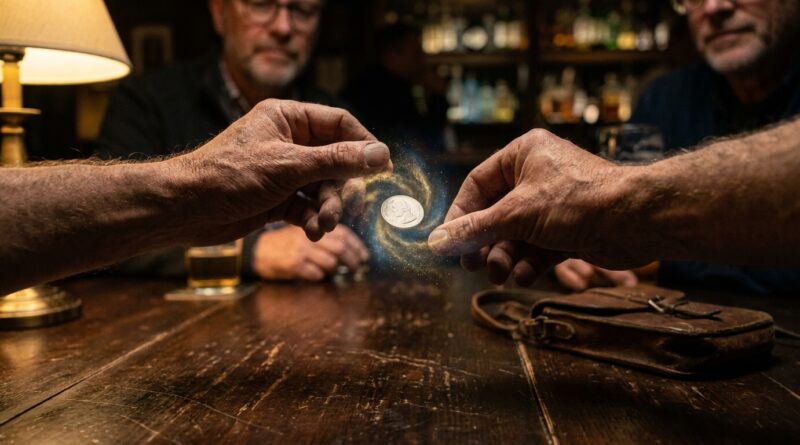
From Viral ‘Slow-Mo Coin Builds’ To Real-World Miracles: How To Create One Atom-By-Atom Coin Appearance You Can Repeat Anywhere
You have probably felt the letdown already. You watch a beautiful reel of a coin appearing one shimmer at a time, pause it, study it, try it in the mirror, and end up with a hand that looks tense, cramped and guilty. Worse, the coin flashes from the side and the whole thing turns from miracle to finger exercise. That frustration is real. Most viral material looks amazing because it is built for one lens, one speed and one perfect take. Real performance is harsher than that. People move. Light changes. Your hands sweat. So instead of chasing another impossible demo, start with one practical goal. Build a single slow motion coin sleight of hand sequence that survives normal viewing, feels comfortable in the hand and can be repeated at a table, in walkaround or while jamming with friends. That is the difference between a clip and a usable piece of magic.
⚡ In a Hurry? Key Takeaways
- Use a relaxed finger palm to edge grip style transition, not a hard thumb palm, to create the cleanest repeatable atom-by-atom coin appearance.
- Practice the production as three beats. Hide, frame, reveal. The illusion comes from rhythm more than raw speed.
- If it only works for your phone camera straight on, it is not finished yet. Test it standing, seated and from both side angles before calling it performance ready.
The big mistake most magicians make
They start with the last frame.
They see the coin fully appear at the fingertips and try to force a secret hold that makes that ending possible. That usually leads to too much thumb pressure, curled fingers and a hand that looks like it is protecting something.
The better way is to work backwards from a natural empty-hand picture.
If the audience remembers an open, soft hand, they will forgive tiny imperfections during the build. If they remember a claw, you are done.
The practical construction plan
Step 1. Pick one coin and stick with it
Do not train this with three different sizes in the same week. Use one coin only for at least a few days. A half dollar or old English penny size tends to read well. Too small and the slow formation looks muddy. Too large and the grip gets stiff.
Your goal is not just concealment. It is a coin that can travel into view in tiny stages without jerking.
Step 2. Start from a relaxed finger palm, not a death grip
For most hands, the best base is a light finger palm or a very soft curled rest near the base of the fingers. Think “resting” the coin, not crushing it. The thumb should look unemployed. If the thumb is doing obvious work, spectators will feel it even if they cannot explain it.
This matters because an atom-by-atom appearance is really a controlled exposure. You are letting the edge of the coin peek into life while the rest stays hidden. A tense hold makes that edge jump out all at once.
Step 3. Use the fingers as shutters
The cleanest version is not the coin moving a mile. It is the fingers moving a little.
Imagine the index and middle finger acting like curtains. As the hand turns slightly inward, the coin rides into a more visible line. Then the fingertips soften open by degrees. The audience reads that as formation.
That is why so many slow motion coin sleight of hand clips look impossible. The real secret is often tiny changes in finger spacing, not some huge hidden steal.
Step 4. Build the reveal in three beats
Do not try to make the whole appearance one continuous mushy action. Break it up.
Beat one: Empty picture. Show a relaxed hand. Palm not flat to the audience, but casually angled. Flat palms invite burning.
Beat two: First glint. A small metallic edge appears near the fingertips or between finger shadows. Pause. Let them register the impossible moment.
Beat three: Completion. The coin slides or blooms into full view as the other hand, eyes or body gives cover through timing, not through frantic motion.
That pause after the first glint is the whole trick. Without it, you are just producing a coin. With it, you are making one appear.
What the hands should actually feel like
This is where many tutorials fail. They show positions, not sensations.
A good atom-by-atom coin appearance should feel:
- Light in the thumb
- Stable at the base of the fingers
- Loose in the wrist
- Slow in the opening, quick only at the final settle
If your forearm is tightening, stop. Reset. Tension travels. The audience may not spot the coin, but they always spot strain.
A simple working sequence you can repeat anywhere
Here is a no-nonsense framework.
Phase A. Casual display
Hand hangs naturally. Fingers are slightly curved. You are not “showing empty.” You are simply existing empty.
Phase B. Attention anchor
Your eyes look at the point where the coin will appear. This pulls their eyes there before anything happens. Good magic often starts with eye line, not finger line.
Phase C. Micro turn
Turn the hand just enough to hide the deepest secret angle and let the near edge of the coin approach visibility. This is a tiny action. Think degrees, not a full twist.
Phase D. Edge emergence
Relax the fingers apart slightly while allowing the coin to creep to the fingertips or side display position. Let the edge catch light. Stop for half a beat.
Phase E. Finish clean
Take the coin openly with the other hand, toss it, tap it on a glass, or immediately go into a vanish. Do not freeze there too long. The ending should say, “Of course it is real.”
Why this works better than the flashy online versions
Because it is built on structure.
Viral clips often depend on perfect framing. Real people do not stand still for your best side. If you want a production that holds up in the wild, the hand must look normal before, during and after the reveal.
That is also why it helps to study angle thinking in general. If you want a bigger picture guide, From Viral ‘Angle-Exposed’ Reels To Real-World Mastery: How To Build One Camera-Proof Sleight You Can Perform From Any Viewpoint is worth your time. The same lesson applies here. A move that survives changing viewpoints beats a miracle that dies the moment someone drifts to your right.
Practice drills that actually improve the move
The silent hand drill
Do the appearance with no patter, no body sway and no fake magic gesture. If it still looks good, the core is solid.
The side-angle mirror drill
Use two mirrors or your phone on a shelf off to one side. Front view lies. Side view tells the truth.
The tension check drill
Every three repetitions, drop your arms and shake out your hands. Then do one more rep at half speed. This keeps you from practicing stiffness into the move.
The interruption drill
Pause halfway through the appearance and return to neutral. If you cannot abort cleanly, the sleight is too fragile for live use.
Common faults and quick fixes
The coin flashes too early
Your hand is too open at the start, or your turn is too large. Close the finger spacing a touch and reduce the angle change.
The coin pops into view instead of forming
You are moving the coin too much and the fingers too little. Reverse that balance.
The hand looks suspicious before the reveal
You are trying to prove emptiness. Stop doing that. Natural beats theatrical emptiness displays almost every time.
You can only do it slowly in practice
That is fine. This move should begin slow. The final settling into full display can be a little quicker. Slow at the start, crisp at the end.
Where to use it in real performance
This is not just an Instagram toy.
Use it as:
- An opening coin appearance before a coins across set
- A one-coin punctuation moment during casual conversation
- A magical “proof” beat before a penetration or vanish
- A soft, visual callback near the end of a routine
The move becomes stronger when it is not the whole meal. It is a beautiful first sentence, not always the full story.
At a Glance: Comparison
| Feature/Aspect | Details | Verdict |
|---|---|---|
| Secret hold | Soft finger palm or relaxed edge position keeps the hand natural and lets the coin emerge in stages. | Best choice for a repeatable real-world appearance. |
| Visual style | Three-beat reveal creates the feeling of formation instead of a fast production. | Looks stronger live and on camera. |
| Angle safety | Needs testing from front and side views, but survives better than one-lens reel handling. | Good for walkaround if you keep the hand relaxed and slightly angled. |
Conclusion
The good news is you do not need a new gimmick every week to keep up with the current wave of coin magic. Right now coin magic is quietly trending again, with new slow-motion appearances and penetrations pushing magicians to ask if pure sleight of hand can compete with hyper-edited reels and heavy gimmicks. It can, if the method is built for humans instead of just for cameras. A single well-structured slow motion coin sleight of hand sequence gives you something practical you can use at walkaround gigs, street sets or informal jams tonight. More importantly, it pushes your thinking in the right direction. Less prop chasing. More attention to structure, hand tension and rhythm. That is the kind of work that lasts, and it is exactly why serious students keep coming back to Magician Book like it is a secret library hiding in plain sight.