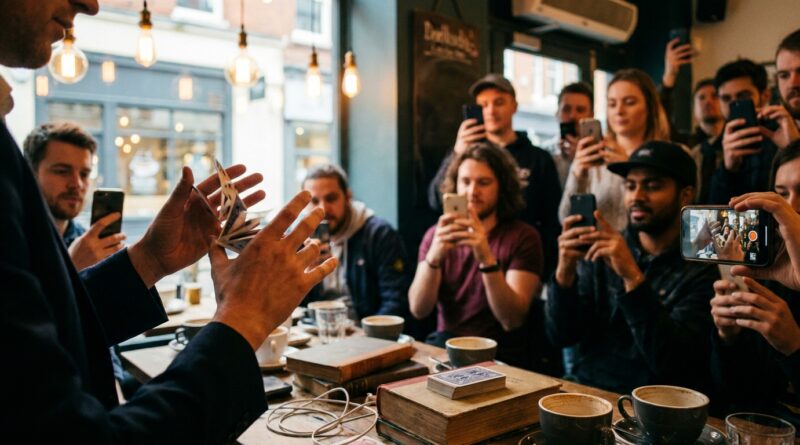
From Viral ‘Angle-Exposed’ Reels To Real-World Mastery: How To Build One Camera-Proof Sleight You Can Perform From Any Viewpoint
You can feel it happening in real time. A spectator shifts half a step to your right, and suddenly the move that looked smooth in your practice mirror starts to feel thin, risky, and a little exposed. That sting is worse now because social feeds are packed with “angle exposed” reels that train people to notice flashes, finger tension, and suspicious hand positions. If your pass, palm, or double lift only survives from one safe front view, that is not bad luck. It is a warning sign. The fix is not learning ten new moves. It is picking one sleight and making it camera proof sleight of hand in the real world. That means testing it from standing, seated, side, and over-the-shoulder views until it stops looking like a move and starts looking like nothing at all. One reliable sleight beats a whole toolbox of fragile ones every single time.
⚡ In a Hurry? Key Takeaways
- Build one sleight that survives real viewing angles before adding more technique to your repertoire.
- Practice with side video, walking spectators, and casual conversation, not just a straight-on mirror.
- A camera-proof sleight is not about fooling slow motion online. It is about staying invisible in normal, messy live conditions.
The New Problem Is Not Exposure. It Is Half-Education
Classic exposure has always existed. What is different now is the format. Short reels do not just reveal methods. They train the audience where to stare.
People may not know how a pass works. But they do know that weird wrist turns, cramped fingers, and “don’t stand there” body language usually mean something fishy is happening. That is enough to weaken a trick.
This is why a camera proof sleight of hand matters. You are not preparing for a hostile magician convention. You are preparing for normal people who have seen just enough online to become better accidental detectives.
Pick One Sleight, Not Your Whole Identity
The biggest mistake is trying to bulletproof everything at once. Don’t. Choose one move that already fits your style and your material.
Good choices for this project
A double lift. A top palm. A false transfer. A control. A simple switch. The best candidate is not the flashiest move. It is the one you actually use in paid gigs, casual performances, or regular sessions.
If your work leans into cards, a double lift is often the right place to start because it shows up everywhere. If you do more close-up with mixed props, a false transfer or palm may give you more value across routines.
What makes a sleight worth “camera-proofing”
It should meet three tests. First, you use it often. Second, it currently feels a little angle-sensitive. Third, if it became invisible, several routines would instantly get stronger.
What “Camera-Proof” Actually Means
It does not mean invisible to a frame-by-frame breakdown from a phone two inches away. That is fantasy. It means the sleight holds up from the views real people create.
Think about the angles you actually face. A person at your left shoulder. Someone seated low at a restaurant. A friend filming casually. A spectator leaning in because they are excited. Those are the viewpoints that count.
The four-angle test
Run your sleight under these conditions:
- Head-on, standing
- Forty-five degrees left and right
- Low seated view
- Over-the-shoulder phone video
If the move only lives in one of those spots, it is not ready yet.
Start With the Ugliest Truth First
Film the move badly on purpose. Side angle. Harsh light. Close range. No patter. No music. No edits.
This part is humbling. Good. You need to see what spectators can see before you can fix it.
Watch for these common problems:
- A sudden change in hand tension
- Fingers curling when they should look relaxed
- An object disappearing before the audience’s attention has moved
- A grip change that screams, “the move is now”
- A body turn that creates suspicion instead of cover
Most sleights are not burned by the secret action itself. They are burned by the weird moment wrapped around it.
Build Natural Cover, Not Desperate Cover
A lot of magicians hide moves by blocking sight lines with a forearm, turning too far, or speeding up. That works only until someone drifts off-center. Then it looks exactly like what it is. Hiding.
Natural cover is different. It comes from actions that make sense even if there were no secret move happening.
Examples of natural cover
- Looking at the spectator as you ask a question
- Squaring a packet because the routine logically requires it
- Relaxing your hands after a magical moment
- Reaching for a pen, box, or coin at a believable time
If you want a good parallel from another corner of technique, the same “under the action” thinking shows up in From Viral ‘Lustig For Life’ Reels To Real-World Card Control: How To Build One Under-The-Action Dice‑Stacking Steal You Can Use In Any Game. The lesson is simple. The secret should ride inside a normal action, not stand next to it waving for attention.
Smooth Is Nice. Timing Is Better
Many hobbyists think a move becomes invisible when the fingers get faster or softer. That helps, sure. But timing usually matters more.
A move done during the wrong beat can be perfect and still look suspicious. A move done during the right beat can be technically average and still pass clean.
Use the “after the fact” moment
One of the strongest times to do a move is just after the audience thinks the important moment already happened. Their mind relaxes. That tiny release is gold.
For example, if a card is shown, named, and everyone reacts, the beat after the laugh or comment often gives you better cover than the obvious “look over here” moment before it.
Practice Like the Room Is Unfair
Mirror work is fine for starting. It is not enough for finishing.
To make a camera proof sleight of hand, you need moving practice. Put your phone on a shelf. Then another on the side if you can. Stand up. Sit down. Talk out loud. Walk two steps. Bring a friend in. Hand them the dirty job of trying to catch you.
A simple stress-test drill
- Do the sleight ten times in silence, focused on mechanics.
- Do it ten times while making eye contact with the camera.
- Do it ten times while saying your real script.
- Do it ten times after lightly jogging in place or moving around, so your hands are not in “practice mode.”
- Do it ten times with the camera at your weak side.
If your technique falls apart the moment you add speech or movement, that is not failure. That is useful data.
Make Peace With Smaller, Cleaner Handling
Sometimes the answer is not more cover. It is less movement.
Big displays often create big angle issues. Tiny grip changes, shorter get-readies, and lower finger travel tend to hold up better from the side. That can mean giving up a flourishy look. Good. Ordinary is your friend.
The strongest sleights rarely look “skillful” in performance. They look forgettable. That is the point.
Use Audience Management Without Looking Like You Are Managing Them
Good audience management is not barking, “Stand over here.” It is shaping the moment so people naturally choose helpful positions.
Easy ways to do that
- Angle your body toward the person you are speaking to
- Offer an object into the space where you want attention to gather
- Take one casual step to reset the viewing line
- Perform on surfaces that keep spectators in front of the action
This matters because no sleight is angle-proof in a magic sense. The goal is camera-proof enough for real life. Smart positioning does part of the work.
Know When to Retire a Move
Here is the uncomfortable truth. Some moves are just wrong for some performers.
If your hands, style, rhythm, or venues constantly fight a certain sleight, it may never become your worker. That is fine. Professionals do not marry methods. They use what survives under pressure.
If your side-view pass always looks tense, maybe your future-proof answer is a better control, not a better excuse.
Build a Personal Checklist for Every Future Sleight
Once you finish one move, save the process. This becomes your filter for the rest of your magic.
Your checklist might include
- Can I do it while talking naturally?
- Does it survive from both sides?
- Can I do it seated and standing?
- Does a casual phone recording look clean?
- Would I trust it for a smart spectator who has seen exposure clips?
That last question is the big one. It keeps you honest.
At a Glance: Comparison
| Feature/Aspect | Details | Verdict |
|---|---|---|
| Practice style | Mirror-only practice looks clean from one safe view but misses side flashes, tension, and timing issues. | Useful for starting, weak for finishing. |
| Angle testing | Phone video from front, side, low, and over-the-shoulder gives a much more honest picture. | Essential if you want real-world reliability. |
| Move selection | One high-use sleight improved deeply will strengthen several routines at once. | Best return on practice time. |
Conclusion
The magic community has a real problem now. Spectators do not show up blank anymore. Many come pre-loaded with TikTok explanations and a rough sense for bad angles, which quietly ruins sleights that used to be good enough. The answer is not panic and it is not chasing every new move online. It is taking one real-world sleight and stress-testing it until it disappears from normal viewpoints, not just the tidy front-on shot from a tutorial. Do that, and you get fewer burned moments, stronger reactions in noisy, imperfect settings, and a repeatable way to future-proof the rest of your material. One honest, camera-proof sleight of hand can do more for your magic than a month of collecting clever methods you do not fully trust.