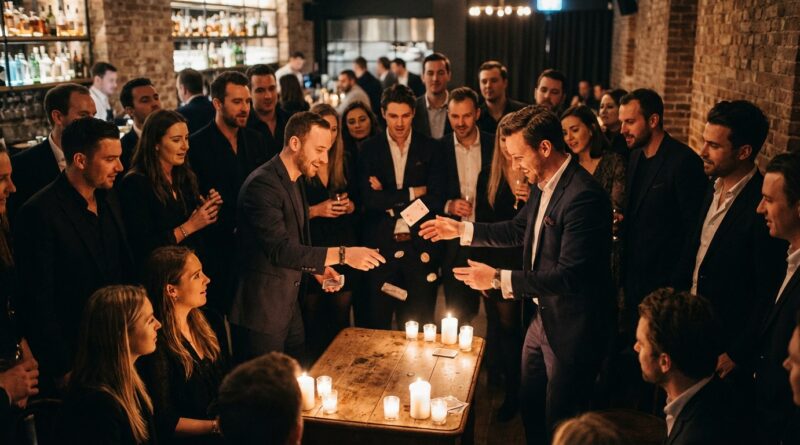
From Close‑Up Crowds To Ticketed Theatre: How To Turn Your Table Sleights Into A 40‑Seat ‘Micro‑Residency’ Show
You know the feeling. At the bar, your set kills. In walk-around, people grab their friends and say, “You have to see this.” But the second you think about selling tickets to a seated show, everything gets foggy. How long should it be? What goes first? What keeps 40 people locked in when they cannot all hold the cards? That gap between “strong close-up magician” and “someone with a real show” is where a lot of good workers get stuck, and it is frustrating because the sleight of hand is often not the problem. The format is. The good news is that the new wave of intimate magic rooms is built for exactly the kind of material you already do well. If you want to learn how to build an intimate close up magic show, start by thinking less like a table-hopper and more like a theatre director. You do not need a huge budget. You need structure, sightlines, pacing, and a reason for each effect to exist.
⚡ In a Hurry? Key Takeaways
- Your close-up show becomes ticket-worthy when it has a clear point of view, not just a pile of strong tricks.
- Build a 45 to 60 minute set from 6 to 8 routines, grouped by texture, stakes, and emotional shape.
- You do not need new knuckle-busting material. In a 40-seat room, clarity, visibility, and pacing matter more than difficulty.
Why intimate close-up rooms feel different
The modern micro-residency is not just “close-up, but with chairs.” That is the first thing to get straight.
What makes these rooms feel fresh is framing. The audience is not catching random bits while ordering drinks. They chose to be there. They sat down. They gave you attention up front. That changes everything.
In a bar set, your job is to interrupt well. In a theatre-style close-up show, your job is to reward attention.
That means your material has to do more than fool. It has to build.
What the audience is really buying
They are buying proximity. They are buying the sense that something impossible happened a few feet away, under conditions that feel personal and clean. They are also buying a point of view.
If your show feels like “here are seven unrelated card tricks and a ring thing,” it may still get applause, but it will not feel like an event.
If it feels like “this performer has a specific way of thinking about memory, chance, cheating, trust, or perception,” now you have a show.
Start with the room, not the tricks
One reason magicians get stuck is that they start by asking, “What is my opener?” Too early. Start with the room you are trying to play.
For a 40-seat room, solve these four problems first
Visibility. Can the back row understand what is happening without squinting?
Rhythm. Can you vary fast pieces, slow pieces, funny moments, and tense moments?
Participation. Are enough people involved that the whole room feels included?
Reset and flow. Can one piece lead into the next without dead time?
This is where many great workers accidentally sabotage themselves. They choose material that destroys at a two-top, but dies when 35 people are watching one pair of hands.
A signed coin vanish may be astonishing from 18 inches away. In a 40-seat room, it may read as “he did something with his fingers.”
You are not lowering standards by adapting. You are building for the format.
How to build an intimate close up magic show from material you already do
Here is the practical path.
Step 1: Make a full inventory
Write down every routine you currently trust in the real world. Not theory. Not “I should work this up someday.” Real workers only.
Now mark each one with these labels:
- Big visual
- Story-driven
- Comedy-friendly
- High audience involvement
- Best for one person
- Best for whole room
- Quiet and intimate
- Strong closer
You will quickly see something useful. You probably do not have a material problem. You have an arrangement problem.
Step 2: Pick one central theme
This does not have to be deep. It just has to be consistent.
Good micro-show themes include:
- How attention fails
- Why gamblers trust patterns
- Objects with personal meaning
- The difference between skill and luck
- What hands can hide
A theme gives your routines a reason to sit next to each other.
For example, if your theme is trust, a signed card to impossible location, a lie detector presentation, a ring-and-string sequence, and a pseudo-psychological prediction suddenly feel related. Not because the props match, but because the idea matches.
Step 3: Build in acts, not in tricks
A solid 45 to 60 minute intimate show usually works well as three blocks.
Block 1. Fast trust-builders. You show skill, warmth, and control.
Block 2. Slower and more impossible. The room settles in. Stakes rise.
Block 3. Personal and memorable. The ending should feel bigger than the method.
This alone fixes a lot of pacing problems.
A sample 50-minute structure that actually works
You do not need 20 tricks. You need enough contrast.
Opening, 8 to 10 minutes
Start with something direct, visual, and easy to read. This is not the time for a procedural prediction with four choices and a math trail.
Think about:
- A visible transposition
- A ring sequence
- A short ambitious card phase with a strong visual ending
- A gambling demo with a clean punch line
This is also a smart place for an organic borrowed-object piece. If you work with rings, a practical routine like the kind discussed in From ‘Physics-Defying’ Ring Reels To Real Workers: How To Build A Practical Ring‑Melt Sleight You Can Use Anywhere can be ideal because it reads as personal, impossible, and easy for the room to follow.
Middle section, 20 to 25 minutes
This is where you earn the ticket price.
Mix one skill piece, one audience-led piece, and one routine with emotional weight.
A useful pattern is:
- One routine that shows technical command
- One routine where the spectator seems to make the magic happen
- One routine with a story, memory, or impossible souvenir
Notice what is happening here. You are changing the source of amazement. First it is your hands. Then it is their choices. Then it is the meaning attached to the effect.
That keeps the show from feeling flat.
Closing section, 10 to 15 minutes
Your closer should feel inevitable, not just loud.
The best closers in small rooms often have one of three qualities:
- A callback to something seen earlier
- A strong impossible object that can be examined or kept
- A shared revelation the whole room understands at once
Do not end on your hardest sleight. End on your strongest memory.
What to cut, even if it fools magicians
If you are serious about learning how to build an intimate close up magic show, here is the painful part. Some of your favorite material does not belong in it.
Cut routines that are too procedural
If the audience has to remember six fairness conditions to appreciate the ending, that is a warning sign.
Cut routines that only play for one pair of eyes
If the magic lives entirely in finger position or angle sensitivity, it may not scale to a seated room.
Cut duplicate effects
Three revelations of selected cards in different methods still feel like three card tricks.
The audience experiences effects, not methods.
Cut “filler” banter
You do not need padding to get to an hour. You need transitions, breathing room, and better choices.
How to make close-up read like theatre
This is where many micro-shows either come alive or feel like a formal gig in a nicer room.
Use callbacks
If a line, object, or idea from minute five returns in minute fifty, the show feels designed.
Give each routine a job
One introduces you. One raises trust. One changes energy. One deepens the theme. One sends them out talking.
If you cannot explain why a routine is in the show beyond “it gets reactions,” keep testing.
Control focus physically
Stand, sit, move, and pause with purpose. In a 40-seat room, tiny staging choices matter.
Raise objects higher than you think. Repeat key information once. Have a close-up pad or surface that contrasts with your props. Light your hands well.
None of this is glamorous. All of it matters.
Ticketed does not mean fancy
A lot of magicians think they need velvet chairs, custom signage, moody jazz, and a cinematic trailer before they can charge.
You do not.
You need a clear promise.
Something like: “An intimate evening of sleight of hand for 32 guests. No stage illusions. No camera tricks. Just impossible things, right in front of you.”
That sells the format.
What people will forgive
- A simple room
- Basic tech
- Minimal set dressing
What they will not forgive
- Not being able to see
- A show that drags
- An ending that fizzles
How to test a micro-residency without betting your month on it
Do not start with a six-week run unless demand already exists.
Run a pilot night
Book a small room. Keep it to one night or a weekend. Cap it at 24 to 40 seats. Sell tickets at a price that feels serious but accessible.
You are not just testing material. You are testing:
- How quickly the room fills
- What copy gets people to buy
- Which routines read best seated
- Where attention drops
- Whether people ask when the next one is
Build the list immediately
This is one of the big advantages of a ticketed intimate show over endless unpaid gigs. Every seat is a chance to build an email list, not just get applause and disappear.
Collect emails at booking. Offer priority access for the next date. Give them a reason to come back, such as a rotating set, a themed month, or a limited-seat series.
Price it like an experience, not a tip jar
If you are moving from restaurant and bar work, pricing can feel awkward.
But a ticketed close-up show is not just “the same tricks with chairs.” It is a designed experience.
Even a modest room can support pricing that reflects that, especially if the seat count is low and the show feels exclusive.
A simple pricing rule
Charge enough that the audience treats it like a plan, not a maybe.
If the ticket is too cheap, people buy casually and skip casually. If it is priced like an event, attendance usually gets more reliable.
What makes these new rooms feel fresh
It is not that the tricks are brand new. Most are not.
What feels new is the mix:
- Close-up skill presented with theatrical pacing
- Small audiences treated like insiders
- Sleight of hand framed as art, not background noise
- Classic methods used in personal, modern ways
That should be encouraging. You do not need to invent a new branch of magic. You need to package your best work in a way that matches how people want to experience it now.
At a Glance: Comparison
| Feature/Aspect | Details | Verdict |
|---|---|---|
| Material choice | Use 6 to 8 routines that are visible, varied, and linked by theme, instead of every strong trick you know. | Less is better. Curate hard. |
| Show structure | Build in three blocks: quick trust-builders, deeper middle material, then a personal or memorable closer. | Best path for a 45 to 60 minute micro-show. |
| Business value | A ticketed room gives you revenue, repeat bookings, email capture, and a stronger local reputation than unpaid grind gigs. | High upside, even at small scale. |
Conclusion
The important shift happening in magic right now is not just new sleights. It is new formats. Intimate, ticketed close-up rooms are giving sleight of hand a better frame, one that feels more like theatre and less like “show us a quick one.” If you have been assuming that space is only for names from New York, Vegas, or San Francisco, or for performers with giant budgets and TV credits, that is simply not true. The jump is more practical than it looks. When you learn how to build an intimate close up magic show, you stop chasing filler and start shaping an experience. You use the handwork you already trust, put it into a smarter structure, and create a 45 to 60 minute show with a point of view. That means real tickets, real audience ownership, a growing email list, and a stronger place in your local scene. You do not need more moves. You need a room, a plan, and the nerve to stop treating your best material like background entertainment.