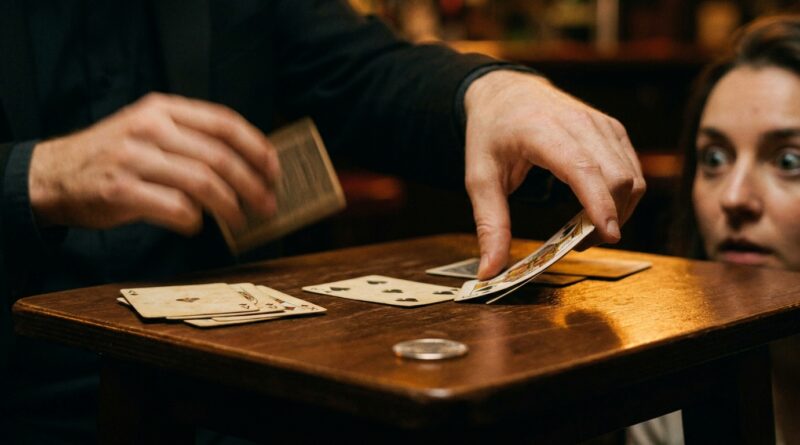
From Optical Illusions To Finger Deceptions: Build One ‘Visual Feint’ That Supercharges Every Sleight You Already Know
You know the feeling. You put in the hours on passes, controls, palms and double lifts, then somebody stares at your hands and says, “Do that again.” They may not know what you did, but they know when you did it. That is the painful part. Your fingers can be fine while your effect still feels suspicious. The fix is often not another knuckle-busting move. It is giving the eye a better story to follow. A good sleight of hand visual misdirection technique makes one action look important while the real action slips in under it. Think of it like an optical illusion for timing. One hand seems to arrive first, one gesture seems to explain the moment, and the watcher’s brain quietly edits the wrong thing into memory. Build that once, and suddenly your old material gets sharper, cleaner, and much harder to burn.
⚡ In a Hurry? Key Takeaways
- The best upgrade for most routines is not a new move. It is one repeatable visual feint that shifts attention and timing.
- Start with a simple “lead hand, dirty hand” pattern. One hand visibly moves first and gives the brain a reason to look there while the other hand does the real work.
- Keep it natural and safe. If the feint looks too dramatic or too fast, it becomes the suspicious part instead of the cover.
The real problem is not your move. It is your picture.
When spectators catch “something,” they usually do not catch the method in detail. They catch a change in rhythm, a hand that suddenly tenses, or a motion that only appears when secret work happens.
That is why many solid sleights still fail under heat. The mechanics may be correct, but the overall image tells on you.
A useful sleight of hand visual misdirection technique fixes the image. It makes the secret action live inside a larger, believable action. The watcher remembers the larger action. The method gets buried.
The one visual feint to build tonight
The Glide-and-Stop feint
Here is the framework. One hand glides visibly and slightly early. The other hand does the secret action during the moment the eye accepts the glide as the main event. Then both hands stop cleanly.
That is it. Simple, but very strong.
The key idea is that people tend to lock onto the first clear motion and treat it as the reason for the moment. Their brain likes clean cause and effect. If your visible hand starts first, even by a fraction, it often becomes the “headline.” The hidden action becomes background noise.
Why this works
The eye is not a camera. It is a prediction machine. It sees motion, guesses what matters, then compresses the rest. If one hand appears to travel with purpose, the brain gives that hand priority. If the secret action happens while the brain is busy sorting that first movement, the timing gets scrambled in memory.
This is why a soft slap, a brush, a take, a point, or a packet squaring action can hide so much. Not because they are flashy, but because they give the eye a neat story to believe.
How to build the feint step by step
Step 1: Pick a move you already do well
Do not start with your hardest sleight. Use something stable. A double lift, top change setup, retention transfer, false transfer, card control, coin shuttle pass, or simple palm transfer is perfect.
Step 2: Decide which hand tells the story
One hand will be the “story hand.” This is the hand the audience should care about. The other is the “work hand.”
Example. In a coin transfer, the receiving hand can become the story hand by gliding in first, opening clearly, and seeming to claim the coin before the actual secret action is processed.
Step 3: Start the story hand a beat earlier
Not a full second earlier. Just a hair. The visible hand should move first by enough to lead the eye, not enough to look staged.
That early start is the engine of the whole feint.
Step 4: Put the secret action in the middle, not at the end
Many magicians make the move right at the final beat, where attention is sharpest. Try placing the secret action during the travel, brush, or settling phase instead.
Think middle, not climax.
Step 5: End with stillness
After the visible glide and hidden action, both hands should arrive at a calm stop. No twitching. No extra adjusting. The stop tells the eye, “The action is over. Nothing else happened.”
A practical example with cards
Using it on a double lift
Let’s say you turn over two cards as one. The weak version is obvious. You get ready, your fingers stiffen, and the turnover itself screams importance.
The stronger version uses the feint.
Your free hand comes in first to point to the top card, or to square the outer edge, or to lightly tap the deck as you make a comment. That hand begins the visual sentence. During that tiny lead-in, the working fingers get their brief. Then the turnover happens as part of the larger action, not as a lonely suspicious event.
To the audience, the moment was “you pointed and showed the card.” Not “you did a move and then showed the card.” Big difference.
Using it on a control
After the selection goes back, many controls look guilty because the deck suddenly becomes precious. Instead, let your other hand come over first to square and slightly angle the deck. The eye reads “casual tidying.” The control happens during that visual cover. Then stop. Relax. Continue.
A practical example with coins
Using it on a false transfer
This is where the Glide-and-Stop feint shines.
The receiving hand does not wait passively. It glides in first with a clear target. It opens, travels, and seems to arrive to take the coin. The retention or false transfer action happens inside that larger picture. Then the receiving hand closes and moves away with confidence while the original hand pauses naturally.
The watcher remembers the travel and the take, not the exact finger moment.
If you like short visual moments that play well on camera, you may also enjoy From Viral Finger Bends To Real-World Miracles: Build One ‘Micro-Sleight’ That Looks Like Camera Tricks In Close-Up. It speaks to the same modern truth. Tiny visual ideas often beat complicated secret mechanics.
What makes a feint look real instead of fake
Give it a reason
Every visible action needs a believable job. You are squaring, pointing, taking, displaying, brushing, or making space. If the motion has no reason, it feels like cover.
Keep the size modest
Bigger is not better. A huge wave of the hand says, “Look at my misdirection.” A small glide says, “This is just how the action works.”
Match your usual rhythm
If your handling is normally easy and conversational, the feint should fit that same rhythm. A sudden burst of speed is a warning sign.
Do not snap the dirty hand away
This is common and deadly. After the secret action, the work hand wants to retreat. Train it to stay normal. Let the story hand carry the moment while the work hand acts innocent because it is innocent now.
Three rehearsal drills that actually help
1. Silent video drill
Record the move with no patter. Watch it back at half speed. Ask one question. Which hand looks important first? If the answer is the wrong hand, fix the lead.
2. Freeze-frame drill
Practice the move and freeze right after the final stop. Does the ending picture look clean and ordinary? If not, your stop is exposing the method.
3. Story-memory drill
Show the move to a friend and ask what they remember seeing, not what they think happened. You want answers like “you took the coin” or “you squared the deck and showed the card.” If they describe finger details, your visual story is too weak.
Where this feint works best
- Double lifts and turnovers
- Card controls during squaring actions
- False transfers and retention vanishes
- Packet switches
- Palm loads hidden by a visible reach or display
- Top changes when a gesture or eye line leads away at the right beat
Where people overdo it
Too much choreography
If every move has a glide, a tap, a brush and a pause, the audience starts seeing the pattern. Use one clean feint, not a whole dance routine.
Too much speed
Fast hands do not equal invisible hands. Often the stronger version is slower at the start, cleaner in the middle, and still at the end.
Using the same feint on every beat
Variety matters. The point is to improve your old toolbox, not replace every natural action with a pet flourish.
Why this matters right now
The clips that spread fastest are often not showing some impossible underground move. They are showing a familiar move wrapped in a sharp visual lie. A finger seems to bend the wrong way. A hand appears to move before the object does. A little slap hides the real transfer. The timing memory gets scrambled, especially on phone screens.
That is why this kind of sleight of hand visual misdirection technique matters so much now. It helps in live performance, where people burn your hands, and on camera, where viewers replay the clip and still cannot pin down the moment.
At a Glance: Comparison
| Feature/Aspect | Details | Verdict |
|---|---|---|
| Learning curve | Uses moves you already know, with a new timing and visual lead instead of brand-new mechanics. | Fastest upgrade for most magicians |
| Best use case | Works especially well on transfers, controls, displays, and any move that can hide inside a larger natural action. | Highly reusable across routines |
| Risk factor | If the feint is too big, too fast, or lacks a reason, it becomes the suspicious moment. | Keep it small and motivated |
Conclusion
You do not need to throw out your current work and start chasing harder secrets. In many cases, your existing sleights are already good enough. What they need is a better visual wrapper. That is the lesson hiding in the clips blowing up across social feeds and forum threads right now. The strongest moments are often simple mechanics paired with brutal visual misdirection. A hand that seems to glide one way while the real work happens elsewhere. A slap that hides the transfer. A tiny camera-friendly feint that scrambles timing in the viewer’s head. The smart move is to build one reusable framework like the Glide-and-Stop feint and start applying it to what you already do. Working magicians get stronger reactions in the real world. Content creators get cleaner, more impossible-looking footage. And you get all of that without relearning your whole toolbox.