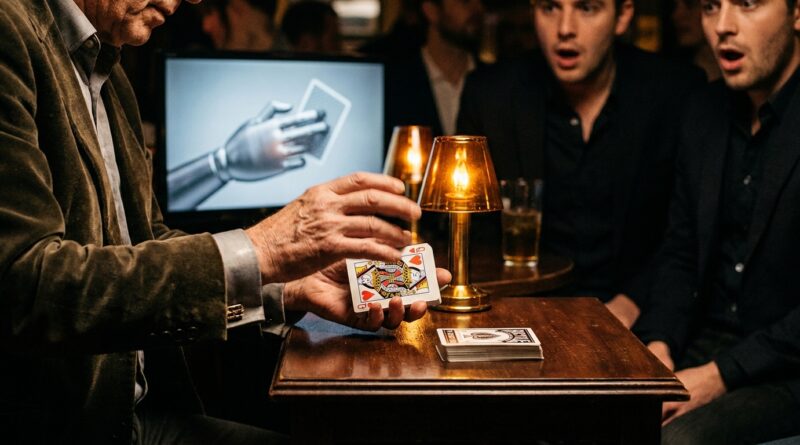
From Real Cards To Robo-Fingers: Build One ‘Machine-Mimic Pass’ Sleight That Makes Your Hands Look More Precise Than AI
If those robot-hand clips are getting under your skin, you are not overreacting. A machine can do a steal ten thousand times, under perfect light, with no nerves and no audience breathing down its neck. Then your perfectly good pass suddenly feels chunky on camera. That stings. The good news is you do not need to beat a robot at being a robot. You just need one move that borrows the look people now associate with machine precision, then lands harder because it is happening live, inches away, in real hands. The answer is a stripped-down, crisp pass built to look deliberate, quiet and oddly mechanical. Think less flourish, more exactness. I call it the Machine-Mimic Pass. It is not about speed for its own sake. It is about removing extra finger motion, tightening the rhythm and framing the moment so spectators think, “That looked too clean to be human,” right before they realize it was.
⚡ In a Hurry? Key Takeaways
- The best answer to the robot hand card magic sleight of hand trend is one ultra-clean pass with fewer visible motions, not more fancy handling.
- Use a “pause, clamp, shift, settle” rhythm and a simple line like, “People keep blaming AI, so watch this live,” to turn the trend into misdirection.
- Practice slowly and protect your hands. Precision comes from relaxed repetition, not squeezing the deck like a vise.
Why this trend feels threatening, and why it is actually useful
Right now, clean equals suspicious. If a vanish or pass looks too perfect online, people assume magnets, edits, robotics or AI. That sounds bad for magicians, but there is a hidden upside.
You now have a fresh hook.
Instead of fighting the comparison, use it. Build one sleight that has that clipped, precise, machine-like look, then perform it live with a line that calls attention to the fact there is no camera trick possible. Done well, that gets you the best reaction of both worlds. First, the “that looked impossible” beat. Then the “wait, that was really your hands” beat.
This is especially strong in walk-around work where people are already half-trained by social media to distrust what they see on a screen.
The move: a “Machine-Mimic Pass” built for clarity
This is not a brand-new secret move from another planet. It is a handling idea. You are taking a classic pass and redesigning its appearance so it reads as exact, compact and almost robotic.
The goal
Make the deck appear to do almost nothing.
Most human passes fail visually because too many things happen at once. Wrists adjust. Fingers crawl. The shoulders tense. The top packet rises, the bottom packet dips and the whole deck seems to have a small panic attack.
The Machine-Mimic Pass cuts all that down.
The visual recipe
Think in four beats.
- Pause.
- Clamp.
- Shift.
- Settle.
That is it. No extra proving. No flourish after the fact. No guilty hands.
How to hold the deck so it looks more precise
Start from a relaxed mechanics grip. Your left hand should look ordinary, not “move incoming.” The right hand comes over in a squarer, flatter posture than many magicians use. That matters.
Robot clips look convincing because the action path is clean. Straight lines. Minimal wobble. Your right hand should mimic that feel by contacting the deck with purpose, not fussing around the edges.
What to change from your usual pass
- Flatten the right fingers a bit more across the top.
- Keep the thumbs quiet. Big thumb action screams method.
- Bring the packets together tightly before the shift, so the deck reads as one block.
- Reduce upward packet travel. Side pressure and cover beat height.
The big idea is simple. Spectators forgive speed. They do not forgive wobble.
The exact rhythm that sells the illusion
This is where many sleights live or die.
Beat 1: Pause
After the card is returned and the break is held, do nothing for half a beat. Not a dramatic freeze. Just enough stillness that your body says, “We are done here.” This kills the feeling that a move is being rushed through.
Beat 2: Clamp
Your right hand comes over and squares the deck with a light, even pressure. The audience should read this as tidying, not covering. If the hand slaps on fast, it looks guilty. If it drifts in lazily, it looks suspicious. Think neat and direct.
Beat 3: Shift
The pass happens in one short internal action. Do not try to win with raw speed. Win with compactness. The packets change places while the deck appears to remain the same size and shape. Your forearms should stay calm. Your shoulders should stay dead quiet.
Beat 4: Settle
This is the secret sauce. Most people finish the pass and then rush away. Instead, let the hands stay in place for a blink. The deck settles. Then the right hand leaves without drama. That stillness reads as confidence and makes the move feel machine-clean.
A line that turns suspicion into theater
You need one sentence that frames the effect before the move happens.
Try this:
“People keep blaming AI for anything too clean, so let’s do this the hard way. Watch my hands live.”
That line does three useful things.
- It names the current trend without sounding defensive.
- It focuses attention exactly where you want it.
- It creates a challenge frame. If they burn your hands and still miss it, the reaction gets stronger.
Do not overplay it. One line is enough.
How to practice it so it looks less human, in the best way
This may sound odd, but stop practicing for smoothness first. Practice for repeatability.
Use a metronome or a silent count
Count “one, two, three, four” with each beat: pause, clamp, shift, settle. If every rep has the same timing, your handling starts to feel eerily exact. That is the robotic quality you want.
Film from ugly angles
Do not only film from your favorite front view. Use chest height, low right side and over-the-shoulder angles. Robot-hand videos get close scrutiny. Your sleight should survive normal human viewing conditions, not just ideal magician angles.
Practice with less grip pressure
Too much tension creates finger flares and packet chatter. Work until you can do the move with just enough pressure to control the deck. Relaxed hands look more skilled than straining hands.
Work in bursts
Ten clean reps beat fifty sloppy ones. If your hands are tired, stop. Precision training is like handwriting. Once fatigue sets in, the quality drops fast.
Common mistakes that ruin the effect
Looking at your own hands
The second you check the deck, you tell the audience there was something to check. Keep your gaze on the spectator or at a neutral point.
Adding a flourish after the pass
If you want machine precision, do not follow it with finger candy. Let the cleanliness stand on its own.
Using it too often
This should be your “that looked impossible” control, not your every-trick hammer. If you repeat a suspiciously perfect action, people start reverse-engineering it.
Trying to beat a robot at speed
You will lose that race, and it does not matter. Live magic wins on impossibility plus presence. Your audience can feel tension, timing and confidence in a way no clip can match.
Where this fits in a real set
The Machine-Mimic Pass is strongest when it turns one fair moment into a sudden impossibility. A selected card returns. You square. You reveal.
It also pairs well with a non-card piece right after, because that breaks the audience’s method track. If they think, “Maybe he is just insanely good with cards,” and then you move into borrowed-object mindreading, the whole set feels broader and harder to explain.
That is why a follow-up like From Borrowed Keys To Street Mindreading: Build One ‘Pocket Pulse Peek’ Sleight That Lets You Reveal Any Thought Without Touching The Deck is such a smart companion. It takes you out of “card guy” territory fast.
Presentation tips that make the move hit harder
Use bright, normal conditions
Do not hide in dim corners. The whole point is to show that clean does not equal fake. Good light helps your case.
Let them burn your hands
If your pass is ready, invite scrutiny. “Watch close” is dangerous with weak technique, but powerful with a tight one.
Keep the deck ordinary
No flashy backs. No suspicious props. A boring deck makes precision look more impossible.
Follow with instant proof
After the pass, reveal immediately if the trick structure allows it. Long pauses give people time to invent methods.
Safety note: protect your hands while chasing precision
There is a real risk here. When people try to look “machine perfect,” they tense up and over-practice. That can lead to sore thumbs, stiff wrists and ugly habits.
Warm up first. Shake out your hands. Do a few easy spreads and overhand shuffles before hard reps. If you feel strain at the base of the thumb or wrist, stop for the day. Better mechanics always beat brute force.
At a Glance: Comparison
| Feature/Aspect | Details | Verdict |
|---|---|---|
| Visual style | Minimal finger travel, squared deck, short internal action, calm finish | Best for creating that “too clean to be human” feeling |
| Difficulty | Moderate. Harder in timing than in raw mechanics | Very learnable if you train rhythm, not just speed |
| Real-world value | Works as both a control and a conversation hook against AI and robot-hand skepticism | Excellent for close-up and walk-around sets today |
Conclusion
You do not need to out-machine a machine. You need to remind people what a real performance can do that a clip cannot. One sharp, compact, robot-inspired pass gives you that opening. It speaks the visual language people are seeing online, but lands harder because it is happening live, under heat, with no edits and no mechanical excuse. That matters right now. Social feeds are packed with flawless robotic handling, and spectators are starting to think anything clean must be camera work or machinery. A pass built around crispness, stillness and a simple “this must be AI” framing line helps you stay ahead of that story. Better yet, it turns the trend into a gift. Instead of feeling threatened by the robot hand card magic sleight of hand craze, you get a new talking point, a stronger moment in performance and a clean way to prove that real hands still hit the hardest.