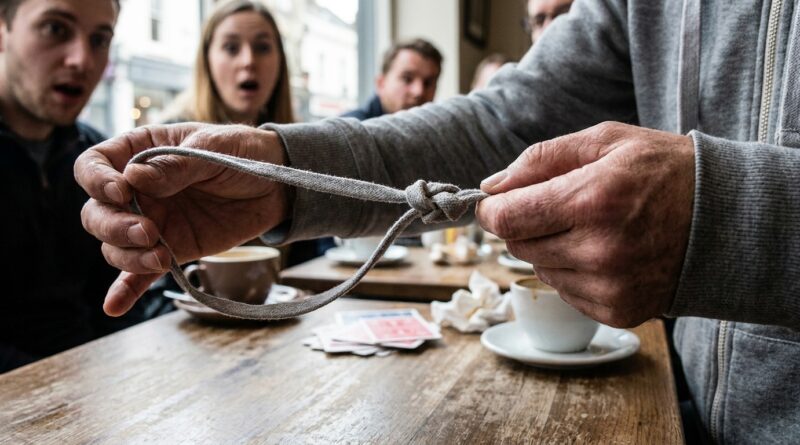
From Simple Knots To Visual Miracles: Build One ‘String Paradox’ Routine That Turns Any Cord Into An Impossible Knot
You know the moment. The cards stay in the pocket, the coins are not there, and someone hands you a hoodie string or a phone cable and says, “Show us something.” That is where a lot of magicians stall out. Not because they lack skill, but because most rope magic feels built for a dealer demo, not a real conversation. Thick ropes, metal rings, long setups. It can feel like the only choices are kiddie knots or stage pieces that do not belong at a coffee shop table.
The good news is you do not need a suitcase of props to build a strong impossible knot sleight of hand with string. You need one clear routine, three phases, and handling that feels as direct as good card magic. If you can control attention, hide a small action, and repeat a beat with a stronger ending, you can turn almost any cord into a visual, personal miracle that people remember because it happened with their object, right in their hands.
⚡ In a Hurry? Key Takeaways
- Build one impossible knot routine around a borrowed cord, a false display, and a clean visual finish.
- Start with a fast knot appearance, follow with a spectator-held phase, then end with an impossible location or instant unlink.
- Use soft, safe cords only. Avoid damaging borrowed items, and never force moves on wired earbuds or expensive cables.
Why this kind of magic hits harder right now
People are reacting to magic that feels close, real, and handmade. A string routine checks every box. It is familiar. It is tactile. It feels impossible in a way cards sometimes do not, because everyone thinks they understand how knots work.
That is the sweet spot. You are not asking them to remember a shuffled order or follow a coin switch. You are taking something ordinary and making it behave in a way their brain rejects on sight.
That is also why a smart knot sequence can become a signature piece. It looks casual, but it lands big.
What a real-world impossible knot routine should do
If you want this to work outside a practice room, your routine needs a few simple traits.
It should use common objects
Think hoodie strings, shoelaces, charging cords with enough slack, or a piece of string you carry rolled in a pocket. If the object already belongs in the room, the trick starts stronger.
It should get visual fast
Do not spend a minute explaining what a knot is. Give them a moment in the first ten seconds. A knot appears. A knot melts off. A loop jumps.
It should build like card magic
Your first phase proves the premise. Your second phase increases fairness. Your third phase gives them the image they talk about later.
It should reset almost instantly
If you cannot do it again for the next group without fussing around, it is not practical enough.
The three-phase routine that works
Here is the easiest structure to use if you want one routine that can live in your set for years.
Phase 1. The instant knot
Start with speed. Hold the string openly, show there is no knot, then create one with a small flick, wrap, or pull-through action hidden by timing and body position. The goal is not to prove total fairness yet. The goal is to establish that knots can appear at your command.
This phase should be short. Six to ten seconds is plenty.
Phase 2. The moving or jumping knot
Now slow down a little. Let them see a real knot, then apparently slide it, shift it, or cause it to appear in a different place. This is where your handling starts to feel like sleight of hand rather than puzzle magic.
One strong idea is to tie a visible knot near one end, pause, then reveal it has traveled to the center. Another is to show two loose ends, have a spectator pinch the middle, and still produce a knot where it should not be possible.
Phase 3. The impossible ending
This is the reputation-maker. The knot appears while they are holding both ends. Or it visibly falls off the string and leaves everything clean. Or a borrowed ring ends up trapped on a knot that was not there a second earlier.
Pick one ending. Do not cram in three. The memory should be simple.
The secret is not the move. It is the frame
Many magicians already know a knot move or two. What they do not have is a routine frame that makes those moves feel modern.
That means thinking less like a rope act and more like a close-up worker.
- Give each phase a reason to exist.
- Repeat the effect, but under stricter conditions.
- Change rhythm. Fast first beat, slower middle, impossible ending.
- Let the object matter. Borrowed is best.
If you want to push that idea further, From Math Paper To Miracle: How To Turn A ‘Knot Trick’ Into Your Next Signature String Routine is a useful companion read because it focuses on turning a neat knot idea into an actual performance piece people remember.
Best cords to use, and what to avoid
Not every string is your friend.
Good choices
Soft cotton cord, hoodie strings, parlor cord, clean shoelaces, and medium-thickness string all read well and handle nicely. They bend easily, keep shape long enough for displays, and do not fight your fingers.
Risky choices
Thin wired earbuds, stiff charging cables, and expensive jewelry cords can make even good sleight of hand look clumsy. They also carry a real risk of damage.
Simple rule
If borrowing the object makes you nervous, do not borrow that object. Switch to your own spare cord and keep the mood friendly.
How to make it personal instead of old-fashioned
This is where many knot routines either come alive or die.
Do not present it like a lecture on sailors or scouts unless that fits your character. A better path is to tie the routine to something human.
- Connections that should not happen.
- Problems that tighten when you pull.
- Family stories, culture, luck, memory, promises.
- The idea that some things “work themselves out.”
That little layer changes the feel. Now the trick is not just, “Look, a knot.” It becomes a visual story with a point.
Misdirection that feels natural
For impossible knot sleight of hand with string, the best misdirection is rarely a big joke or a dramatic gesture. It is smaller than that.
Use the spectator’s hands
The moment they hold one end, pinch the middle, or check a knot, the heat comes off you and onto the condition.
Talk after the secret action, not before
Beginners often chatter while doing the move. Better to do the move in a quiet, motivated moment, then speak on the reveal.
Keep the string moving when it should move
Awkward stillness is suspicious. Natural motion is cover.
Practice plan that does not waste your time
You do not need fifty knot moves. You need one set that looks smooth.
Week 1. Learn the displays
Practice showing no knot, showing one knot, and showing the string clean. Clean displays matter more than the secret move.
Week 2. Drill one creation and one vanish
Get those reliable before adding anything else. Film from chest height. If it fools your camera at that angle, you are getting close.
Week 3. Add spectator management
Rehearse your lines and hand positions. Where do they hold? When do you ask? What do you say if they grab early?
Week 4. Run the full script
Now perform the whole routine without stopping. No fixing midstream. That is how weak moments show up.
Common mistakes that make string magic look cheap
- Using a cord too short to read clearly.
- Repeating the same knot appearance three times with no escalation.
- Explaining too much before anything happens.
- Rushing the reveal and not letting the image land.
- Choosing a move that is angle-heavy for walk-around conditions.
If you avoid those five problems, your routine instantly feels more polished.
Where this fits in a working set
This kind of routine is more flexible than people think.
Street and casual performance
Great opener. It is quick, visual, and object-driven.
Table hopping
Perfect as a texture change after cards. It resets the room because nobody expects a cord to become the star.
Parlor
Use a thicker cord and bigger gestures. The phases still work. You just scale the visuals.
At a Glance: Comparison
| Feature/Aspect | Details | Verdict |
|---|---|---|
| Prop practicality | Uses borrowed strings or one pocket-sized spare cord, with almost no setup. | Excellent for real-world performance. |
| Audience impact | Highly visual, easy to follow, and stronger because spectators think they understand knots. | Often hits harder than another card sequence. |
| Skill requirement | Moderate. More about timing, displays, and structure than knuckle-busting finger work. | Very learnable for close-up magicians. |
Conclusion
If you have been stuck between kiddie rope tricks and big formal rope acts, this is the lane worth taking. One smart impossible knot sleight of hand with string can give you a piece that feels modern, personal, and useful almost anywhere. Social feeds and even local news clips keep showing the same pattern. Audiences light up for magic that feels tactile and human, especially when a simple object turns into a visual impossibility. That gives you a chance to stand out without copying another card set. A good string routine is organic, relatable, easy to theme around your own story or culture, and flexible enough for busking, walk-around, or parlor. Best of all, it uses skills many magicians already have. Attention control, clean displays, and timing. Put those into one structured knot routine, and you may end up with the piece people ask to see again by name.