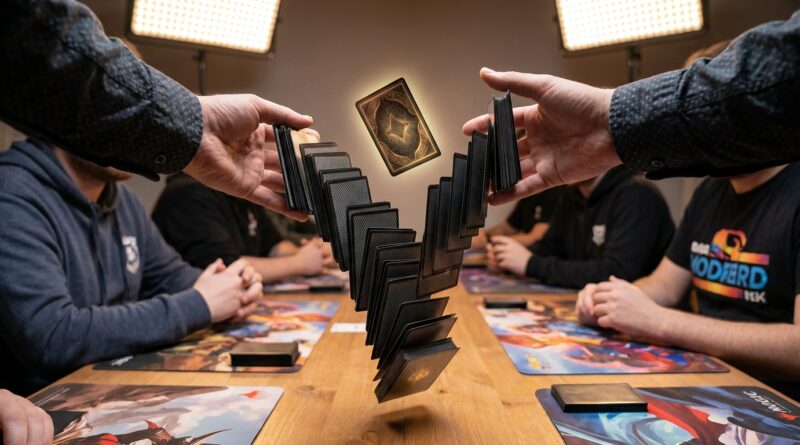
From Sleeved Decks To Table Miracles: Build One ‘Card‑Sleeve Cascade’ Sleight That Makes Any TCG Look Like CGI
If you have ever tried a fancy flourish with sleeved trading cards, you already know the pain. The deck sticks when you want it to flow, sprays when you want control, and somehow finds the floor the second someone starts filming. That is why so many “looks like CGI” clips feel annoying as much as inspiring. They make sleeved decks look effortless, while most real-world handling feels like wrestling a stack of tiny laminated bricks. The good news is you do not need a full cardistry reboot. You need one dependable move that is built for sleeves, not borrowed from poker cards. I call it the card-sleeve cascade. It is part display, part false action, part visual convincer. Done right, it gives you a smooth waterfall look with enough structure to hide a control, a stock, or a vanish setup. More important, it works under overhead lights, at a table, and in front of people who are close enough to burn your hands.
⚡ In a Hurry? Key Takeaways
- The best sleight of hand with sleeved trading cards starts with pressure control, not speed. A good sleeve cascade uses the sleeves’ extra glide on purpose.
- Start with a 20 to 30 card packet, softer grip, and a slight downward angle. Learn the release before you try to hide controls inside it.
- Use clean, tournament-safe handling. You want a visual miracle, not bent corners, marked sleeves, or a judge call.
Why sleeved decks break normal card handling
Standard card magic advice often falls apart the moment sleeves enter the picture. Sleeves add thickness, make the edges slicker, and change how pressure moves through the packet. A Faro that felt easy with bare cards can become a crunchy mess. A dribble can clump. Even a simple spread can flash because the stack sits taller in the hands.
That is the first mindset shift. Stop treating sleeves like a handicap. Treat them like a different material. If you do that, the card-sleeve cascade becomes much easier to learn because you are finally working with the deck instead of fighting it.
What the card-sleeve cascade actually is
The move is a controlled mini-waterfall from one hand to the other, using a beveled packet of sleeved cards. To an audience, it reads as a smooth, flashy release. To you, it is a utility action. You can use it to:
- Show a deck as loose and mixed.
- Cover a top-stock retention.
- Mask a break adjustment.
- Create a beat before a reveal or vanish.
- Turn a TCG shuffle moment into something that feels impossible on camera.
The secret is not a hidden gimmick. It is the combination of bevel, thumb pressure, finger drag, and packet size.
How to build the move from scratch
Step 1: Start smaller than your ego wants to
Do not begin with a full 60-card Commander brick or a double-sleeved tournament deck. Start with 20 to 30 sleeved cards. That gives you enough weight for the visual effect without forcing your hands into a death grip.
If you can make a small packet look smooth, you can scale up later. If you start too big, you will learn bad tension habits.
Step 2: Set the grip
Hold the packet in your dominant hand from above, long edges parallel to the floor. Thumb on one long edge. Middle and ring finger on the opposite long edge. Index curled lightly at the outer short edge. Pinky relaxed, helping only if the stack feels unstable.
Your receiving hand sits underneath, palm up, ready to catch the falling cards. Keep it close. This is a cascade, not a card explosion.
Step 3: Create the bevel
Push the top of the packet slightly forward with the thumb while the fingers pull back very slightly. You are making a gentle diagonal tension through the sleeved stack. Not a dramatic bend. Just enough so the cards want to release one by one instead of in ugly chunks.
This is where sleeves help. Their slick surfaces want to separate. Your job is to stop them from separating all at once.
Step 4: Use controlled release, not force
Begin releasing pressure with the thumb first, then let the fingers follow. Think of it as opening a valve. If you squeeze harder, the cards will jam and dump. If you relax too much, they will slip as a slab. The sweet spot is a soft, even release that lets gravity and sleeve glide do most of the work.
The receiving hand should move just enough to stay under the falling line. Let the packet build into the hand naturally. Do not snatch at cards mid-drop.
Step 5: Add the “miracle” look
Once the release is stable, angle the dominant hand slightly downward and a touch outward toward the viewer. This makes the cascade read bigger on camera and cleaner across a table. Overhead lighting will catch the sleeve edges and make the stream of cards look almost digital.
That is the point where people start saying, “Wait, do that again.”
The three mistakes almost everyone makes
1. Gripping like the deck owes you money
Tension kills this move. Sleeved cards need guidance, not punishment. If your forearm is tight, the cascade will look jerky.
2. Using bad sleeves for visual work
Old, dusty, split, or mixed-brand sleeves are chaos in plastic form. If the corners catch, the move dies. Matte backs can still work well, but the condition needs to be decent and consistent across the packet.
3. Practising only front-on
What looks magical from your phone camera may flash badly to the person sitting at your right. Test the move from both side angles and under bright top light. If it survives that, you have something usable.
How to turn the cascade into actual sleight of hand
This is where the move becomes more than pretty shuffling. The best sleight of hand with sleeved trading cards hides method inside moments that seem too casual to matter. The cascade is perfect for that.
Use it as a false fairness display
Retain a top stock or key card, then cascade only the lower portion into the other hand. To spectators, the deck appears loose and freely handled. To you, the working cards never moved.
Use it to cover a break transfer
As the packet settles into the receiving hand, the thumb can quietly pick up or relax a break. The visual action gives you natural cover because attention is on the falling stream, not on the tiny shift at the edges.
Use it before a vanish or transposition
A sleeve cascade creates a strong memory. People remember that the deck looked open, fluid, and impossible to control. That memory helps sell what comes next. If a selected card vanishes after that display, the audience feels they just saw order dissolve into magic.
Best conditions for practice
Use the exact sleeves you plan to perform with. That sounds obvious, but many people practise with one brand and perform with another. Big mistake. Sleeve thickness, finish, and corner cut all change the release.
Also, practise seated and standing. A move that looks great at chest height can fall apart when done over a playmat. TCG environments are not magic bars. You may be across from a player, beside a judge, or packed into a noisy event hall. Build the move where it will live.
Angle testing that actually matters
If you want this to fool both camera viewers and live spectators, test it in three ways:
- Phone camera at table height.
- Standing spectator at your right shoulder.
- Overhead room light or shop light.
If the packet separation stays smooth and your hidden stock or break stays invisible, you are ready. If not, reduce the packet size and fix the pressure before trying to go bigger.
What kind of sleeves work best
Fresh sleeves with even edges are easiest. Slightly broken-in sleeves often look best because they glide without being wildly slippery. Double-sleeved decks are harder, but not impossible. You just need a smaller cascade and more patience.
If the deck is a spectator’s and feels like a brick, do not force the full visual version. Use a shorter, tighter cascade. A modest success beats a dramatic fumble every single time.
Why this fools people better than a normal flourish
Most spectators think of flourishes as decoration. The card-sleeve cascade feels different because sleeved decks are supposed to be awkward. When you make one behave like liquid, it lands as something beyond “fancy handling.” It looks wrong in the best way.
That is why these clips spread so fast on social feeds. People are not just impressed. They are confused. And confusion is a very useful place for a magician to start.
At a Glance: Comparison
| Feature/Aspect | Details | Verdict |
|---|---|---|
| Learning curve | Easier than many packet cuts, harder than a basic dribble. Most of the work is in pressure control. | Very learnable for regular TCG players and close-up magicians. |
| Real-world usefulness | Can function as display, cover, rhythm break, and visual convincer with sleeved decks. | Much more useful than a flourish that only looks pretty. |
| Performance safety | Safe if done with moderate packet size and healthy sleeves. Risk rises with overfilled, damaged, or double-sleeved decks. | Good for live and camera work if you respect the deck conditions. |
Conclusion
Magic audiences are being re-trained by viral trading-card clips that look impossibly smooth, and many magicians are quietly losing ground because their sleight of hand collapses the moment a spectator hands over a sleeved deck. That is exactly why this move matters. A good card-sleeve cascade is not just eye candy. It is a repeatable, angle-tested tool that lets close-up workers, TCG judges, and casual card slingers turn a trend into something practical. Learn it slowly. Keep the packet small at first. Let control beat speed. Once it is in your hands, you will have a piece of sleight of hand with sleeved trading cards that plays on camera, survives overhead lighting, and still fools the guy across the table. That is how real card handling stays one step ahead of the feed.