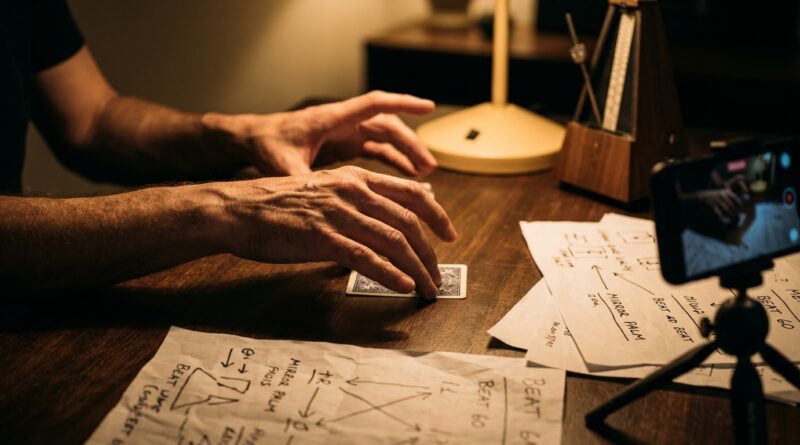
From Smoothest Palms To One-Hand Mastery: Build One Ambidextrous Sleight That Doubles Your Power Overnight
You can feel this problem the second your favorite grip gets blocked. A spectator stands on the wrong side. The camera wants the other angle. The table edge forces an awkward pickup. Or your dominant hand is simply tired, cramped, or busy holding something else. Suddenly a move that felt “automatic” turns into a small panic. That frustration is real, and a lot of magicians are quietly admitting the same thing right now. They are not short on sleights. They are short on options. That is why ambidextrous sleight of hand training matters more than the next download or clever gimmick. If one hand can do the work and the other hand cannot, you do not really own the move yet. The good news is this is fixable. You do not need to rebuild your whole technique library. You need one practical system that teaches your weaker hand to become useful, then reliable, then natural.
⚡ In a Hurry? Key Takeaways
- Ambidextrous sleight of hand training starts best with one core move, not your whole arsenal. Pick a palm, switch, or control you already trust.
- Train the weak hand in tiny reps. Five to ten clean minutes a day beats an hour of messy frustration once a week.
- Do not chase speed early. Bad reps lock in tension, flashes, and strain. Smooth and safe wins first.
Why this suddenly matters so much
For years, a lot of card workers got away with being one-handed in practice, even if they never said it out loud. If your right hand could palm, cull, side steal, or top palm well enough, you built routines around that. You learned your blocking. You stood in the right spot. You controlled the room.
Then real-world friction showed up.
Phone cameras changed framing. Social clips made performers work tighter. Walkaround gigs got more crowded. Tables got smaller. Spectators stood closer. And many magicians found out that their “best” move only worked when the universe behaved nicely.
That is the hidden cost of a one-sided technique base. Your sleight is not just a move. It is a move plus ideal conditions. Once those conditions disappear, the move feels weaker than you thought.
The smart goal is not perfect symmetry
Here is the part that helps people relax. You do not need both hands to look identical. You are not trying to become a mirror image machine.
You want functional ambidexterity.
That means your non-dominant hand can do enough of the job, often enough, under enough conditions, that you stop getting trapped. Maybe your left-hand top palm will never feel as invisible as your right-hand one. Fine. If it can save a routine when the camera shifts left, that is value. Real value.
Start with one ambidextrous sleight that pays you back fast
If you try to train ten weak-hand moves at once, you will quit. The better plan is to choose one sleight that already sits near the center of your work.
What to choose
Pick a move that checks at least two of these boxes:
- You already use it often.
- It appears in more than one routine.
- It solves angle or camera problems when switched hands.
- It can cover for injury, fatigue, or object handling in the other hand.
- It leads into other technique you already know.
For many card workers, strong choices include:
- Top palm
- Bottom palm
- Classic palm with a coin
- Double lift setup and get-ready
- Side steal
- Simple false transfer
- One-handed top card control
If your topic is “from smoothest palms to one-hand mastery,” palm work is the obvious place to start. A good palm in the weak hand changes everything. It gives you better ditching paths, cleaner body turns, and more freedom in how you pick up, gesture, or receive objects.
The overnight part is not magic. It is reframing.
You probably will not build a concert-level weak hand by tomorrow. But you can double your usable options overnight if you stop asking, “Can my bad hand do this perfectly?” and start asking, “Can my other hand get me through this moment?”
That shift matters.
If your left hand can hold a passable palm while your right hand points, reaches, or picks up a glass, your routine opens up instantly. If your non-dominant hand can execute a basic control from one angle, one camera setup, or one spectator position, your toolkit is already bigger by tomorrow’s gig or filming session.
The 4-step system for ambidextrous sleight of hand training
1. Copy the shape before the timing
Most people fail here because they train speed too early. Your weak hand first needs the map. Study the finger positions, pressure points, deck tilt, and wrist shape. Freeze the move into still frames.
If you are learning a palm, break it into pieces:
- Starting grip
- Contact point
- Load action
- Retention or cover shape
- Relaxed display position after the move
Practice those positions without caring if the motion looks magical yet. Your weaker hand is learning where to live.
2. Build “ugly smoothness”
This is the middle stage no one enjoys. The move is clunky, but it no longer feels impossible. Good. Stay there a while.
Do sets of five slow reps. Stop if tension spikes. Reset. The point is not clean deception yet. The point is a smooth enough motion that the hand stops arguing with itself.
3. Add a job for the other hand
A sleight becomes useful when it happens during life. Your strong hand reaches for the card box. Picks up a drink. Gestures. Turns over a packet. Adjusts a close-up pad.
This is where weak-hand training starts paying rent. A palm held in stillness is one thing. A palm held while the other hand does normal business is where confidence grows fast.
4. Train exits, not just entries
Most magicians practice getting into a move. Far fewer practice living with it and getting out of it. Yet in real performance, that is where panic happens.
If you weak-hand palm a card, can you:
- Square the deck naturally?
- Turn your body without flashing?
- Transfer the object if needed?
- Ditch cleanly?
- Produce from that hand without looking guilty?
That last stage is what turns a practice trick into usable technique.
A simple 14-day training plan
Days 1 to 3. Learn the positions
Work for 5 to 10 minutes. No speed. No performance face. Just positions and pressure.
- 10 static holds
- 10 slow entries
- 10 resets
Days 4 to 6. Make the action smaller
Now reduce excess motion. Watch your shoulders and wrist. Weak hands love to over-help with the whole arm.
- 5 reps from the front
- 5 reps in a mirror
- 5 reps on camera
Days 7 to 10. Add misdirection jobs
Use the strong hand to do something normal while the weak hand holds the move.
- Pick up the card box
- Point at a spectator
- Turn your body
- Reach for a marker
Days 11 to 14. Put it inside a routine beat
Do not train the move naked forever. Put it between lines of script, eye contact, and a natural reason to pause. This is where the move starts to belong to you.
The biggest mistakes people make
Practicing while tense
If the weak hand feels like a claw, stop. Tension teaches tension. Shake out the hand. Short reps. Fresh start.
Trying to match the dominant hand too soon
Your strong hand may have years of hidden mileage. The weak hand is not late. It is just new.
Only practicing the secret action
The audience sees the before and after more than the move itself. Practice how the hand looks when it is supposedly doing nothing.
Ignoring pain
Discomfort from unfamiliar work is one thing. Sharp pain, numbness, or strain is another. Stop and adjust. A future-proof technique plan should also protect your hands.
How to know the training is working
You do not need perfection to measure progress. Look for these signs:
- Your weak hand stops looking “busy.”
- You can talk while doing the move.
- You stop staring at the hand.
- You can recover after a slightly bad rep.
- You start seeing new staging options in old routines.
That last one is the real prize. Ambidextrous sleight of hand training is not just hand training. It is route training. It gives your routines alternate roads.
Where this helps immediately in the real world
Camera work
If you film tutorials, demos, or performance clips, one-handed dependence shows up fast. A move that only hides from your favorite side can make filming a chore. A workable opposite-hand version gives you cleaner framing options.
Tough venues
Restaurants, bars, trade shows, and loud events are messy. The floor plan rarely cares about your preferred grip. Ambidexterity gives you backup.
Table layout problems
Sometimes your servante, case, close-up pad, or spectator sits on the “wrong” side. A mirrored handling can save dead time and awkward body turns.
Hand fatigue or minor injury
This is the part many magicians ignore until they need it. If one hand gets irritated, stiff, or overworked, even partial skill in the other hand can keep you functional.
One practical example with palm work
Let us say your best move is a right-hand top palm. Great. Now build a left-hand version with one modest goal. You do not need it to anchor your whole act. You need it to solve one situation.
For example:
- Palm in the left hand while the right hand gestures to a selected card location.
- Hold the palm in the left while the right hand opens the card box.
- Use the left-hand palm when the main spectator is burning your usual right-side angle.
That is enough. You have created a second doorway into material you already know. No new trick purchase needed.
At a Glance: Comparison
| Feature/Aspect | Details | Verdict |
|---|---|---|
| Best starting point | One high-use sleight, such as a palm, control, or false transfer you already know well in the dominant hand | Best value for fast progress |
| Practice method | Short daily sessions, slow reps, camera checks, and routine-based use instead of marathon drilling | More effective and easier on the hands |
| Main payoff | Better angles, cleaner filming, more venue flexibility, and backup when one hand is blocked or tired | Quietly doubles the usefulness of existing sleights |
Conclusion
The recent chatter among working magicians is telling. People are circling back to fundamentals because they are running into hard limits with one-hand-only practice. That anxiety is justified, but it is also useful. It points to the fix. Ambidextrous sleight of hand training is not flashy, yet it may be the most practical upgrade you can make right now. It helps with angle restrictions, awkward table setups, camera framing, and the very human fact that hands get tired, busy, and occasionally hurt. Better still, it does not ask you to throw out what you already know. It asks you to get more from it. Start with one sleight. Train the weak hand until it is calm, then useful, then trustworthy. Do that, and every move you already paid for starts pulling double duty. That is not hype. That is real working value.