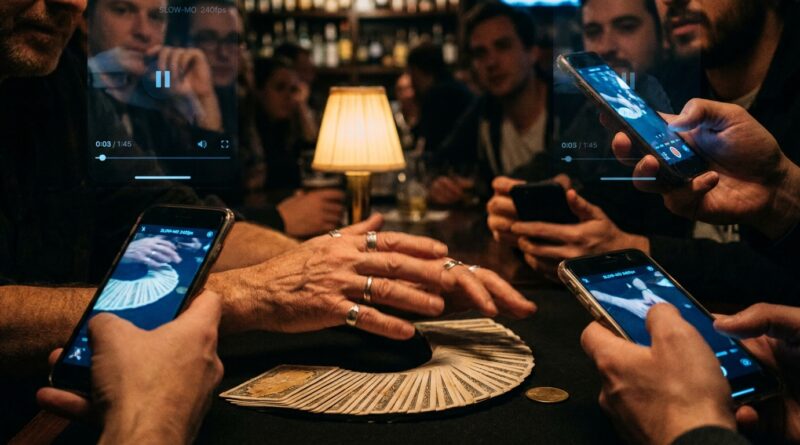
From Viral ‘Revealed Tricks’ Outrage To Real-World Power: Build One Anti‑Exposure Sleight That Survives Slow‑Mo And Frame‑By‑Frame Scrutiny
If you are a working magician right now, the mood is rough. You put years into making a move invisible, then somebody posts a smug “revealed” clip and suddenly spectators arrive pre-loaded with bad guesses and fake confidence. Worse, they can pause, zoom, and scrub your best moment frame by frame. That gets into your head fast. The good news is you do not need a whole new act to fight back. You need one sleight of hand that still fools slow motion exposure because the dirty work is split, softened, and hidden inside normal actions instead of living in one fatal frame. Think less “fast secret move” and more “layered transfer with no single tell.” That is the blueprint here. We are going to build one anti-exposure utility move you can drop into card or coin work so your magic survives live heat, phone cameras, and the armchair detectives in the comments.
⚡ In a Hurry? Key Takeaways
- Build a split-action false transfer or false take, not a “quick move,” because slow motion catches single-frame secrets.
- Start by hiding the method inside three honest beats: display, contact, relax. The secret happens across all three.
- This does not make exposure impossible, but it makes lazy replay analysis far less useful and protects real-world reactions.
The real problem is not exposure. It is fragile construction.
A lot of classic material still works. The issue is that many routines were built for human eyes in real time, not for a stranger dragging a timeline back and forth on a bright phone screen.
That changes what gets punished. Tiny finger flashes. One suspicious grip change. One frame where the object is clearly in the wrong place. If the whole secret sits in that instant, your method is now living on borrowed time.
So the fix is not just “be faster.” Faster often looks worse on replay.
The fix is to use a move where the audience cannot point to one exact frame and say, “There. That’s when it happened.” If they cannot isolate the moment, exposure clips lose a lot of their power.
The blueprint: the Layered Retention Transfer
For both cards and coins, the best anti-exposure idea is the same. Split the method across phases so no single beat carries the whole load.
I call it the Layered Retention Transfer. You can think of it as a false transfer built from three pieces.
Phase 1: Show something true
Let them really see the object. A coin is openly at the fingertips. A card is openly squared on top or clearly inserted. This matters because replay-proof magic starts with a clean picture, not with weird “proving” actions.
Phase 2: Create believable contact
The receiving hand approaches and makes natural contact before any secret retention or steal matters. This is where many exposed moves fail. The hand looks like a claw trying to grab a secret, not a hand simply taking an object.
Phase 3: Relax before the reveal
After the false take or hidden retention, do not snap into “ta-da” mode. Let both hands settle. Breathe. If one hand screams guilt and the other hand screams “look over here,” replay becomes much more useful to the skeptic.
The secret is spread out. The image is calm. That is what gives you a sleight of hand that still fools slow motion exposure.
How this looks with a coin
Let’s use the old problem child: the false transfer. Everyone thinks they know it now because they saw one bad tutorial.
Step 1: Fingertip display
Hold the coin where it can be seen clearly. Not pinched like you are protecting it. Not buried in the hand. Just visible, easy, casual.
Step 2: Receiving hand leads the story
The empty hand comes in palm up, then folds naturally as if it is taking the coin. The taking hand should not “snatch.” It should arrive early and close late.
Step 3: Retain with the original hand during closure
The retention does not happen as one twitchy micro-move. It happens while the taking hand closes and the original hand relaxes. That overlap is the key. To a replay watcher, there is no neat single frame where “the steal” is obvious, because the eye is tracking a normal exchange.
Step 4: Both hands earn their behavior
The “full” hand should not freeze like it is protecting a secret. It should act like a hand that is casually holding a coin. The retaining hand should not immediately run away. It should have a reason to exist, whether that is reaching for a wand, touching the table, or gesturing.
This is what many exposed performances skip. The move is not the method. The behavior after the move is half the method.
How this looks with a card
The same thinking works for card magic. Instead of one fast top change, side steal, or control that gets murdered by replay, use layered timing.
Example: a control disguised as squaring
Say a card is returned to the middle. The common mistake is making the control happen in one obvious squaring action. That gives exposure accounts a clean freeze-frame.
Instead:
- Show the card honestly going in.
- Pause for a tiny beat.
- Begin a normal square.
- Let the secret shift happen during the larger action, not before or after it.
- Continue with an unrelated gesture so the square is not the punctuation mark.
You are not trying to beat a camera with speed. You are trying to deny the camera a clean “gotcha” moment.
If you are also worried about social clips getting dismissed as fake, this pairs nicely with the thinking in From Viral ‘Is It Editing Or AI?’ Clips To Real-World Miracles: Build One Anti-Camera Sleight That Still Kills On Reels. The overlap is simple. Good anti-camera construction and good anti-exposure construction both rely on making your actions look boringly real.
Why this survives slow motion better
Not perfectly. Better.
That distinction matters. A determined magician with enough knowledge can still reverse-engineer almost anything. But viral exposure does not usually come from skilled analysis. It comes from low-effort certainty.
Layered transfers beat low-effort certainty because:
There is no single guilty frame
If the secret is distributed across contact, closure, and relaxation, freeze-framing one instant does not explain the effect.
The visible story remains true
The object really was displayed. The hands really did meet. The deck really was squared. Replay sees honest actions, not just fake ones.
It attacks assumptions, not just eyesight
Most exposure content relies on the viewer assuming, “Ah, he switched it right there.” Your goal is to make “right there” impossible to pin down.
Practice it the modern way
Here is the part many performers avoid. You need to rehearse for the way people actually watch now.
Use your phone at 0.5x and frame scrub
Record the move from spectator height, not just from your own eyes. Watch it at normal speed first. Then at half speed. Then drag through it frame by frame.
Ask three questions:
- Can I identify a single suspicious frame?
- Does one hand become tense or unnatural?
- Would a non-magician think anything looked odd before the effect lands?
Mute the video
Patter can hide a lot of sins. Mute the clip. If the move still looks innocent, you are getting somewhere.
Test under bad conditions
Harsh overhead light. Side angle. Close phone lens. Those are the conditions that create exposure clips, so those are the conditions you should train for.
Three mistakes that make replay analysis easy
1. Treating speed as camouflage
Fast is fine. Jerky is not. Speed often creates the very moment replay hunters want.
2. Ending the move too soon
If the method ends and you immediately reveal, all heat lands on the method beat. Keep a buffer.
3. Acting guilty with the dirty hand
A hand that freezes, curls, retreats, or over-proves emptiness is writing the exposure caption for them.
Where to plug this in first
Do not rebuild your whole set tonight. Start with one effect you already perform a lot.
- A coin vanish into pocket or purse frame.
- A card control before a reveal you already trust.
- A transposition where one object seems to move only after a calm beat.
Pick the trick that currently feels most threatened by replay. Then swap the old “one-moment” move for this layered structure.
You are future-proofing the method without throwing away the routine.
At a Glance: Comparison
| Feature/Aspect | Details | Verdict |
|---|---|---|
| Single-beat secret move | Method happens in one obvious instant, often depending on speed and a perfect angle. | Weak against slow motion and exposure clips |
| Layered Retention Transfer | Secret is spread across display, contact, closure, and relaxation, with no single fatal frame. | Best practical upgrade for modern close-up work |
| Phone-based rehearsal | You test from spectator angles at normal speed, 0.5x, and frame-by-frame before using it live. | Important if you want the move to survive online scrutiny |
Conclusion
The current wave of “exposing every magic trick” content is annoying for a reason. It can make strong, hard-earned material feel disposable. But this is also a good moment to tighten your construction and stop relying on sleights that only work if nobody replays them. A layered false transfer or false take gives you something practical you can use right now in cards or coins. It protects the mystery live, holds up better on camera, and makes casual exposure a lot less damaging because there is no easy frame to point at. You may not control TikTok, YouTube, or the latest smug reveal account. You can control whether your method lives in one weak instant or in a chain of normal actions that still fools under scrutiny. Start there. One stronger sleight can steady a whole act.