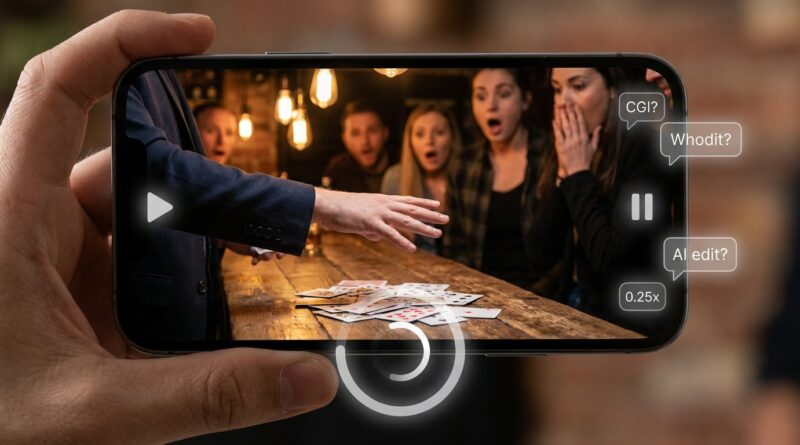
From Viral ‘Is It Editing Or AI?’ Clips To Real-World Miracles: Build One Anti-Camera Sleight That Still Kills On Reels
You can feel the mood shift the second you post a strong card clip now. Instead of “how did you do that?” you get “editing,” “CGI,” or the new favorite, “AI.” That is maddening if you have spent years building real technique. It is even worse when somebody slows your video down, frame-hunts every beat, and decides your sleight of hand must be fake because the move looked too clean. The answer is not to post weaker magic just to look honest. The better answer is to build one sequence on purpose for this moment. If you want sleight of hand that fools slow motion camera, start with a routine that removes the usual red flags. One angle. One object in frame. One continuous action. One impossible ending. Done right, it survives rewatches, plays hard in person, and quietly tells viewers, “No cuts. No filters. Just hands.”
⚡ In a Hurry? Key Takeaways
- Build one continuous, no-cut card sequence with a clean start, a visible middle, and an impossible finish if you want a clip that reads as real.
- Use slower, motivated actions instead of speed. The more every hand movement has a reason, the less slow motion helps the viewer.
- The goal is not just fooling a camera. It is rebuilding trust with real audiences who now assume every miracle online is edited.
The big shift is not technical. It is psychological.
A few years ago, a flawless clip made you look skilled. Now it can make you look guilty.
That is the part many performers miss. Viewers are not always judging your move. They are judging the format. Vertical video, perfect lighting, a sharp visual change, and a suspiciously clean ending all scream “post-production” to a crowd that has been trained by fake content.
So if you want a piece of sleight of hand that fools slow motion camera, stop asking, “What is my flashiest move?” Ask, “What would still look fair if someone watched it three times, slowed it down, and distrusted me from the start?”
What an “anti-camera” sequence actually is
It is not a new sleight. It is a design rule.
An anti-camera sequence is built to survive the things that usually kill card magic on video:
- Jump-cut suspicion
- Off-frame moments
- Hand blocking at the wrong time
- Instant visual changes with no clear cause
- Moves that depend on blur
The idea is simple. If the viewer thinks the method happened during a missing moment, then remove the missing moment.
The best template: one selection, one control, one proof, one reveal
You do not need a ten-phase routine. In fact, that usually hurts you on camera.
The strongest template is this:
1. A fair selection
Keep it ordinary. A card is seen, remembered, and returned. No fancy handling. No weird displays that feel “too magician.”
2. One invisible control or placement
This is the method beat. It should happen during a justified action, not during a sudden burst of speed. Slow and normal beats fast and twitchy on camera.
3. A visible condition
Show something the viewer can track. The deck goes into the box. The cards stay on the table. Your other hand is empty. This is the proof layer that makes editing claims weaker.
4. One impossible reveal
End with a location or transposition that feels final. Not “maybe that happened.” More like “if there was no cut, this should be impossible.”
If you like routines with a stronger dramatic hook, the thinking overlaps nicely with From Viral Talent Show Shockers To Real-World Magic: How To Build One Story-Driven ‘Impossible Card Location’ That Actually Plays Like TV. The key in both cases is that structure beats raw finger-flinging.
A practical anti-camera routine you can build this week
Here is a simple model. Not exposure. Just a frame for construction.
The “Boxed Before the Reveal” sequence
Have a card selected and returned. Secretly control it where you need it. Then do something camera-friendly and trust-building. Put the deck back in the card box before the final revelation.
Now pause.
That pause matters. It tells the viewer the dirty work is over. It also creates a mental lock. People think, “Okay, if the deck is already boxed, the trick must be finished.”
Then produce the selected card from a place that feels disconnected from the method. Your pocket. Under a glass. Folded in view if that fits your style.
Why this works on camera:
- The timeline is easy to follow.
- The deck being boxed feels like a point of no return.
- Slow motion has less to attack because the magic effect lands after the action appears complete.
Rules for sleight of hand that fools slow motion camera
Rule 1: Kill the “gotcha frame”
Most online suspicion comes from one ugly frame. A finger clip. A packet edge. A thumb that does not belong where it is.
Film your handling at half speed on your phone. Not to admire yourself. To find the frame a skeptic will screenshot. Then fix the choreography.
Rule 2: Replace speed with motivation
A move done fast says, “Do not look here.” A move done with purpose says, “I am just squaring the deck.”
Slow motion destroys speed-based deception. It does not destroy natural action nearly as easily.
Rule 3: Keep both hands in the story
If one hand goes dead while the other does all the business, viewers smell it. Give each hand a job the camera can understand.
One hand holds. One hand squares. One hand places. One hand opens the box. Clear jobs look honest.
Rule 4: Stay in frame
This sounds obvious, but it is where many clips lose trust. If the deck dips low for a second or leaves frame during a key beat, comments will fill with “cut there.”
Build the sequence so the important objects never disappear.
Rule 5: Use an ending stronger than the move
The finish should be what people talk about, not your fingers. If the ending is impossible enough, viewers stop obsessing over the exact second they think something happened.
How to test whether your clip looks fake for the wrong reasons
Show it to three kinds of people:
- A magician who knows what to hunt for
- A non-magician who watches lots of short-form video
- A friend who is naturally skeptical
Ask one question only: “At what moment would you accuse this of editing?”
Do not defend yourself. Just listen.
If all three point to the same beat, that is your weak link. It may not be the method. It may be the camera angle, your pacing, or the way you framed the effect.
What to say in the caption, and what not to say
Do not write, “No edits, I promise.” That sounds like a denial before the trial starts.
Better options:
- “Single take.”
- “Shot live after a show.”
- “One continuous performance.”
Short. Calm. No pleading.
And if you can film with a spectator in frame, even briefly, that helps. Real reactions are not proof, but they do shift the vibe away from “content trick” and toward “actual magic happened here.”
Why live performance still matters here
The funny part is that building anti-camera magic usually makes you better in the real world too.
Why? Because the same features that make a clip feel honest also make live magic stronger:
- Clear effect
- Simple timeline
- Fewer procedural steps
- Stronger conviction moments
You are not just making social content. You are pressure-testing your material against the most suspicious audience possible.
One mistake to avoid
Do not chase “proof” so hard that the trick becomes stiff.
Some performers get so worried about camera accusations that they over-display everything. They show empty hands too often. They freeze unnaturally. They telegraph innocence. And that can look just as suspicious.
Natural is still the target. Fair-looking, not desperate-looking.
At a Glance: Comparison
| Feature/Aspect | Details | Verdict |
|---|---|---|
| Fast visual change | Looks flashy, but often invites frame-by-frame scrutiny and editing claims. | Weak for trust |
| Continuous single-take sequence | Keeps objects in frame, removes suspicious gaps, and gives viewers a clean timeline. | Best anti-camera choice |
| Impossible location ending | Shifts attention from finger action to outcome, especially when the deck seems out of play first. | Strong live and on video |
Conclusion
Right now, every strong clip risks getting dumped into the same comment pile: fake, edited, AI. That is frustrating, especially when the work is real. But this moment can also sharpen your magic. If you engineer one tight, bulletproof anti-camera sequence, you are doing more than protecting a Reel. You are building a template. One that looks honest on video, hits hard live, and gives skeptical viewers fewer places to hide. In the last 24 hours alone, the debate over real sleight versus digital fakery has flared up again, and working magicians are getting pulled into it whether they want to or not. A well-built sequence is your best answer. Not an argument. Not a disclaimer. A piece of magic so clean, so clear, and so well-structured that even when people replay it, they still have to deal with the same uncomfortable thought: maybe it really was skill after all.