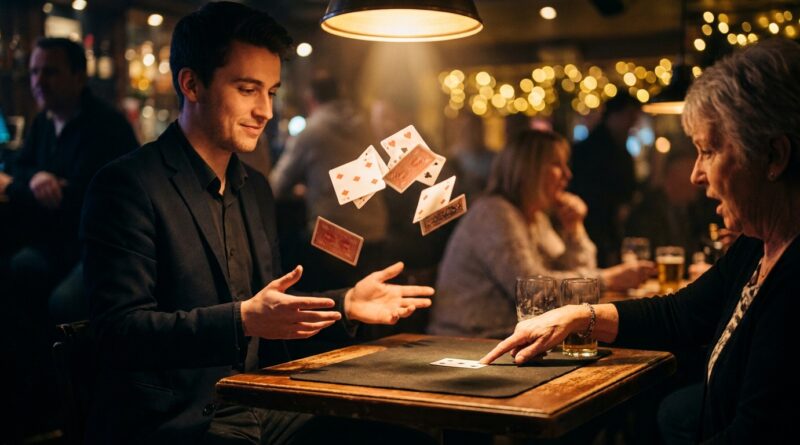
From Viral Talent Show Shockers To Real-World Magic: How To Build One Story-Driven ‘Impossible Card Location’ That Actually Plays Like TV
You have probably felt this already. You watch a talent show clip, somebody names a card, the performer pauses for half a beat, and then the card turns up in the one place it absolutely should not be. It feels unfair. Then you go hunting for a real-world version and run straight into a wall of bad exposure, camera-only junk, and routines that are really just three unrelated tricks wearing the same jacket. That is frustrating, especially if you want one strong impossible card location sleight of hand routine you can actually perform at a table this week. The good news is you do not need TV edits or ten knuckle-busting moves. What you need is structure. A clean beginning, a believable loss, a reason for the impossible place, and one method path you can repeat until it feels like second nature. Build that, and the effect starts to play much closer to the miracles people think they saw on screen.
⚡ In a Hurry? Key Takeaways
- A strong impossible card location sleight of hand routine is less about secret moves and more about one clear story: fair choice, lost card, impossible destination.
- Start with one location you can carry every day, like wallet, pocket, card box, or under a watch, then build your handling backward from that ending.
- Do not chase TV-level chaos. A worker-grade routine needs angle safety, repeatability, and a script that makes the ending feel bigger than the method.
Why the TV Version Feels So Much Stronger
Talent shows cheat in ways live performers cannot. They have music, editing, cutaways, audience sweetening, and a built-in promise that something huge is about to happen.
But that is not the whole story.
The best TV card miracles also do one thing very well. They tell a simple story. A thought becomes a card. The card becomes impossible to track. Then it appears somewhere that feels emotionally loaded, not just technically clever.
That is the part you can steal. Not the method. The shape.
If you have read From Viral ‘Mirror Dimension’ Clips To Real-World Miracles: How To Build One On-Body Card Change That Looks Like Camera Magic In Person, it is the same basic lesson. Viral magic often looks impossible because the effect is framed well. Live magic wins when you keep that strong framing but strip the handling down to something human beings can do under pressure.
The Blueprint: Build One Routine, Not Five Half-Tricks
If you want this to feel like a reputation-maker, your routine needs four beats.
1. A fair-looking selection
The spectator should feel like the card could have been anything. That does not mean you need a truly free choice every time. It means the moment has to feel clean.
For most workers, this means using a force or control you can perform while talking and making eye contact, not while staring at your hands like you are diffusing a bomb.
2. A convincing loss
This is where many routines get weak. The audience has to believe the card is gone. Not sort of lost. Gone.
A false shuffle, a control under offbeat timing, or a simple replacement with strong body language can do the job. The move matters less than the picture in their mind.
3. A reason for the impossible location
The destination should not feel random. “It is in my other pocket” is a puzzle. “Before we started, I put one card in my wallet because I had a strange feeling about tonight” is a story.
Stories land harder than puzzles.
4. A reveal that breathes
Do not rush the ending. Slow down. Let them remember the fairness. Then reveal the impossible place clearly. If it is folded, sealed, isolated, or has been in view, milk that fact gently.
The reveal is not where you speed up. It is where you cash in.
Pick the Right Impossible Location
Not every location is worker-friendly. Some are brilliant on video and awful in the real world. Some are practical enough to do all week.
Best everyday options
Wallet. Strong, classic, and believable. It feels personal. It also gives you a reason to isolate something before the trick starts.
Card box. Very practical. Especially good if the deck goes back in the box at some point and the box has been in play from the start.
Pocket. Simple and direct. Stronger if the card is folded, clipped, or otherwise impossible rather than just loose.
Under watch or on-body location. High impact, but only if your handling is smooth and your audience management is good.
Options to be careful with
Under glass. Great in the right venue. Useless in many others.
Sealed impossible places. Very strong, but they often bring reset issues, angle concerns, or too much setup for casual work.
Spectator’s pocket or bag. Can be devastating, but only when your style supports that level of interaction.
The Practical Build: A Worker-Grade Skeleton Routine
Here is the routine shape you want. This is not exposure. It is staging advice. Think of it as a map.
Phase 1: Set the hook
Open with a premise people understand fast. Try something like, “TV magic looks impossible because they make one card matter more than the whole deck. Let’s do that with yours.”
Now you have given the trick a frame. Good.
Phase 2: Make the card personal
Have the card named, seen, signed, or otherwise anchored in memory. Signed is strongest if your ending allows it.
The more personal the card feels, the bigger the final location hits.
Phase 3: Lose it cleanly
Control or force as needed, but the audience memory should be simple. They saw the card go in. The deck was mixed or at least treated casually enough to suggest loss.
This is where magicians often over-prove. Resist that. Too much proving creates suspicion.
Phase 4: Build a false solution
Act like the trick is about finding the card in the deck. Spread, fail, joke lightly, or show confidence that something else is happening.
This creates a wrong path in their mind. They think the ending will be one kind of trick. Then you hit them with another.
Phase 5: Shift attention to the impossible place
Only now do you introduce the location. Your wallet. Your pocket. The card box that has been sitting there. Your watch band.
If the location has been visible from the start, say so. If it has been untouched, say so. If a spectator has been holding it, even better.
Phase 6: Reveal with pauses
Open slowly. Let them react to each layer. “There is one folded card.” Pause. “You signed yours, right?” Pause. Then show the face.
Those pauses are not theater fluff. They give the brain time to catch up.
How to Make It Feel Like TV Without Acting Like TV
You do not need fake shouting, big windups, or overacting. What you need is control over attention.
Use narrower choices
TV magic often looks stronger because the choices are framed tightly. In live work, you can do the same with language. “Touch one.” “Take this one.” “Remember it.” Clean and direct beats wordy and chaotic.
Keep the dead time out
Nothing kills impossible card location magic faster than procedural sludge. If you need to get to a position, do it while asking a question, making a joke, or shifting eye contact.
Give the object a job
Your wallet is not just a prop. It is a prediction holder. The card box is not packaging. It is quarantine. Your jacket pocket is not storage. It is a place that was never supposed to matter until it suddenly does.
When objects have a role, the routine feels designed instead of improvised.
What Newer Magicians Usually Get Wrong
The biggest mistake is method collecting. One force from here. One palm from there. One revelation from somewhere else. The result is a Frankenstein routine with no rhythm.
The second mistake is choosing the hardest method because it sounds more pure.
That is backwards.
The best impossible card location sleight of hand routine is the one you can do cleanly when the table is loud, the spectators are burning your hands, and somebody asks you a question halfway through the control.
Real workers choose methods that survive contact with real people.
Common weak points to fix
Too many phases. One selection, one loss, one impossible arrival. That is enough.
No emotional reason for the location. If the place matters, the trick matters more.
Rushing the reveal. Slow endings get remembered.
Practicing moves without practicing transitions. The secret often lives between the tricks, not inside them.
A Simple Practice Plan for This Week
If you want to carry this into your next gig, use a boring practice plan. Boring works.
Day 1: Pick one ending
Choose wallet, box, pocket, or on-body. Just one.
Day 2: Pick one route to control the card
Not three controls. One. The one you already trust.
Day 3: Write a 30-second script
Why does the card matter. Why does the location matter. What is the exact line before the reveal.
Day 4: Rehearse standing up
Not at your desk. In the clothes you might actually wear.
Day 5: Test on one real person
You are not testing if the trick fools them. You are testing if the story is clear.
Day 6: Cut 20 percent
Remove extra lines, extra displays, and extra handling.
Day 7: Perform it three times
Same routine. No swapping methods after one shaky run.
At a Glance: Comparison
| Feature/Aspect | Details | Verdict |
|---|---|---|
| Best routine structure | Fair choice, believable loss, meaningful impossible location, slow reveal | This is the sweet spot for strong live reactions |
| Most practical location | Wallet or card box for most performers, with pocket close behind | Best mix of impact, carry, and repeatability |
| Biggest trap | Copying TV pacing or collecting too many methods instead of building one finished routine | Avoid this if you want a trick that survives real gigs |
Conclusion
People are bringing talent-show expectations to close-up magic now. That can feel annoying, but it is also a huge opportunity. If you build one solid impossible card location sleight of hand routine with a clear story and a practical ending, you can give them that same “no way” feeling without pretending you are on a soundstage. That is the point. Not pipe dreams. Not secret collecting. One worker-grade miracle you trust enough to perform anywhere. For newer magicians, that shift matters. It moves you away from chasing methods and toward owning a routine. And one owned routine can do more for your reputation this week than fifty bookmarked tutorials ever will.