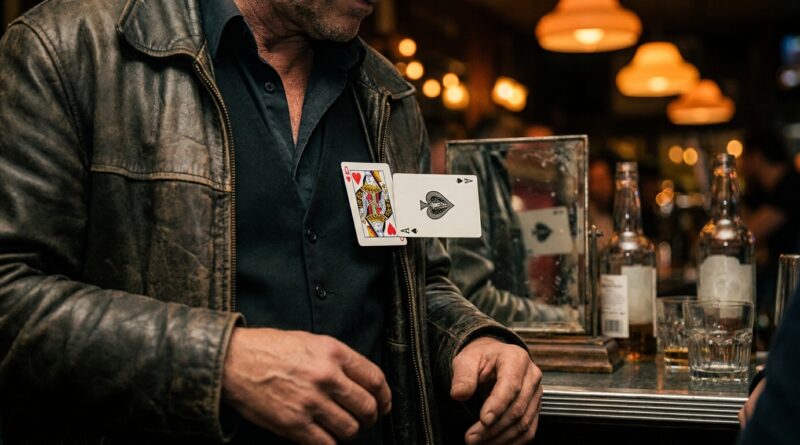
From Viral ‘Mirror Dimension’ Clips To Real-World Miracles: How To Build One On-Body Card Change That Looks Like Camera Magic In Person
You know the feeling. A move looks deadly on your phone, you post a clean little clip, and people swear it is camera trickery. Then you try to do that same visual change for actual humans at a table, under overhead lights, next to a mirror, with three people burning your hands from bad angles. Suddenly the miracle turns back into method. That gap is frustrating, especially now that audiences have been trained by short videos to expect impossible, edit-looking moments in real life. The good news is you do not need a gimmick, a stooge, or a one-shot social media move. You need one practical change built for the body, not the lens. Think of it as a live VFX beat. Fast. Framed. Protected by motion and timing, not by editing. If you build it right, your spectators will remember a card flipping through a strange little “mirror dimension” moment, even though everything happened inches from their eyes.
⚡ In a Hurry? Key Takeaways
- The best mirror dimension sleight of hand card change for real people is not a literal packet flip. It is a body-framed one-card visual change that uses natural cover, a brief reflective beat, and a simple color change core.
- Start with an Erdnase-style change or Clipshift-style visual, then wrap it in a “display, mirror, return” sequence so the effect feels like a live camera wipe.
- Angle safety matters more than raw speed. Practice in front of a real mirror, phone camera, and standing spectators before taking it into paid or high-pressure performances.
Why the TikTok version falls apart in the real world
A lot of viral “mirror dimension” magic is really editing grammar dressed up as sleight of hand. There is a packet turnover. A swipe. A frame block. A quick push toward the lens. Online, that reads as impossible.
In person, the audience does not watch like a camera. They lean. They shift. They look early. They catch reflections in windows, bottles, polished tables, and the black screen of a nearby phone. That is why many social-first changes feel fragile outside a controlled clip.
If you want a mirror dimension sleight of hand card change that survives real conditions, the goal is different. You are not trying to copy the exact viral move. You are trying to copy the feeling of it.
The feeling you are chasing
When people say a clip looks like “camera magic,” they usually mean three things happened at once.
- The card was seen clearly before the change.
- The transformation happened during a motivated visual event.
- The reveal landed instantly, with no obvious cleanup.
That is your blueprint. Clear before. Covered by a reason. Instant after.
The live solution: the “Display, Mirror, Return” change
Here is the practical structure I recommend.
Phase 1: Display
Show a single indifferent card cleanly on top. Do not rush this. If they do not register the card, the later visual means nothing.
Hold the deck in mechanics grip in the left hand. The right hand comes over and lightly squares the top edge. This gives you a natural reason to set up your preferred visual change.
Phase 2: Mirror
This is the secret sauce. Instead of changing the card in a dead, flat display, bring the top card up toward your chest or slightly toward the spectator’s eye line, as if you want them to “catch the reflection” or “watch the image bend.”
You are not using a real mirror. You are creating a mirror beat with body framing.
The card briefly turns edge-on, or near edge-on, to the audience. That tiny moment mimics what video editors do with a wipe or dimension flip. During that beat, execute the change.
Phase 3: Return
Immediately bring the changed card back into a flat, readable display. No extra twitch. No apology. No repeat. One beat out, one beat back, and the new card is there.
To the audience, it feels like the image passed through a visual seam and came back altered.
The easiest core method to plug into this structure
If you already do a reliable color change, use that. If not, start here.
Best starter core: Erdnase change
The Erdnase change works because it is direct, common, and strong from the front. It also gets better when you stop trying to do it as a “look what my fingers can do” stunt and instead hide it inside motion.
In this routine shape, the top card is displayed. The right hand approaches to “tilt” the card toward the imaginary mirror line. As the audience tracks the card’s motion, the right fingers pull the top card back and the next card appears. Then you immediately flatten the deck back toward them.
That is simple, practical, and surprisingly modern-looking when framed well.
If you are more advanced: Clipshift or shapeshifter variant
These can look more impossible, but they come with more angle issues and more failure points under pressure. If you work standing, surrounded, or in loud bar conditions, the extra flash is often not worth the extra risk.
For most people, a strong Erdnase handling with great timing will beat a nervous advanced move.
How to make it feel like a “mirror dimension” moment
This part matters more than the sleight.
Use a verbal cue
Say something short like, “If I turn it just right,” or, “Watch the face catch for a second.”
This gives the movement a reason. It also tells their brain that a visual event is about to happen. That is exactly what short-form video does with framing and pacing.
Create a hinge point
Do not wave the deck around. Pivot from one clear point. Usually that is the lower inner corner near the left thumb. A controlled pivot looks impossible. A loose flourish looks suspicious.
Keep the travel small
The “mirror” movement should be two or three inches, not a giant arm swing. Think camera wipe, not windshield wiper.
Reveal on the return, not on the turn
This is a big one. Many magicians try to make the change happen while the card is fully visible. Sometimes that works on video. In person, it often looks grabby.
Better approach. Let the audience remember that the card went into the turn as one thing and came back as another. Their memory stitches the miracle together for you.
A full working blueprint
Here is a practical sequence you can start using.
- Control a contrasting card to second from top. An indifferent card sits on top.
- Spread or double-undercut casually as needed before the effect begins.
- Show the top card flat and still. Let them name it.
- Right hand comes over to “square” and lightly contact the top card.
- Say, “If I turn it like a reflection, it changes on the way back.”
- Lift the front edge slightly and angle the deck toward your chest or spectator eye line.
- During that turn, execute the Erdnase change.
- Immediately return the deck flat to display the new top card.
- Pause. Let it breathe.
- Either deal the changed card off cleanly or go into a follow-up phase.
That is the whole machine. Nothing fancy on paper. Very strong in the real world.
Angle-proofing the move
This is where most people lose the battle.
Best audience position
Slightly left of center, one to three people, chest-level performance height. If someone is hard right and low, adjust your torso, not just your hands.
Use your body as the side wall
Bring the action into the space just in front of your sternum, not way out at arm’s length. Your body becomes a natural shield. The move also looks more intimate and more deliberate.
Watch for accidental mirrors
Actual mirrors are obvious, but shiny tables, windows, and drink fridges are the real troublemakers. Before performing, do a quick scan like a stage performer checking sightlines. Two seconds of awareness can save you a lot of pain.
What to practice, in the right order
Do not start by grinding the sleight at full speed for an hour. That is how you get a tense, ugly change.
Step 1: Silent shape
Practice the display, turn, and return with no actual move. Make the body motion look calm and motivated.
Step 2: Insert the change slowly
Add the sleight at half speed. You are teaching your hands where the secret lives inside the visible action.
Step 3: Use a mirror, then stop trusting the mirror
A mirror is good for posture and gross flashes. It is bad for making you think the audience sees what you see. After a few reps, switch to a phone camera at spectator height.
Step 4: Practice with speech
Real performances include breathing, words, and eye contact. If the move only works in total silence, it is not ready.
Common mistakes that scream “move”
Changing before the audience has locked in the first card
If they did not clearly see the original card, the effect becomes a vague flourish.
Over-proving fairness
The more you insist the card is really there, the less magical it feels. Show it once. Clearly. Then move on.
Snapping too hard
A little visual punctuation is fine. A big dramatic hit often reads as cover.
Repeating the same change
Do it once. If they ask to see it again, you won.
How to script it so it feels modern, not cheesy
You do not need to talk about dimensions unless that fits your style. Just use language that gives the eye a job.
Try lines like:
- “Watch the picture, not my fingers.”
- “It changes in the turn, not in the snap.”
- “There is a weird moment where the face stops looking flat.”
Notice the pattern. Short. Visual. No fake science.
When this change is the wrong choice
Be honest with yourself. If you are fully surrounded by people who are lower than your hands, this is probably not your best weapon. Use a transposition, top change, or a card-to-impossible-location instead.
A good magician is not the person who forces one move into every situation. It is the person who picks the right tool for the room.
At a Glance: Comparison
| Feature/Aspect | Details | Verdict |
|---|---|---|
| Core method | Erdnase-style color change hidden inside a brief turn toward the body | Best balance of visual impact and practicality |
| Angle safety | Strong from the front and slight left/right, weaker for low hard-side spectators | Very workable if you manage body position |
| Social-media feel vs live reliability | Captures the “edited” vibe without depending on cuts, wipes, or gimmicks | Ideal for updating a close-up set for modern audiences |
Conclusion
The trick is not to beat TikTok at being TikTok. It is to understand what those clips taught people to expect, then build a live moment that scratches the same itch honestly. Short-form platforms are teaching audiences to expect impossible edits and hyper-visual jumps, which quietly raises the bar for every close-up worker. A practical, edit-proof, mirror-aware card change gives you a way to meet that expectation in the real world. If you can show the card clearly, hide the method inside a motivated “mirror” turn, and return with an instant reveal, you will have something rare. A move that feels like camera magic, right there in person, with no gimmicks and no excuses.