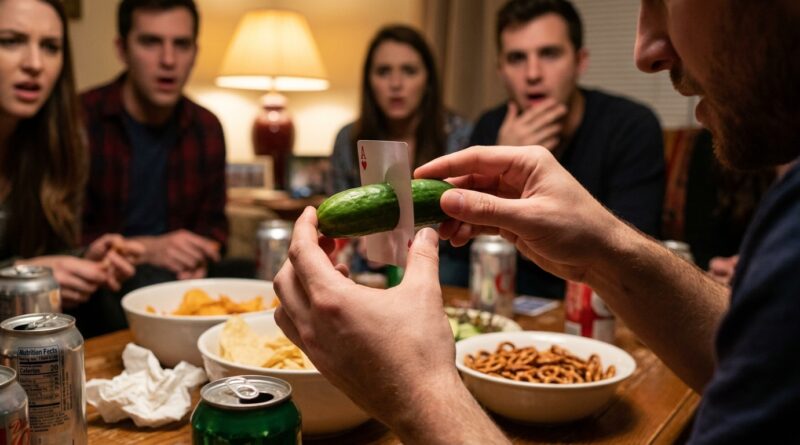
From Viral ‘Cucumber Card Stunts’ To Real-World Miracles: How To Build One Everyday Object Transposition You Can Do At The Snack Table
You have probably seen those cucumber-and-card clips by now. A playing card seems to pass through a cucumber slice, or the cucumber appears somewhere it plainly should not be, and the comments fill up with equal parts awe and eye-rolling. That frustration is fair. A lot of these videos are shot for the camera first and the real world second. They look great in a vertical reel, then fall apart the second a spectator leans left, stands up, or asks to touch something.
The better move is not copying the exact stunt. It is taking the same visual idea and building a practical transposition from ordinary snack-table objects. Think card, cucumber slice, napkin, and glass. No CGI. No fragile setup. Just a clean switch in conditions people understand instantly. If you want a cucumber card magic sleight of hand tutorial that actually survives live performance, start with structure, not gimmicks. The method matters, yes, but framing, timing, and object choice matter even more.
⚡ In a Hurry? Key Takeaways
- Use a simple card-and-cucumber transposition, not a fake “through” effect, if you want something reliable in person.
- Build the routine around a covered moment with a napkin or coaster, then rehearse your audience angles before worrying about speed.
- Use clean food items and avoid letting spectators eat anything used in the trick after handling.
Why the viral version usually fails in real life
Social video rewards impossible-looking moments. Live magic rewards clarity. Those are not always the same thing.
The viral “cucumber card” clips often depend on one of three things. A camera angle. A pre-cut or altered object. Or editing hidden by fast movement. None of that helps when somebody is standing three feet away holding a drink and staring right at your hands.
What does help is a strong effect description. A selected card is isolated. A cucumber slice is isolated. Under impossible conditions, they trade places. That is easy to follow. It feels strange. And it uses objects people can see, name, and remember.
The effect you should build instead
Here is the practical version.
A spectator signs a card. You place it under a napkin or coaster on the table. A cucumber slice goes visibly under an upside-down glass. Nothing looks suspicious. After a beat, the card is found under the glass, and the cucumber slice is under the napkin.
That is a transposition. It scratches the same itch as the viral clips, but it is much better for real-world use.
Why this version works
First, the conditions are simple. People understand “this was here, now it is there.”
Second, the objects are ordinary. A signed card kills the idea of duplicates. A cucumber slice is visual, funny, and memorable. The glass and napkin provide natural cover without screaming “magic prop.”
Third, it is modular. You can do it at a bar, a picnic table, a brunch spot, or a kitchen counter with minor changes.
What you need
Keep it boring. That is the point.
- A regular deck of cards
- One signed selection
- One cucumber slice, not too wet and not paper-thin
- A napkin or coaster
- An ordinary drinking glass
The cucumber slice matters more than you think. If it is too wet, it sticks where you do not want it. If it is too thick, it becomes clumsy to handle. Aim for a firm slice around coin thickness.
The method in plain English
This is where many “tutorials” lose people. So let’s keep it simple. You are not making a card melt through a vegetable. You are secretly switching which object sits under which cover during a motivated off-beat.
Phase 1. Establish the objects clearly
Have a card selected and signed. Show the cucumber slice openly. Let people register both. Do not rush this. The stronger the memory of the starting positions, the stronger the ending.
Phase 2. Load the card where it can be moved easily
Place the signed card under a napkin or coaster. In practice, many performers use a fold, curl, or slight offset so they can pick it up cleanly later. The audience just needs to believe it is trapped and isolated.
Phase 3. Isolate the cucumber under the glass
Set the cucumber slice under an upside-down glass. This gives you a visual anchor. Everyone can still see it. That is useful.
Phase 4. Create the secret moment
The secret work happens when attention is on the effect, not the mechanics. This might be as you adjust the glass, straighten the napkin, ask the spectator to place a finger on one object, or direct all eyes to the signed face of the card one last time.
The exact sleight can vary. A shuttle-style transfer, a lapping action if seated, a simple cover switch with the napkin, or a glass-assisted load. The key is this. The cover action must look like housekeeping, not a move.
Phase 5. Reveal slowly
Lift the glass. Show the signed card. Pause. Then lift the napkin or coaster to reveal the cucumber slice. The pause matters. Let the first surprise land before the second one arrives.
A beginner-friendly handling that feels advanced
If you want a cucumber card magic sleight of hand tutorial that does not ask for knuckle-busting work, start with the napkin switch version.
The napkin switch idea
The napkin gives natural cover for picking up and replacing small items. While attention is on the spectator’s signed card and your verbal recap, you use the napkin to carry one object and leave another behind. To the audience, you are just squaring the table.
This is not glamorous. That is why it works.
Why the glass helps
An upside-down glass acts like a display case. Once the cucumber is under it, people stop expecting direct contact. That lowers heat on the critical area. It also gives the final reveal a clean picture.
Angle-testing the routine before you perform it
This is where most people skip homework and regret it later.
Set your phone on a table and record from three positions. Straight on. Slightly left. Slightly right. Then do the routine exactly as you would for a friend. No “perfect take” nonsense. Just a real run.
Watch for three things.
Flashing
Can the hidden object be seen during the switch? If yes, lower your hands, change the cover object, or turn the body less.
Suspicious pauses
Do you stop moving only when the dirty work happens? That is a tell. Your rhythm should stay even.
Messiness
Does the cucumber leave moisture on the card, napkin, or glass in a way that creates clues? Dry the slice lightly before performance.
How to make it feel impossible, not just clever
Method gets you through the door. Theater gets applause.
Use a signed card
This is non-negotiable if you want the ending to hit hard. A random card under the glass is interesting. Their signed card under the glass is a story they will repeat.
Do not oversell the cucumber
The weirder the object, the less you should talk about it. If you make a huge deal out of the cucumber, people sense a trap. Treat it casually, like the nearest snack happened to become part of the trick.
Give each object a job
The napkin protects the card. The glass traps the cucumber. The spectator guards one of them. Little bits of logic make a simple method feel airtight.
Common mistakes that kill this trick
Choosing the wrong cucumber slice
Soggy slices are the enemy. They stick, smear, and slow you down.
Performing too soon
If you have not tested it standing and seated, do not debut it at a paid gig. Snack-table magic lives or dies on comfort.
Trying to mimic the viral visual exactly
Those clips often sell a “penetration” effect. Live performance usually prefers a transposition because the conditions are easier to prove and the handling is safer.
Ignoring reset
If you work casually at events, you need to reset in seconds. Carry a few fresh slices in a small food-safe container and keep extra napkins handy.
Real-world presentation lines that help
You do not need a comedy monologue. Just enough language to focus attention.
Try this:
“We all know internet videos cheat. So let’s make this harder. You sign the card. The cucumber stays in sight. If they switch places, blame lunch.”
That line does two useful things. It addresses the viral trend without sounding bitter, and it frames the effect as a fair test.
Safety and etiquette matter more than magicians think
This is food. Treat it like food.
- Use clean hands and clean surfaces.
- Do not offer used food for eating after the trick.
- Avoid this routine in settings where food handling would look careless.
- If the venue is formal, switch to a lime slice, coaster, or sugar packet for a tidier look.
That last point is worth remembering. The method is portable even if the cucumber is not.
How to practice without making your kitchen look ridiculous
Use a poker chip or bottle cap in place of the cucumber while learning. It is cleaner and easier to track. Once the timing is solid, move to the real object.
Practice in this order:
- Object pickup and replacement under cover
- Natural hand positions with napkin and glass
- Full routine with patter
- Recorded angle checks
- One live test for a trusted friend
The big trap is practicing the move in isolation forever. Practice the whole sequence. Real spectators remember the flow, not your finger positions.
When to use this, and when not to
Great times to perform it
Casual parties. Brunch tables. Hospitality suites. Trade show side moments. Any place where a weird, visual piece can break the ice fast.
Bad times to perform it
Very cramped seating. Poorly lit cocktail rooms with no stable surface. Upscale dinners where messing with produce would feel out of place. Use judgment.
Why this beats chasing every new gimmick
Trends move fast. A practical routine lasts.
The appeal of the viral stunt is obvious. It feels impossible with everyday stuff. But if your version only works for a phone lens, you do not really own the effect. Once you build a sturdy transposition from ordinary objects, you have something better. You have a routine.
That routine can be dressed up, simplified, shortened, or turned into a multi-phase set piece. You can swap the cucumber for a pickle chip, citrus wheel, cookie, or folded receipt depending on the venue. The skeleton remains the same.
At a Glance: Comparison
| Feature/Aspect | Details | Verdict |
|---|---|---|
| Visual impact | Signed card and visible cucumber switch places under clear, ordinary conditions. | Strong enough for live reactions, not just camera reactions. |
| Difficulty | Moderate. More about timing, cover, and handling than hard finger work. | Very workable for serious hobbyists and pros. |
| Real-world practicality | Uses common objects, resets fairly quickly, but needs a clean surface and decent food handling. | Best as a casual close-up piece, not an every-table workhorse in all venues. |
Conclusion
The public already likes this kind of weird visual magic. That part is proven. What they have not seen enough of is a version that works off-screen, in bad lighting, with real people leaning in. If you build this as an everyday-object transposition instead of a fake camera miracle, you get something much more useful. It still feels modern and strange, but now it is dependable. That is the sweet spot. For magicians and serious hobbyists, a structured, angle-tested routine like this is a practical answer to the cucumber-card craze. You stop chasing edits and start building a piece that can actually live at the snack table.