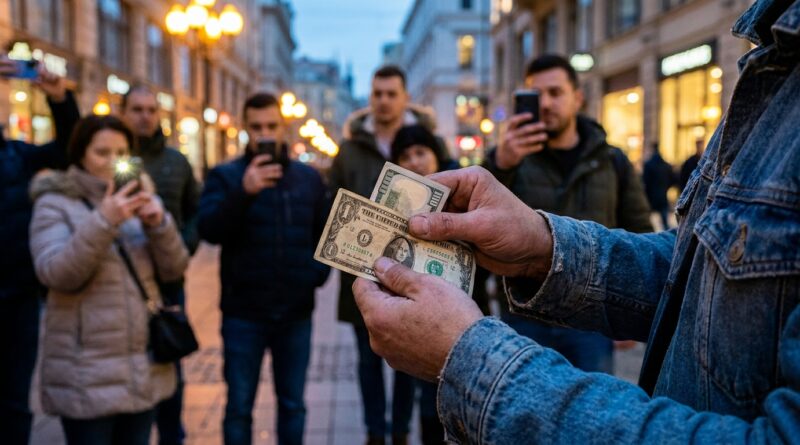
From Viral ‘Street Cash Changes’ Clips To Real-World Magic: How To Build One Angle-Proof Bill Switch You Can Do With Any Currency
Your feed makes it look easy. A bill flashes, fingers wiggle, and suddenly a one becomes a hundred. Then you try the same kind of thing in the real world and the whole setup starts to wobble. Somebody is on your left. Somebody taller is looking down. Somebody asks to see both hands. That is where a lot of viral money magic falls apart, and it is frustrating. You do not need another fragile download that only works for one camera angle and one country’s currency. You need one angle proof bill switch sleight of hand approach that is practical, clean, and flexible enough to use at a table, in walkaround, or while somebody films you from too close. The good news is you can build that kind of switch by focusing on structure, not hype. Once the mechanics and timing are right, the same core move can work with almost any paper money you are likely to carry.
⚡ In a Hurry? Key Takeaways
- An angle-safe bill change is less about a secret gadget and more about folded orientation, hand position, and when the audience thinks the change happens.
- Start with a two-bill practice setup in your own currency, then drill the display, turnover, and cleanup separately before trying full speed.
- If a bill switch only looks good straight-on, it is a clip for social media, not a worker for real people standing beside you.
Why so many money changes look great online and shaky in person
Camera magic has changed the market. Dealers know a visual money change sells in seconds if the trailer is sharp and the moment is quick. The trouble is that a lens is forgiving in ways humans are not. A phone camera usually sits in one lane. Spectators do not.
That is why a move can feel amazing in your bedroom and scary in paid work. The issue is not always the method itself. It is often the handling around it. Bad angles usually come from one of three places. The fold hides too much only from the front. The dirty hand travels too much. Or the moment of change is treated like a stunt instead of a tiny piece of theater.
If that sounds familiar, you are not failing. You are just trying to turn a clip into a routine.
What “angle proof” really means
Nothing is truly angle proof in the absolute sense. If somebody is behind you, they can burn your hands. So let us use a more honest definition. For working magicians, angle proof means safe for normal human viewing conditions. Front. Slight left. Slight right. A person seated lower. A person standing a little higher. A phone filming from a casual position.
That means your bill switch needs three things.
1. A display that looks open before the change
If the audience never feels they saw a fair bill, the transformation has no weight. Your starting display should be simple, not fussy. Show enough to register the object. Do not overprove.
2. A change moment that happens under motivation
The best switches do not scream, “Secret move now.” They happen as you square the bill, gesture, align the edges, or apparently show both sides.
3. A cleanup that leaves you relaxed
If your shoulders tighten after the change, people sense it even if they do not know why. The ending should let you either hand out the changed bill or move naturally into the next beat.
The real-world blueprint for one dependable bill switch
Instead of chasing a dozen methods, build one framework you can adapt. Think of it as a bill switch chassis. The exact fold may vary with your currency, but the bones stay the same.
Use a narrow, tidy packet
Most currencies can be folded into a compact rectangle that allows one visible face at the start and a different visible face at the finish. Keep the packet thin and squared. Thick folds create edge flashes and make the hands look like they are wrestling a receipt.
Keep the long edge toward the audience
This matters more than many magicians realize. With many currencies, the safest orientation is the one that shows a broad face to the front while hiding the layered edges along the top or bottom line of sight. Side spectators tend to catch depth, not width. So your handling should favor a flatter look.
Build the switch around a turnover or regrip
The most practical handlings use a reason to rotate or square the bill. That natural action gives you cover. It also makes the move look like a continuation, not an event. If the fingers freeze and then the magic happens, people feel the gears turning.
End cleaner than you started
A lot of flashy changes peak too early. The visual is nice, but the performer is left with a mess to hide. A worker’s switch should finish in a position where you can display, pocket, hand out, or immediately segue into another effect.
How to make the method currency-agnostic
This is where many tutorials let people down. They teach a trick for one exact bill size and print layout. Real performers need more flexibility.
Start with proportion, not denomination
Forget the printed number for a second. Focus on size, stiffness, and contrast. Your practice pair should match closely in dimensions. If your local notes vary in color or portrait placement, that is fine. You just need a fold that gives you a convincing “before” window and “after” window.
Adjust the fold depth to the paper
Some notes are crisp and springy. Some are soft and tired. Polymer notes can behave very differently from cotton paper. Do not force one exact fold width. Tune it. A slightly deeper fold may hide edges better on a slippery note. A shallower fold may make the switch smoother on softer currency.
Use contrast wisely
If the bills are dramatically different in color, your displays must be cleaner. The stronger the visual contrast, the less slop you can get away with. That is not bad news. It just means your blocking has to be a touch stricter.
The handling details that save your angles
These are the small things that separate a bill switch that “works” from one you trust in public.
Do not pinch at the center for too long
A center pinch often creates a suspicious tunnel where spectators expect something hidden. Hold near an edge or corner when possible. It looks less guarded.
Move the hands less than you think
Big waving motions are not natural cover. They are alarm bells. Small, direct actions are safer. If the bill needs to turn, let it turn. Do not stir the air around it.
Use your eyes as misdirection
Look at the audience just before the moment of change, then back to the bill for the reveal. People tend to follow your attention. It is old advice because it still works.
Keep one side “dead” and one side “alive”
This is a useful rehearsal idea. One side of the bill packet is the side you are willing to show more openly. The other is the side you protect with body line and finger placement. Label them in your head. It reduces accidental flashes.
A simple practice plan you can start tonight
You do not need a week-long retreat. You need smart reps.
Phase 1. Learn the static positions
Practice the start display, the hidden transition position, and the final display without doing the full move. Freeze in each one. Check them in a mirror from front, left, and right.
Phase 2. Drill the change in slow motion
Make the switch happen painfully slowly. That sounds backward, but slow practice exposes catches, edge flashes, and finger tension.
Phase 3. Add the script
A bill change with no words often feels abrupt in person. Add one short line that motivates the action. Something like, “Watch the print, not my fingers,” or, “If I fold the value inward, the number changes first.” The words create rhythm.
Phase 4. Film from bad angles
Do not just record the hero shot. Put your phone too low, too high, and slightly off to the side. You will learn more from ugly footage than flattering footage.
How to turn a switch into a routine instead of a puzzle
A naked transformation is strong, but it gets stronger when it means something. Maybe a small bill changes into a larger one as a joke about inflation. Maybe foreign currency changes into local notes while you talk about travel. Maybe a borrowed bill changes and then changes back.
This is the same lesson that helps card magic survive scrutiny. If you enjoyed the thinking in From AI Card Scanners To Real-World Deception: How To Build One ‘Instant ID’ Routine That Feels Completely Unprepared, the overlap here is obvious. The stronger the effect feels in context, the less the audience fixates on the move itself.
Common mistakes that make a good bill switch look bad
Let’s keep this practical.
Rushing the reveal
If the changed bill appears before the audience has fully registered the starting bill, you lose impact. Give them a beat to understand what they are seeing.
Overhandling after the change
You do not need to keep proving the bill is real. Show it cleanly, relax, and move on. Too much display can create suspicion where none existed.
Choosing the wrong venue
Even a strong angle proof bill switch sleight of hand is not for every setting. Windy outdoor patios, very dim bars, and spectators packed shoulder-to-shoulder can all raise the difficulty.
Depending on gimmicks you cannot replace fast
Gimmicks are not evil. But if your whole set depends on a delicate setup that dies after one performance, that is not ideal for working conditions. A skill-based method gives you more mileage.
At a Glance: Comparison
| Feature/Aspect | Details | Verdict |
|---|---|---|
| Angle safety | Works best when the folded packet stays flat, the hidden side is managed, and the switch happens during a natural turnover or squaring action. | Good enough for real spectators, not just a front-facing camera. |
| Currency flexibility | Adapts to different notes by adjusting fold depth, packet size, and display windows rather than relying on one exact bill layout. | High value if you travel or perform outside the U.S. |
| Long-term usefulness | Needs practice, but once learned it avoids constant buying of new visual downloads and can fit many presentations. | Best choice for magicians who want a worker, not just a trailer moment. |
Conclusion
You do not need to panic-buy every new cash change that hits your feed. Trends come and go. A solid, practical, currency-agnostic, angle-safe bill switch stays useful. That is the real win here. It lets you keep the visual punch people love on social media while giving you something you can actually trust when real humans are standing at your sides. Start with one method. Tune it to your currency. Drill the displays, the turn, and the cleanup until the move feels boring in your hands. That is when it becomes powerful for everyone else. Cut through the gimmick-heavy noise, keep your magic relevant on camera and in person, and build a skill-based solution you can start practicing tonight and still be using years from now.