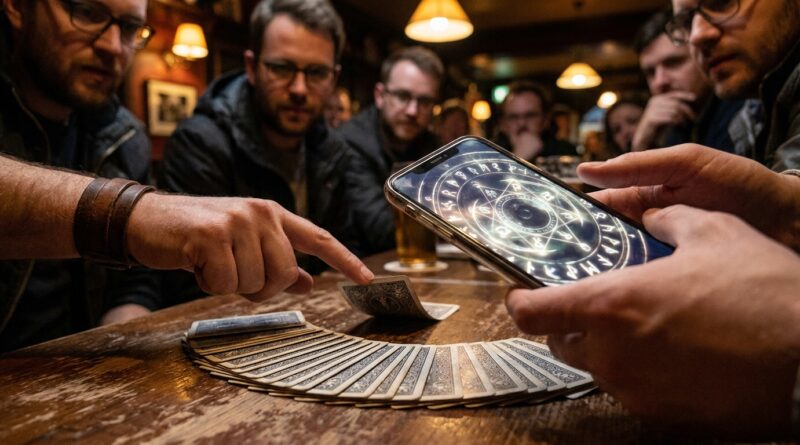
From AI Card Scanners To Real-World Deception: How To Build One ‘Instant ID’ Routine That Feels Completely Unprepared
You can feel the panic creeping in. Somebody films your card reveal, pauses the video, zooms in, then jokes that an app could probably name the card faster than you can. That fear is not silly. It is real. Phone cameras are better, rewind is instant, and card-recognition tools are teaching people that objects can be identified on sight. If your effect is built around, “I know what you picked,” that mystery can feel thinner than it did a few years ago. The fix is not to fight the phone. It is to build a routine that stays strong even when people record it, replay it, and try to fact check it later. The goal is simple. Stop performing a naked reveal. Start performing an impossible chain of events. That shift gives you a phone proof sleight of hand routine with borrowed deck conditions that feels casual, clean, and completely unprepared.
⚡ In a Hurry? Key Takeaways
- Do not hang your whole effect on instant identification. Build a layered routine where the reveal is only one beat in a longer impossible sequence.
- Use a borrowed deck, let the spectator handle key moments, and script clear time gaps so any rewind shows fairness instead of a suspicious move.
- The safest modern approach is not “faster tricking.” It is stronger structure, better audience management, and effects that survive zoom, replay, and casual phone analysis.
Why “instant ID” feels weaker now
A few years ago, naming a card out of nowhere could fry people.
It still can. But the culture around it has changed.
People now live with apps that identify plants, songs, shoes, coins, bills, trading cards, and random objects from a photo. Even if they do not use those tools every day, they believe those tools exist. That matters. Once the audience believes identification is easy for technology, your basic “I know what you have” reveal stops feeling like pure impossibility.
That does not mean card magic is broken. It means the old framing is weaker.
The smarter play is to make identification only one part of the effect. The real miracle becomes this: the object is borrowed, the choice feels free, the handling looks hands-off, the timing seems impossible, and the ending lands in a way a scanner could never explain.
The new goal: build a routine, not a moment
If you want a phone proof sleight of hand routine with borrowed deck conditions, aim for three layers.
Layer 1: The object is ordinary
Borrowed deck. Borrowed bill. Pocket change. Something people already trust.
Layer 2: The procedure is messy in a human way
Real people shuffle badly. They peek awkwardly. They forget instructions. Good. That helps. Perfectly neat procedure can look staged on video. Slightly imperfect real handling often looks more honest.
Layer 3: The ending is bigger than recognition
Do not just name the card. Predict where it lands. Match a serial number pattern. Reveal a folded bill before the choice is fully explained. Make the final image stronger than “he figured it out.”
The framework: one “instant ID” routine that feels completely unprepared
Here is a practical structure you can plug into tonight.
Phase 1: Borrow and disarm
Start with, “Let’s use your deck so I cannot be accused of bringing a weird one.”
That line does two jobs. It gets a laugh, and it heads off the first suspicion before it forms.
If a deck is not available, use a bill, receipt, business card, or handful of coins. The method is less important than the structure.
Phase 2: Let them mix, then stop caring about order
Have the spectator shuffle. Really shuffle. If cards spill, even better. It looks normal.
Then say something like, “I do not need order. I just need one moment you remember clearly.”
This is important because it shifts the audience away from deck setup as the explanation. You are quietly telling them the trick does not depend on stack, sequence, or prearranged order.
Phase 3: Create a memory anchor
Have them remove a card, look at it, and square it back anywhere, or hold onto it depending on your method.
Then ask a strange but harmless question.
“Did you see the card quickly, or did you really lock it in?”
That question sounds casual, but it creates a memory marker. People now remember the selection as a deliberate, private event. On video replay, that moment reads stronger because the audience sees the spectator mentally owning the card.
Phase 4: Add a dead moment
This is where many magicians rush, and it hurts them.
Do not reveal right away.
Talk for five to ten seconds. Hand the deck back. Ask who usually wins card games. Comment on the age of the deck. Mention that people think the hard part is finding the card, but the hard part is knowing when a person has settled on it.
This dead time is gold. It creates distance between the secret action and the effect. Rewind loves immediate cause and effect. Time delay kills that.
Phase 5: Seem to fail on purpose
Now name the wrong color, suit, or value first. Not wildly wrong. Just close enough to feel human.
For example: “Red. No, that is what you wanted me to say. It is black.”
Or, “It feels high. Not a face card. More stubborn than that.”
This matters because scanners look instant and exact. You want the opposite. You want intuition, correction, and tension. The audience stops comparing you to software because your performance no longer looks like software.
Phase 6: Land with a second impossible beat
Once the card is identified, do not stop.
Go straight into one of these:
- The card is at a number they named earlier.
- The card is reversed in the borrowed deck.
- The card matches a prediction written before the selection.
- The card’s value matches the last digits on a borrowed bill.
That second beat is what makes the routine survive phone culture. A camera might support the idea that you glimpsed a card. It does not neatly explain a layered ending.
A plug-and-play script you can use
Here is a simple performance spine:
“Use your deck. Shuffle it so I cannot possibly know anything.”
“Take one out. Look at it. Really remember it. Do not just glance.”
“Put it back wherever you want. I am not even going to touch the cards for a second.”
“People think magic is about fast hands. It usually is not. It is about catching one honest moment.”
“I am getting red. No, wait. That would be too easy. Black. A spade, I think. Not small. Not picture. Seven? No. Higher stress than that. Nine of spades.”
Pause.
“That would be lucky. This would be worse.”
Then reveal the second phase, whether that is position, prediction, reversal, or connection to another object.
Timing notes that make this play better on camera
Hold your pauses a beat longer than feels natural
Live performers often rush because silence feels dangerous. On video, slight pauses read as confidence.
Keep key actions chest high
If you dip everything to waist level, the phone camera turns your hands into a mystery blob. Chest-high handling is clearer, cleaner, and ironically less suspicious.
Do not talk during the exact secret moment if you can help it
Busy patter around a move can look like cover. Clean silence, then natural speech after, often looks more honest on replay.
Let spectators repeat the fairness for you
Ask, “You shuffled, right?” or “You could have put it anywhere?”
Their answers become built-in testimony on the recording.
Audience management beats that make “gotcha” filming harder
You cannot stop people from filming. You can shape what the camera captures.
Stand slightly off-center, not square-on
This gives the live audience a good view while avoiding the perfect tutorial angle for the person holding a phone.
Give the spectator jobs
Have them hold the deck, push in the card, name the stopping point, or open the prediction. The more the spectator does, the less the camera sees a single suspicious operator controlling every variable.
Frame the trick as a test of memory and timing, not detection
If you say, “I will find your card,” people look for technique. If you say, “I want to test whether a choice leaves a trace,” they watch the participant instead. Attention moves away from your hands.
Using everyday objects instead of cards
This same routine skeleton works with money and small objects.
Borrowed bill version
Have someone note the last two digits of a bill’s serial number. Fold it, switch focus, create a time gap, then reveal those digits as part of a larger prediction or as a match to a card value and position.
Coin version
Use a handful of mixed change. Have someone secretly choose one coin, hide it, and then reveal not just the coin type but where it later appears or what date range it belongs to.
Business card version
Someone writes a word or number, mixes it with blank cards, and you reveal the thought, then show that the card has been isolated in a wallet or under a phone case from the start.
The lesson stays the same. Recognition alone is not enough. Build a two-step impossibility.
Where sleight of hand still matters
None of this means method no longer matters.
It matters a lot.
But your sleights should support the feeling of disorder and fairness, not show off technical control. A simple control, glimpse, force, switch, or key-card principle can still destroy a room if the structure around it is modern.
In fact, this is where many magicians can relax a little. You do not need the knuckle-busting move seen only from one safe angle. Often, you need a durable method wrapped in smart timing.
Make it feel less like a stunt and more like a real moment
If your performances are getting shaped by social clips, it is worth studying routines that hold up from multiple views and still feel human in person. That is why From Viral ‘Story Decks’ To Real-World Reactions: How To Build One Narrative-Driven Card Routine That Survives Any Angle is a useful companion read. The big idea is similar. A routine survives better when the audience is following a clear emotional path, not just waiting to catch a move.
Common mistakes that make your “instant ID” look flimsy
Revealing too quickly
Fast reveal equals easy explanation. Build time separation.
Making the card identity the whole plot
If the trick ends at “it was the Queen of Hearts,” people can file that under guessing, peeking, or tech help.
Over-proving fairness
Too much “look, normal deck, normal hands, nothing funny” sounds defensive. Let the structure prove fairness.
Using a method that dies under replay
If a phone can catch the move cleanly from one pause-and-zoom, retire that version for live casual work.
At a Glance: Comparison
| Feature/Aspect | Details | Verdict |
|---|---|---|
| Borrowed deck strength | Using the spectator’s own cards removes suspicion about marked, stacked, or gimmicked props before the trick even starts. | Best starting point for a phone proof routine. |
| Single reveal vs layered reveal | A one-step “that is your card” ending feels weaker in a world where people assume recognition can be automated. A second impossible beat adds depth. | Always choose layered structure when possible. |
| Replay resistance | Time gaps, spectator handling, chest-high actions, and a casual script make rewinds less useful for exposing the method. | Stronger than angle-dependent flash moves. |
Conclusion
CardSight-style tools that can identify trading cards from a single photo are teaching people a new habit. They now assume technology can instantly know what someone is holding. That quietly chips away at the mystery of basic reveals. The answer is not to panic or perform faster. It is to build stronger routines. If you use a borrowed deck or ordinary objects, add a real time gap, let the spectator do more of the handling, and finish with a second impossible beat, your magic stops feeling like object recognition and starts feeling genuinely unprepared. That is the point. You are not trying to beat a camera. You are trying to create a chain of events that still looks impossible after the camera has done its worst. Get this framework into one card or bill effect tonight, and you will have something far tougher, cleaner, and better suited to the world people actually live in now.