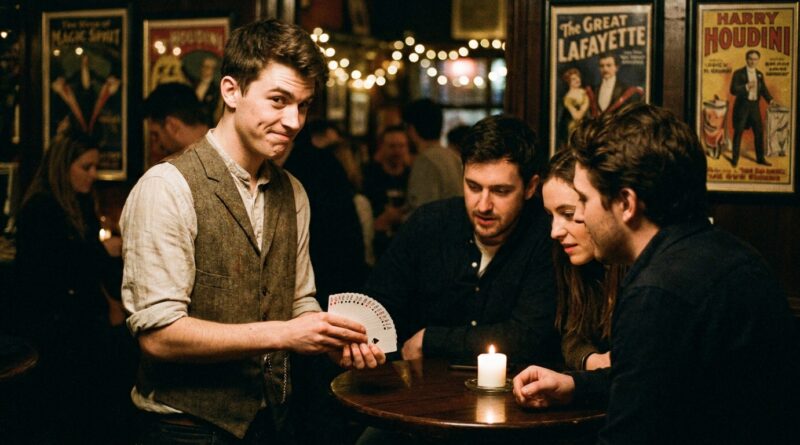
From Viral ‘Story Decks’ To Real-World Reactions: How To Build One Narrative-Driven Card Routine That Survives Any Angle
You have probably felt this already. A story-driven card piece can look incredible on a phone screen, then feel painfully fragile the second three real people stand at three real angles and start burning your hands. That is the frustration. The clip kills online, but in the room the pacing drags, the secret moment flashes, or the whole thing sounds like borrowed emotion wrapped around a standard control. The fix is not more drama, better music, or another gimmick. It is structure. If you want a storytelling card magic routine sleight of hand workers can trust, you need one routine built for human reactions, not camera framing. The good news is you likely already own everything you need. A regular deck, a few reliable moves, and a story with clear beats will do more for you than chasing the latest viral handling. Build it right once, and you get a closer that plays for auditions, walk-around, parlour, and the person who says, “Do that again, but slower.”
⚡ In a Hurry? Key Takeaways
- Build one routine around a simple three-beat story, one visual moment, and one impossible ending that survives repeat viewing.
- Use only angle-safe sleights you can do while talking, and test every phase with spectators on your left, right, and slightly behind.
- If a move only works for a phone camera, cut it. A routine that gets booked again beats a clip that gets liked once.
Why so many “story decks” die in the real world
The online version cheats for you. Tight framing hides dirty edges. Editing smooths over dead time. Music tells people when to feel something. Real spectators do none of that.
They interrupt. They laugh at the wrong place. They stand too close. They lean. They ask to hold the card. They remember where your hands were two seconds ago.
That is why a lot of modern story pieces collapse. Not because the performer lacks skill, but because the routine was designed backwards. It started with a cool visual and then a story was glued onto it.
If you want this to work outside selfie-mode, start with conditions first. Who is around you. What they can see. When they can talk. What can be examined. What must still make sense if the room is noisy.
The blueprint: one routine, four layers
A durable routine has four layers working together. Miss one and the whole thing feels thin.
1. The story layer
Keep it short and personal enough to feel real, but broad enough that you do not sound like you are auditioning for sympathy. Think memory, chance, timing, a near-miss, a promise, a wrong turn, a person you almost met. Small stories play better than epic ones.
2. The effect layer
Your audience should be able to describe what happened in one sentence. “My card kept escaping.” “A thought-of moment changed the deck.” “The card ended where it should not.” If the effect needs a paragraph, simplify it.
3. The method layer
Use proven sleight of hand you can trust under heat. Controls, forces, false displays, a palm if you truly own it, and a switch only if the motivation is natural. This is not the place to show how clever you are. It is the place to stay invisible.
4. The staging layer
This is where viral routines often fail. Where are your spectators. When are your hands empty. Which moments are chest-high, tabled, or in a spectator’s hands. If you cannot map the geography of the trick, the room will map it for you.
Start with a story that gives the deck a job
The deck should not just be a prop that listens politely while you talk. It needs a role in the story.
Bad version: “This reminds me of my childhood, anyway pick a card.”
Better version: “I used cards because this was the only way I knew to keep track of chances I missed.” Now the deck means something. Every shuffle, loss, and return can connect to the theme.
A useful test is this. Remove the trick. Is there still a clear story? Now remove the story. Is there still a clear trick? If either side dies completely, rebuild until both stand on their own.
Use the three-beat structure that keeps audiences with you
Most strong narrative card routines can be built from three beats.
Beat 1: The premise
Set the emotional frame and establish the impossible condition. A card is selected. It is lost fairly. A choice matters.
Beat 2: The proof
Show that the deck is now behaving in line with the story. This is where one visual event belongs. One. Not four. Too many visuals makes the routine feel like a demo reel.
Beat 3: The payoff
End with something stronger than another rise-to-top. The card appears in a location with meaning. The spectator reveals the final change. The ending answers the story, not just the method.
This matters because stories need closure. Sleight-heavy magicians often stop at the second beat because the move worked and the reaction came. Real workers know the final image is what gets retold.
Choose moves that can survive being watched from the side
Here is the blunt rule. If a move needs your audience directly in front, use it only as seasoning, not the spine of the routine.
Your core should be made from angle-forgiving tools:
- Convincing controls that look casual, not showy
- Forces with natural outs
- False shuffles and cuts you can perform while making eye contact
- Double lifts you can enter and exit cleanly
- Top changes only if your timing is bulletproof
- Palms only if the hand can stay relaxed and justified
If you like eerie, visual moments, it is worth studying how atmosphere can support method without making it fragile. That is one reason From Cruise Ship Parlors To Your Close‑Up Set: How To Build Shadow‑Play Sleights That Feel Like Real Voodoo lands so well. The best spooky moments are not random style. They are staged to protect the secret and focus the eye.
Build in one “camera-proof” visual, not a whole string of them
Magicians get in trouble when they try to make every phase clip-worthy. Real people do not need five miracles in ninety seconds. They need one clean moment they can latch onto.
Pick one visual and let the rest of the routine be clear, fair, and tightening. That one visual can be:
- a card visibly turning over in the deck
- a slow color change at the fingertips
- a card appearing reversed among face-down cards
- a signed card arriving in a meaningful place
Everything before it should make it feel impossible. Everything after it should make it feel final.
Angle-test your routine like a product, not a poem
This is the step most performers skip. They rehearse the script. They polish the voice. They never stress-test the handling.
Run these four tests
The left-side test: Put a friend off your weak side. Can they see breaks, get-behind moments, or suspicious packet edges?
The right-side test: Same idea. Many magicians only protect one side because that is how they filmed it.
The drift test: Ask two people to slowly move while you perform. Real audiences rarely stay still.
The repeat test: Perform it, wait a minute, then let someone recap what they think happened. If their recap exposes your method path, the structure is too transparent.
If a phase fails one of these tests, do not defend it. Replace it.
Give every sleight a reason to exist
In strong storytelling card magic routine sleight of hand design, a move should never show up because “that is how the trick works.” It should happen because the moment demands it.
Need a control? Tie it to squaring the deck after the spectator pushes the card in. Need a false shuffle? Tie it to losing the memory, mixing the chances, or making the choice impossible to trace.
This is how method stops looking like procedure.
A simple example
Story theme: missed chances.
Selection: “One choice out of many.”
Control: “We lose it the same way we lose moments. Casually.”
False shuffle: “Then life mixes everything.”
Revelation: “But some things still come back.”
Now the actions feel connected. That alone makes the routine seem more impossible.
Do not make the script too “important” to interrupt
This is a big one. Social media teaches performers to talk in polished monologues. Real spectators hate feeling trapped inside your speech.
Write your script in chunks, not paragraphs. Build breathing room into it. Let the audience answer, react, joke, or ask a question without wrecking the flow.
A good story routine is conversational. You are sharing a frame, not delivering theatre at people from six inches away.
Use this ratio
For every twenty seconds you talk, there should be a moment where the audience does something. They choose, hold, push in, name, confirm, or reveal. Activity keeps the story from turning into a TED Talk with bicycles.
Create an ending that matters even if they know cards
Plenty of spectators have seen a card rise to the top. Fewer have seen a card journey end in a place that fits the story.
Good endings for a signature routine often include:
- the signed card inside an object tied to the story
- the only face-up card in a face-down spread
- a prediction written before the selection is made
- the spectator discovering the final card, not you
The key is this. The ending should feel like the only possible ending. Not the most surprising one. The right one.
How to make it yours without buying anything new
You do not need a custom printed deck, a new wallet, or some hot release from last week. Personalising a routine usually comes from choices, not props.
Change the frame, not the engine
Take a reliable structure and swap the emotional wrapper:
- For weddings, use timing and almost-meeting.
- For corporate work, use decision-making and hidden outcomes.
- For private parties, use memory, luck, or names.
- For auditions, use a story that shows character fast and stays under control.
The method can stay mostly the same. The meaning changes with the room.
A practical model routine you can build this week
Here is a simple skeleton.
Phase 1: Choice
A card is selected and signed. The script frames it as a decision, memory, or missed chance.
Phase 2: Loss
The card goes clearly into the middle. You control it. Use a false shuffle that keeps the feeling of fairness.
Phase 3: First return
The card appears in a clean, visual way. This is your one strong visual.
Phase 4: Escalation
You make the conditions stricter. Spectator pushes it in. Deck is held by them, or the card is isolated.
Phase 5: Final location
The signed card appears somewhere that answers the story. Pocket, box, reversed in deck, under their hand, inside a note, wherever your current skill honestly supports.
That is a worker. Tight. Clear. Adaptable.
What to cut right now
If you are serious about building one durable routine, cut these habits:
- Long false explanations before the trick starts
- Two-handed displays that only look clean straight-on
- Scripted pain that sounds borrowed from talent shows
- Extra phases added just because they fooled magicians
- Any move you cannot do while someone talks over you
Hard truth. A smaller, clearer routine with fewer clever moments usually gets stronger reactions.
At a Glance: Comparison
| Feature/Aspect | Details | Verdict |
|---|---|---|
| Story structure | Three beats. Premise, proof, payoff. Keeps emotion and effect easy to follow. | Best choice for real audiences |
| Sleight selection | Use angle-safe controls, forces, false shuffles, and only one high-risk visual moment. | Safer than clip-first handling |
| Repeat and reset value | A clean ending, logical script, and simple props make it easier to repeat or adapt on the spot. | Strong worker potential |
Conclusion
A narrative-driven, high-impact card piece is exactly what a lot of magicians want right now, especially with TV auditions and viral clips pushing that mix of emotional story and visual miracle as the new standard. The trap is thinking you need to copy the style of the feed to keep up. You do not. Most working magicians already have the chops. What they need is one signature routine that survives real angles, real interruptions, and real scrutiny. If you build around a simple story, one clear effect, reliable sleight of hand, and an ending people can retell, you get something far more useful than a flashy clip. You get a closer that fits your voice, holds up in the room, and can be customised without buying a single new gimmick. That is the point. Be TV ready if you want, but build for the people standing around you. Likes fade fast. A routine that earns repeat bookings does not.