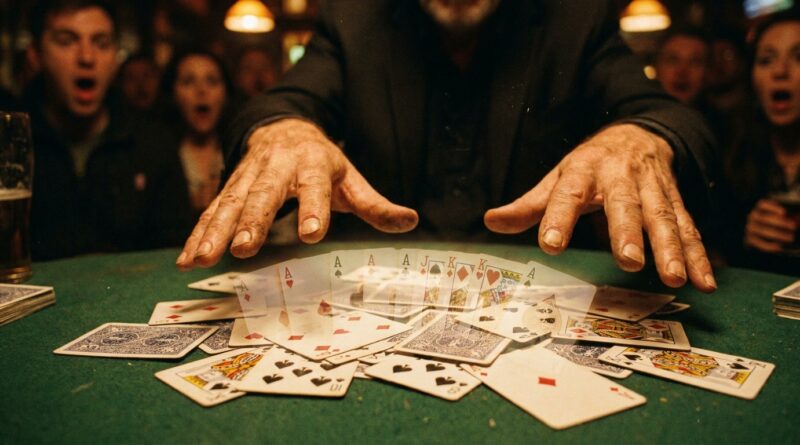
From Viral ‘Slop Shuffles’ To Real Reactions: How To Turn One Chaotic Triumph Into A Crowd‑Killing Signature Routine
You have probably seen them. A quick slop shuffle Triumph clip. Cards go face up into face down, everything looks loose and messy, then boom, the deck fixes itself and one selection is staring back at the camera. It gets likes because it feels reckless and clean at the same time. Then you try it for real people and the heat lands in all the wrong places. The shuffle looks suspicious. The reveal comes too fast. And instead of that loud, shocked reaction you hoped for, you get a nod and a half-smile. That is frustrating, especially when the move itself is not bad. The problem is not the slop shuffle. The problem is treating a viral handling like a finished routine. A good slop shuffle triumph sleight of hand routine needs structure, timing, cover, and a reason for the chaos. Once you add those things, the same “throwaway” move can turn into something strong enough for paid work.
⚡ In a Hurry? Key Takeaways
- A viral slop shuffle Triumph becomes powerful only when you wrap it in a clear beginning, a convincing middle, and a delayed, impossible ending.
- Start by keeping the messy shuffle visual, then add one control, one moment of offbeat, and one stronger reveal instead of copying the clip move for move.
- If you work surrounded, test the routine for angles, pacing, and spectator memory, not just how good it looks from your own phone camera.
Why the viral version gets attention but weak reactions
The social clip is built for the lens. Real performances are built for people.
That sounds obvious, but it is where many good magicians get stuck. A phone clip can hide timing with cuts, camera position, and speed. A spectator at a bar does not give you any of that. They burn your hands. They talk over you. They look from the side. They remember the parts that felt fair and forget the parts you hoped they would not notice.
The usual viral “slop shuffle” Triumph also skips the stuff that creates conviction. There is often no real selection procedure, no dramatic pause, no clear statement of what is supposed to happen, and no reason for the cards to be mixed that way in the first place. The result is a pretty display, not a routine.
That is why the same handling can look amazing online and feel flat live. You are not missing talent. You are missing architecture.
What a real slop shuffle triumph sleight of hand routine needs
1. A clean effect in the spectator’s mind
If the audience cannot explain the plot in one sentence, the reaction drops.
For Triumph, the sentence should be simple. “My card was lost in a deck mixed face up and face down, and then all the cards fixed themselves except my card.”
Every phase of your routine should support that memory. If you add extra cuts, funny displays, or a second plot, the effect starts to blur.
2. A reason for the slop
Messy handling can look fair, but only if it feels motivated.
Give the chaos a purpose. Maybe you say, “Let’s make this impossible to track.” Maybe you frame it as a challenge. Maybe you present it as a mistake that gets corrected. The exact script matters less than the feeling. The shuffle should seem like a deliberate worsening of the conditions, not a suspicious move you needed for method.
3. A delayed reveal
Many viral clips rush to the ending because speed helps online. Live, speed can hurt you.
When the cards straighten instantly after the shuffle, spectators often assume the fix happened during the handling. Delay the magic. Let the mixed condition breathe for a moment. Show a little disorder. Ask a question. Then reveal the impossible correction. That beat gives the audience time to build an internal picture of the mess before you erase it.
How to reverse-engineer the viral handling into a worker
Step 1: Keep the visual hook
Do not throw out the part that made you like the clip. The slop shuffle image is strong because it feels bold. Keep that. You want the audience to remember a deck that looked genuinely wrecked.
Just make sure the picture is readable. If your hands cover the packet too much or the cards blur together, the visual gets muddy. A smaller, clearer mess beats a bigger, confusing one.
Step 2: Strengthen the selection
This is the first place to improve the clip.
Have the card chosen in a way that feels impossible to manipulate. Let them look at it. Let another person remember it too. If your style allows it, have the spectator return the card themselves, then take the deck back casually for the control. The more ordinary this phase feels, the more impossible the ending becomes.
A weak selection process creates a hidden problem. Even if the slop shuffle fools them, they may decide the card was never really lost. That kills the effect.
Step 3: Use one dependable control
Do not overbuild this. A slop shuffle triumph sleight of hand routine does not need six knuckle-busting moves. It needs one control you can do while talking, under pressure, in bad lighting, when someone is looking from the wrong side.
That might be a classic pass for some people, but for most workers it is something simpler and steadier. A double undercut. A side steal you trust. A jog control. The point is not showing off. The point is arriving at the shuffle phase with confidence instead of hope.
Step 4: Separate the secret work from the dramatic moment
This is a big one.
If the audience thinks “the move happened when it got messy,” your reactions will shrink. So build the routine so the method and the memory do not line up neatly. Do your necessary work either before the apparent chaos, or bury it under a moment of natural relaxation. Then let the slop shuffle read as evidence, not as procedure.
That one change often turns a clever trick into a real reaction piece.
Step 5: Add a convincer before the restoration
Before the deck rights itself, give them one more look at the disorder. Spread a few cards. Flash mixed orientations. Let the image land.
Do not overprove it. Too much proving starts to smell like method. But one clear convincer helps lock in the memory that the deck was truly mixed.
Step 6: Reveal in two stages
The strongest version is usually not “everything is fixed and here is your card” all at once.
First, show that the deck has corrected itself. Let that reaction hit. Then, after a breath, reveal the selection. Two waves beat one. This pacing gives the audience time to react to the impossible order before you hit them again with the personal kicker.
A practical routine template you can actually use
Here is a simple structure that works in the real world.
Opening
Have a card selected and remembered by more than one person if possible. Control it cleanly. Keep your hands relaxed and your script light.
The challenge frame
Say you are going to make tracking the card impossible by mixing face up into face down. This gives the slop shuffle a reason and tells the audience what matters.
The messy shuffle
Do the viral-looking slop display, but slow down enough that people can read it. The image should be “this is a disaster,” not “his hands are moving fast.”
The offbeat
Pause. Look up. Ask the spectator if they still want to change their mind, or joke that you may have overdone it. This tiny beat is gold. It relaxes the room and helps disconnect the shuffle from the restoration.
The correction
Spread or ribbon the deck to show all the cards one way. Keep this clean. Do not celebrate too early. Let them see it.
The kicker
Now isolate the one reversed card, or the one face-down card in a face-up spread, depending on your handling. Name the selection if your presentation suits that. Then let them turn it over or remove it themselves if you can. Ownership makes the ending stronger.
Common mistakes that quietly ruin Triumph
Moving too fast
Fast hands can hide method, but they also hide effect. If the audience cannot track the conditions, there is nothing impossible to remember.
Making the slop shuffle too pretty
This sounds backward, but true chaos should look a little casual. If your display is too symmetrical or too careful, it starts to look like a flourish with a secret built in.
Talking through the climax
When the deck rights itself, stop filling the air. Give people a second. Silence is often where the swear-word reaction happens.
Using a reveal angle that only works for the front camera
If you are surrounded, test from the sides and above. A move that looks impossible on Instagram can look weird from seat three at a dinner table.
How to make it feel fresh even if people know Triumph
This plot is old, which is actually good news. Old plots survive because they work. Your job is not to reinvent the engine. It is to improve the ride.
The slop shuffle already helps because it feels modern and off-the-cuff. To push that further, make your handling look less formal. Avoid magician language. Speak like a person. Let the mess feel accidental even when it is not.
You can also change where the heat goes. Instead of making the moment about your skill, make it about their memory. “You saw them mixed.” “You could have stopped me earlier.” “There should still be face-up cards in there.” That kind of framing turns the effect into their experience, not your demo.
Testing it before you take it to a paid gig
Here is a simple checklist.
Can they retell it clearly?
After performing, ask a friend what happened. If they cannot describe the mixed deck condition clearly, your display needs work.
Can it survive interruptions?
Try the routine while someone asks questions or jokes around. Real-world conditions are rarely quiet and polite.
Can you do it standing, seated, and slightly crowded?
A worker should survive more than one performance setting. If the routine only works at chest-high camera angle, it is still a clip, not a set piece.
Do the reactions rise on the second and third performance?
If they do, that usually means your pacing is improving. If they stay polite, you may still be performing the move instead of the effect.
At a Glance: Comparison
| Feature/Aspect | Details | Verdict |
|---|---|---|
| Viral slop shuffle clip | Strong visual, quick payoff, often built for one angle and short attention spans. | Great inspiration, weak as-is for live work. |
| Real-world routine structure | Clear selection, motivated chaos, offbeat, delayed restoration, and layered reveal. | Best path to stronger reactions. |
| Suitability for paid gigs | Depends on angles, pacing, and whether the method holds up under heat and interruption. | Use only after real audience testing. |
Conclusion
The gap between what trends and what works is real, and magicians feel it every week. A flashy clip can make a slop shuffle look like the whole trick, when really it is just one moment inside a much bigger structure. If you reverse-engineer the effect, give the chaos a reason, slow the memory beats down, and build a reveal people can actually process, you end up with something far more valuable than a copied move. You get a slop shuffle triumph sleight of hand routine that earns reactions in the places that matter, at tables, in bars, and in paid sets where people are close and attention is messy. That is the win here. Fewer hours spent chasing edits. More confidence walking into a gig with one modern Triumph that looks loose, survives heat, and still fools people who think they already know how Triumph is supposed to go.