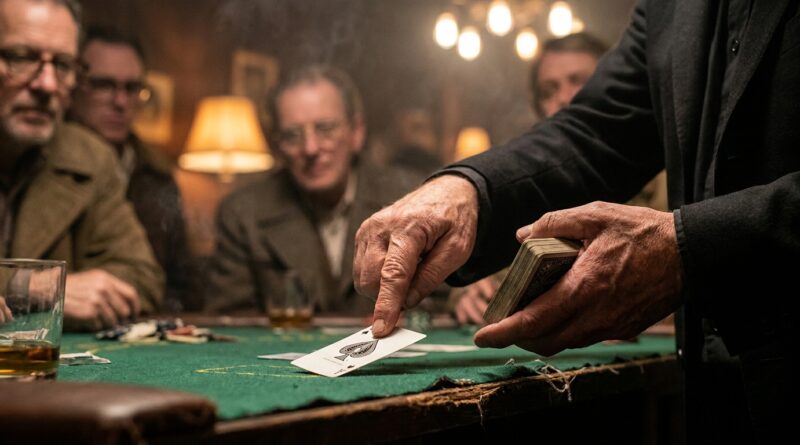
From Viral ‘Center-Deal’ Clips To Real-World Power: How To Build One Invisible Table-Edge Deal For Everyday Card Magic
You have probably felt this lately. Your feed is packed with center-deal clips and table-edge deal demos that look unreal for eight seconds, then seem impossible to trust when a real human is burning your hands from two feet away. That frustration is fair. A lot of this stuff is built for the lens, not for game night, not for walk-around, and definitely not for the kind of close-up set where people lean in and stare at the deck like they paid rent on it. The good news is you do not need a casino-level center deal to get that same dangerous, underground flavor. What you need is one invisible table edge center deal sleight of hand idea that survives normal angles, normal tables, and normal nerves. Build that, and suddenly you have a move that looks like serious cheating but works in the real world, where most magic actually lives.
⚡ In a Hurry? Key Takeaways
- A practical table-edge pseudo center deal is more useful than a pure gambling center deal for most magicians.
- Start by making the action look identical to your normal deal, then hide the dirty work in timing, edge contact, and body position.
- If the move only works for a phone camera, it is not ready. Build it for friends across the table first.
Why the viral version keeps disappointing people
The camera lies a little. Not in a malicious way. It just crops, flattens depth, and rewards bold motions that happen in one narrow lane of vision.
A spectator does the opposite. They shift in their chair. They lean left. They look at your grip before they look at the card. They catch rhythm changes. They notice tension.
That is why so many flashy center-deal clips feel amazing online and shaky in person. The move may be technically hard, but that does not automatically make it practical.
For most magicians, the goal is not to beat a surveillance team in a real card room. The goal is to create the feeling of impossible control while staying safe under heat.
That is the same lesson behind strong coin work too. A move has to survive real bodies, not just good framing. If you liked that idea in coin magic, you will probably enjoy From Viral Quick Cuts To Live Heat: How To Build One Invisible ‘Coin Fusion’ Switch You Can Use Surrounded. Same basic truth. If it dies when people are close, it is not done yet.
What to build instead of a true center deal
Build a convincing table-edge deal that suggests center-deal skill without demanding center-deal risk.
That means three things.
1. It should start from a normal dealing picture
Your hands need to look familiar. If your honest deal lives in one grip and your false deal lives in a weird claw, people will feel it even if they cannot name it.
2. It should use the table edge as camouflage, not as a crutch
The edge gives you cover for alignment, friction, and brief shielding. Good. Use that. But the move should still read as one relaxed dealing action.
3. It should aim for effect, not legal proof
You are not trying to pass a gaming test. You are trying to create the impossible impression that you dealt a card from somewhere it should not have come from.
The working idea: an “invisible” table-edge center-style deal
Here is the simple version.
You keep a desired card second from top, or near-top in a known position depending on your routine. As the deck approaches the table edge, your dealing action lets the top card hesitate for a blink while the wanted card is pushed or drawn into the dealing path under cover of the edge, the receiving hand, and the natural sound of the deal landing.
Notice what this is not. It is not a pure center deal in the gambling sense.
It is a center-style illusion built around edge cover, rhythm, and audience management. For magicians, that is often the smarter tool.
How to make the move invisible
Match your honest deal first
Before you try the sleight, film ten ordinary deals. Watch the speed, finger pressure, deck angle, and where your eyes go.
Then build the false version to match that footage.
This is backwards from how many people practice. They learn the secret action first, then hope the visible action will sort itself out. It usually does not.
Use the edge at the last possible moment
Do not camp at the table edge like you are waiting for cover. Arrive there naturally. The deck should touch or near-touch the edge only when the deal is already happening.
If you hover too long, people feel that something important is occurring there.
Keep the deck low, not buried
Low is good. Buried is suspicious.
You want enough edge relationship to hide the switch in alignment, but not so much that it looks like you are scraping the deck for mechanical help.
Let the sound help you
One of the best pieces of camouflage is the click or slap of a dealt card hitting the table. Many magicians obsess over finger positions and forget about audio cover.
The dirty moment should resolve right as the card lands.
Give the eyes somewhere else to go
Not with wild misdirection. Just normal purpose.
Ask a question. Name the player. Tap the dealt pile. Glance at the recipient. Small social actions pull heat off the extraction moment without looking like stage business.
A simple practice ladder that actually works
Stage 1: No trick card, no pressure
Work the action with random cards and no routine. Your only goal is making the visible picture match the honest deal.
Stage 2: Fixed target near the top
Place a contrasting card in the position you want to secretly deal from. Repeat until you can hit it without freezing or checking the deck.
Stage 3: Add recipients
Deal to three or four spots around the table. This matters. A move that works straight ahead may wobble when your shoulders and wrist have to address different positions.
Stage 4: Add conversation
If you cannot talk while doing it, you do not own it yet.
Stage 5: Use it inside one short effect
Not a full gambling demo. One punchy routine. Maybe you apparently lose a card, deal a few hands, and prove you can place it wherever you want. Keep it tight.
The biggest mistakes people make
Trying to look skillful
This one hurts a lot of good magicians. They want the move to look dangerous, so they add attitude, tension, and speed.
Real invisibility looks boring.
Practicing only from one camera angle
Front view is not enough. Check front-left, front-right, seated eye level, and slightly above. Real spectators do not stay locked in one frame.
Overbuilding the method
You do not need six secret adjustments in one deal. Usually one hidden displacement plus good rhythm beats a complicated technical pile-up.
Using it too often
If every deal is suspiciously powerful, people start reverse-engineering. Use the move once or twice where it matters. Let the rest be clean and ordinary.
Where this fits in real performance
This kind of table edge center deal sleight of hand works best when it appears as a side weapon, not the whole show.
Good places to use it:
- A gambling-themed phase in an ambitious card set
- A pseudo-demonstration of “dealing from the middle” without claiming real casino technique
- A casual game-night miracle where the chosen card keeps landing in impossible hands
- A close-up set where you want one sharp moment that feels edgy and different from standard double lifts and controls
Bad places to use it:
- Under challenge conditions with everyone told to burn your hands
- As a repeated proof of actual cheating skill
- On bad surfaces where the table edge gives inconsistent contact
- When your honest deal is still shaky
Choosing the right table matters more than people admit
Not every edge is your friend.
Best surfaces
Square or slightly rounded edges. Stable height. Enough friction that the deck does not skate. Enough smoothness that cards release cleanly.
Worst surfaces
Deep overhangs. Thick cloth lips. Sticky lacquer. Tiny café tables where your body position gets cramped.
If you plan to use this in the real world, practice on ugly tables too. Kitchen table. Pub table. Folding table. Not just your best close-up pad at home.
How to sell it without overselling it
The script matters.
If you say, “Let me show you a real center deal,” you are inviting people to judge the move as a technical demonstration.
If you say, “Card cheats learned to make impossible cards appear where they wanted,” you give yourself room. You are creating a story of control, not entering a courtroom.
That tiny shift makes the move much stronger because the audience remembers the effect, not the taxonomy.
At a Glance: Comparison
| Feature/Aspect | Details | Verdict |
|---|---|---|
| True center deal | Very high technical demand, harsh angle issues, strong prestige, low practical use for most performers | Amazing skill goal, poor first choice for working magic |
| Table-edge center-style deal | Uses edge cover, matching rhythm, and audience position to create the same feeling with less risk | Best balance of danger, learnability, and real-world use |
| Camera-only demo handling | Looks strong from one framed angle, often breaks under side views or live scrutiny | Fine for clips, weak for live performance |
Conclusion
The last year has trained a lot of magicians to chase the hardest-looking move in the shortest-looking clip. I get the appeal. But most of us perform shoulder to shoulder, across small tables, with friends, strangers, and people who do not care what the move is called if the effect hits hard. That is why a practical, angle-aware table edge center deal sleight of hand is worth your time. It gives you that underground cheating vibe without forcing you into a level of risk that makes the move unusable. Build one version that looks like your real deal, works on ordinary tables, and stays calm under heat. That is not settling. That is choosing a weapon you can actually carry into the real world.