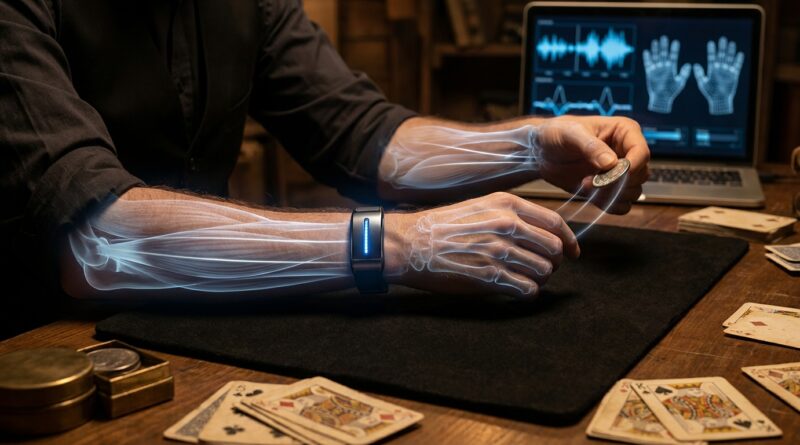
From Lab Tech To Living Room Miracle: How MIT’s Ultrasound Wristband Points To The Next Era Of ‘Hands‑Free’ Sleight of Hand
If you have ever spent an entire evening trying to make a coin steal look casual, you know how maddening this can be. The move works in the mirror, then falls apart on camera. Your pinkie count flashes. Your grip change looks tense. Your wrist does one tiny weird thing, and suddenly the whole illusion feels like a move instead of a moment. That frustration is real. What makes MIT’s ultrasound wristband research so interesting is not just the robotics angle everyone is talking about. It is the idea that a wearable can read tendon movement and muscle activity in your forearm with surprising detail. For magicians, that points to something big. We may be heading toward a future where sleight of hand training with hand tracking technology is not guesswork, not “do it until it feels right,” but a more measurable process. Not mechanical. Just clearer, smarter, and a lot less dependent on hoping your hands are hiding what your body is shouting.
⚡ In a Hurry? Key Takeaways
- MIT’s ultrasound wristband research could eventually help magicians measure hidden tension, tendon load, and motion efficiency during sleights.
- Right now, you can start using a simple practice system with slow video, repeatable drills, and tension notes to mimic what future hand tracking tools may make easier.
- The goal is not to turn magic into lab work. It is to reduce strain, spot tells earlier, and make sleights look like ordinary actions instead of suspicious ones.
Why this matters to magicians more than most tech writers realize
Most coverage of this kind of wearable research focuses on robots. Fair enough. If a machine can understand human hand movement better, it can copy tasks that used to be hard for software and hardware to handle.
But there is another group that should be paying very close attention. Magicians. Especially close up workers.
Think about what sleight of hand really is. It is not just speed. It is not just finger strength. It is controlled movement under social pressure, with timing, relaxed posture, and natural-looking tension. That is exactly the sort of thing advanced sensing tools are built to study.
So when MIT shows a wrist-worn system that can monitor tendons and micro-movements in the forearm, the big story is not just “robots may get better hands.” The big story is that human performers may eventually get better feedback.
What MIT’s ultrasound wristband is actually doing
Here is the plain-English version.
The wristband uses ultrasound to look beneath the skin and track what is happening with muscles, tendons, and other structures involved in hand movement. Unlike a smartwatch that mostly tracks motion from the outside, this kind of system aims to read the mechanics that create the motion.
That matters because sleight of hand often fails before the object even flashes. It fails when your forearm stiffens. It fails when one finger starts compensating for another. It fails when a secret action needs twice the muscular effort of a normal action.
An audience may not know why something looked odd. Their brain just catches that it did.
A tool like this could, in theory, help identify that hidden difference.
Why “naturalness” is so hard to train
Most magicians learn by using mirrors, phone cameras, and repetition. All of that still works. It is still important. But those tools only show the outside result.
They do not tell you whether your classic palm is creating excess forearm tension compared with your empty-hand gesture. They do not tell you whether your retention vanish uses a needlessly long finger path. They do not tell you whether your pass gets invisible only because you are doing it under very specific body conditions you cannot repeat on demand.
That is where sleight of hand training with hand tracking technology gets interesting. It gives you the possibility of measuring the hidden layer, not just the visible one.
A better way to think about technique: three measurable ideas
1. Tendon load
This is the effort cost of the move. How much strain are you putting into the hand and forearm to keep a coin clipped, a card aligned, or an object concealed?
If the hidden version of an action takes far more effort than the innocent version, that difference often leaks into your timing and body language.
For example, if your top palm makes your wrist rigid but your ordinary deck handling stays loose, your audience may not catch the palm itself. They may catch the stiffness.
2. Path efficiency
This is how direct the movement is. Secret actions often become messy because we add extra travel. The fingers curl too far. The hand rotates more than needed. The object takes a longer route than the eye expects.
Efficient pathing tends to look cleaner and feel more repeatable. It also usually makes the move easier to do under pressure.
3. Micro-tension
This is the tiny strain you barely notice until it ruins the illusion. A thumb that presses too hard. A forefinger that locks. A pinkie that sticks out. A shoulder that rises half an inch when you load something.
Micro-tension is one of the biggest reasons good sleights look suspicious on replay.
How this could change practice sessions
Let’s say tools inspired by this MIT work become consumer-friendly. Maybe not tomorrow, but eventually. What might change?
You would not just review whether a coin vanish fooled your camera. You could compare your “empty hand reach” against your “secretly loaded reach” and see whether the muscle pattern is dramatically different.
You could test several methods for the same effect. Not just by opinion, but by consistency.
You could ask useful questions like:
- Which steal creates the least extra forearm tension?
- Which grip change keeps the hand closest to my normal gesture profile?
- Which pass uses the shortest path with the fewest compensations?
- Which concealment method tires my hand out fastest after 30 repetitions?
That is not killing artistry. That is removing waste.
A practical training framework you can use right now
You do not need an MIT lab on your wrist to start thinking this way. You can build a low-tech version of the same mindset today.
Step 1. Record the innocent action first
If you want to improve a false transfer, first record the real transfer. If you want to improve a top change, first record the honest handling that supposedly matches it.
This gives you a baseline. Without a baseline, you are comparing your move to your imagination.
Step 2. Watch for tension before flashes
Do not only ask, “Can I see the object?” Ask:
- Does the wrist freeze?
- Does one finger move too early?
- Does the forearm tighten before the secret action?
- Does the shoulder or elbow help when it should not?
These are often the real tells.
Step 3. Score your sleight after every set
Keep it simple. After ten repetitions, rate the move from 1 to 5 in these categories:
- Tension
- Path length
- Timing consistency
- Recovery to a relaxed hand
You are trying to create objective habits, even before you have objective sensors.
Step 4. Reduce effort, not just visibility
A move can be invisible and still be bad for you. If it strains your hand, slows your reset, or only works when you are fresh, it is not as practical as it seems.
Good technique should survive repetition.
Step 5. Build a “natural gesture library”
Film how your hands move when you are relaxed. How you point. How you hand over a coin. How you square a deck casually. How you drop your hands at your sides.
Then compare your sleights to those real gestures.
This may sound basic, but it is exactly the kind of comparison smarter wearables could make much easier in the future.
Where hand tracking technology could help specific sleights
Classic pass
The pass is a perfect example of a move that lives or dies by hidden tension. A sensor-driven system could potentially show whether the secret action creates a distinct muscular spike compared with an ordinary squaring action.
If it does, your problem may not be speed. It may be excess effort.
Coin steals
Coin work often exposes path inefficiency. The object travels farther than needed. Fingers over-close. The hand braces before contact. Tracking tools could help isolate which phase is costing you smoothness.
Object vanishes
Many vanishes fail because the dirty hand does not return to a believable rest state quickly enough. That is a recovery problem. Wearables could be useful here because recovery can be measured as much as the steal itself.
What this means for injury prevention too
This part gets overlooked.
Close up magicians repeat tiny, forceful motions for years. Palming pressure, edge grip tension, packet handling, one-handed cuts. If a future wearable can flag overuse patterns or uneven load, that is not just a performance win. It is a health win.
For hobbyists, it could stop bad habits early. For pros, it could help manage strain before it becomes pain.
That matters. No sleight is worth tendon trouble.
The limits of this idea
Let’s keep our feet on the ground.
Even if this technology becomes available, it will not replace audience management, timing, script, or confidence. A perfect tendon profile will not save a weak routine. And not every deceptive action is the one with the lowest measured effort. Sometimes theater beats efficiency.
But better feedback still matters.
Think of it like slow-motion video for athletes. It did not replace coaching. It made coaching sharper.
What magicians should do next
Start paying attention to the conversation around wearables, hand tracking, and fine motor sensing. Not because you need to buy a lab gadget tomorrow, but because the ideas behind them are useful right now.
When you practice, stop asking only, “Did it flash?”
Also ask:
- Was that the easiest version of the move?
- Did my hand return to normal quickly?
- Could I repeat that 50 times without tension building up?
- Does the secret action match the body language of the honest action?
That shift in thinking is the real upgrade.
At a Glance: Comparison
| Feature/Aspect | Details | Verdict |
|---|---|---|
| Tendon load tracking | Could reveal when a secret move uses far more muscular effort than the innocent action it is meant to copy. | Very promising for cleaning up hidden tension. |
| Path efficiency analysis | Helps compare how direct or wasteful different steals, passes, and transfers are. | Excellent for choosing practical methods, not just flashy ones. |
| Micro-tension feedback | Could spot tiny stiffness patterns that cameras miss but spectators still feel. | Potentially the biggest breakthrough for making sleights look truly natural. |
Conclusion
Right now, tech media is fascinated by robots learning human-level hand dexterity. That is a real story, but it is only half the story. The other half is what those same sensing tools could do for performers who already depend on precise, deceptive, natural-looking hand movement every day. If magicians start thinking in terms of tendon load, path efficiency, and micro-tension, practice stops being blind repetition and becomes something you can benchmark and refine. That does not make magic less human. It makes your classic passes, coin steals, and object vanishes feel more like ordinary life and less like something a spectator could freeze-frame and figure out. And that is the real miracle here. Not replacing skill, but helping you shape it into something softer, smarter, and much harder to catch.