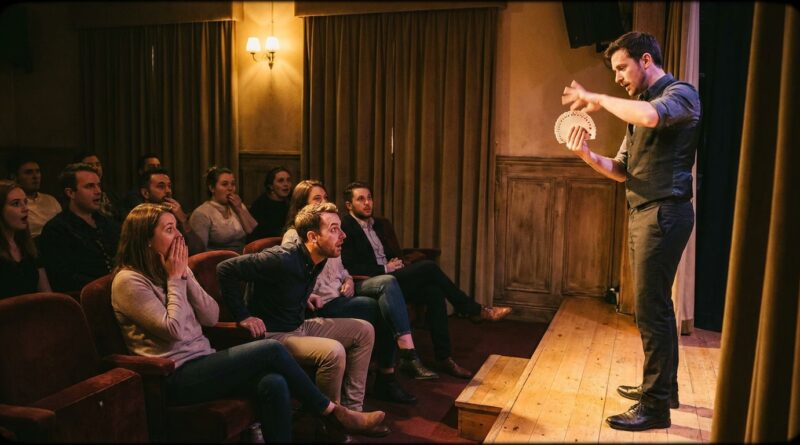
From Table Hops To Arena Shows: Build One ‘Parlour-Size’ Sleight System That Survives Any Room
You know the feeling. A move gets gasps at a table, then goes strangely flat the second you stand up and face twenty, fifty, or a hundred people. Nothing changed in your hands, but everything changed in the room. Suddenly the angles feel wider, the timing feels tighter, and the secret starts looking smaller than the effect. That is the awkward middle zone a lot of magicians get trapped in. Too big for pure close-up. Too intimate for full stage methods. So they either rush, flash, or swap their strongest sleight for something safe but forgettable. The good news is you do not need a whole new act. You need a system. If you build one solid parlour-size framework around a favorite move, you can make it play for a bar crowd, a small theatre audience, and even a camera lens without losing what made it powerful in the first place. That is the real goal of parlour sleight of hand for small theatre audiences.
⚡ In a Hurry? Key Takeaways
- Build around one move that is already strong up close, then enlarge the conditions, the sightlines, and the moment of revelation.
- Test every phase standing up, chest high, with spectators on three sides and a phone recording from the back.
- If the audience cannot clearly track the object, the stakes, or the ending, the trick is too small for parlour no matter how clever the handling is.
The core problem is not your technique
Most of the time, the move is not failing because it is weak. It is failing because the room is asking different questions.
At a table, people can burn your hands from two feet away. In a parlour room, they need to understand the plot from ten or twenty feet back. On camera, they need a clean frame and a clean reason to care. Those are three different jobs.
Close-up rewards detail. Parlour rewards clarity. Hybrid venues reward both at once.
That is why a killer control, switch, load, or palm can feel electric at a bar and dead in a small theatre. The audience is no longer judging just whether you fooled them. They are judging whether they could follow what mattered.
Start with one “anchor move,” not a whole new act
If you want a practical upgrade you can use tonight, pick one sleight you already trust under pressure. Not five. One.
Good anchor moves usually fit at least three of these points:
- You can do them standing.
- You can do them while talking.
- You can hit them consistently when your pulse is up.
- They create a result the audience can describe in one sentence.
- They do not depend on tiny finger detail being seen.
That last point matters a lot. The audience does not need to see the move. They need to see the conditions before it, and the impossible change after it.
Good candidates for scaling up
A top change can work. A one-handed top palm can work. A shuttle pass can work. A retention vanish can work. A billet switch can work. A false transfer can work.
What matters is not the name of the move. What matters is whether the effect around it can breathe in a bigger room.
The three-part system for scaling a close-up move into parlour
1. Make the object readable
If people in row four cannot instantly identify the thing being used, the effect shrinks before it begins.
That means:
- Use larger props when possible.
- Use stronger color contrast.
- Keep objects separated, not cluttered.
- Raise action to chest or shoulder height.
A coin vanish with a half dollar may be gorgeous up close. In parlour, it may become a shiny mystery blob. The same structure with a jumbo coin, a bright poker chip, a folded bill, or a ring box may suddenly play.
Do not confuse “same trick” with “same object.” Preserve the effect. Change the scale.
2. Make the conditions simple
The audience should understand the fairness before the secret happens. If they are still decoding the setup, the impact gets cut in half.
Use plain language. Fewer phases. Cleaner displays.
For example, instead of:
“I will lose your card, control it, and then something impossible will happen.”
Try:
“You push your card into the middle. I never go near the deck again.”
That is much stronger in a small theatre because everyone knows what to watch.
3. Make the reveal room-sized
This is the part many magicians skip.
A close-up trick can end with a whisper. A parlour trick needs a punctuation mark. The reveal has to land in the body, not just the brain.
Ways to do that:
- Pause before the climax.
- Use a volunteer’s reaction as part of the reveal.
- Show the ending high and still.
- Repeat the impossible condition in one short sentence.
- Let the audience catch up before moving on.
If the magic happened, but half the room is still asking “Wait, what changed?” then the issue is not method. It is framing.
A field-tested template you can use tonight
Here is a simple build for parlour sleight of hand for small theatre audiences.
Phase 1. Establish the rules
Show the object clearly. Name what matters. Slow down.
Example: “One signed card. One envelope. Your name on the flap. Nothing goes near it.”
Phase 2. Put the secret moment inside a larger action
This is where your sleight lives. Do not present it like a challenge move. Hide it inside a natural beat.
Ask a question. Turn your body slightly. Shift attention to the volunteer. Pick up a marker. Hand over an object. The move should ride on a reason.
Phase 3. Freeze the picture
Once the conditions are set, stop fiddling. Parlour audiences read stillness as honesty.
If your hands keep adjusting props after the dirty work, the room feels that tension even if they do not know why.
Phase 4. Reveal in layers
First let the volunteer react. Then show the object to the wider room. Then restate the impossibility.
This helps your trick play live and on camera at the same time.
How to test whether a move is truly parlour-ready
Do not trust the mirror. Do not trust the practice room. Test under stupidly honest conditions.
The “two meters plus phone” test
Stand up. Put your props at performance height. Place one person close, one person six to ten feet back, and a phone camera even farther back.
Run the routine at real speed.
Then ask three questions:
- Could everyone tell what the object was at every stage?
- Could everyone explain the effect in one sentence?
- Did anyone feel confused before the magic moment?
If the answer to any of those is no, do not add more sleights. Strip away clutter.
The angle stress test
Have people sit left, right, and center. Then repeat with one person standing. Hybrid rooms are messy. You are not always getting perfect theatre sightlines.
Your goal is not to make a move literally angle-proof. Very few are. Your goal is to make the audience experience angle-resistant.
That means the method may still have weak points, but the blocking, timing, and script stop people from living in those weak points.
If you are also working on card material with a stronger presentation spine, this pairs nicely with From Viral ‘Story Decks’ To Real-World Reactions: How To Build One Narrative-Driven Card Routine That Survives Any Angle, because the same rule applies. A routine survives bigger rooms when the audience can track the story and the effect without needing to inspect every fingertip.
What to change first when a close-up piece dies in parlour
Change the height
Many tricks improve instantly when the action moves from waist level to chest level.
Change the pacing
Parlour often needs less speed, not more. Fast hands in a bigger room can look nervous instead of skillful.
Change the participant job
Give the spectator a stronger role. Holding an envelope, guarding a ring, naming a position, or confirming a signature gives the whole room something to invest in.
Change the final picture
Your ending should be visible. If the climax is tiny, the audience will react tiny.
Common mistakes that make sleight of hand feel small
Too many phases
What feels like texture up close feels like repetition in a theatre.
Too much procedural talk
If you sound like you are giving tax instructions, people mentally step back.
No offbeat for the method
Close-up workers sometimes keep everything “hot” all the time. Parlour needs temperature control. Build in cool moments.
Props that disappear under light
Silver on silver. Thin billets. Dark objects against dark clothes. Stage lighting can punish all of that.
A reveal aimed only at the volunteer
The helper matters, but the whole room paid for the miracle.
A simple example: scaling a card control into a small theatre moment
Let’s say your anchor move is a card control. Up close, the trick may end with a direct revelation from the top of the deck. Fine for a table. Small for parlour.
To scale it:
- Have the card signed in bold marker.
- Use one clear selection, not multiple choices.
- Control the card during a natural beat, not as a challenge flourish.
- Place the deck away or in a spectator’s hands.
- Reveal the card in a larger impossible location, or as a visible isolated card everyone can register.
Same sleight. Bigger effect. Better theatre.
That is the mindset shift. Stop asking, “How do I make this move visible?” Start asking, “How do I make this effect readable?”
Build one script that survives live, close-up, and camera
This matters more now than it did a few years ago. More rooms are hybrid. More audiences are filming. More bookers want a set that can shift from intimate to ticketed without a full rebuild.
So write one script that does three jobs:
- It tells the back row what matters.
- It tells the close spectator where to look.
- It tells the camera when the key image arrives.
If one line can clarify the conditions, use it every time. If one pause makes the reveal stronger, protect it. Consistency is not stiffness. It is what lets a strong piece survive different rooms.
At a Glance: Comparison
| Feature/Aspect | Details | Verdict |
|---|---|---|
| Object visibility | Readable props, strong contrast, and chest-high handling help the whole room follow the effect. | Essential for parlour playability |
| Method under angles | A move does not need perfect angles if the blocking, timing, and audience focus are managed well. | Good enough beats technically perfect but unreadable |
| Reveal size | A bigger final image, clear pause, and volunteer reaction turn a small secret into a room-filling moment. | Usually the biggest improvement you can make fast |
Conclusion
You do not need to throw out your close-up identity to work a small theatre well. You just need to build one reliable parlour-size system around a move you already trust. Make the object readable. Make the conditions simple. Make the reveal big enough for the room. Right now live magic is shifting hard toward hybrid venues where a single set has to play in a small theatre, on camera and up close without changing the script. Working pros and serious students need material that still feels dangerous and real under stage lights and phones from every angle. The good news is this is fixable. Once you scale one favorite move properly, you have a repeatable process you can use across your act, whether you are heading for a convention showcase, a cruise audition, or a local ticketed parlour show.