From Loose Objects To Locked-In Miracles: Build One ‘Everyday Object Switch’ That Survives Any Angle In Real Life
You know the feeling. Someone hands you a borrowed ring, there is a sugar packet on the table, a napkin by your elbow, and suddenly all your polished card and coin work disappears from your brain. Instead of doing real magic, you end up poking at objects, forcing a vanish that looks guilty, or turning the moment into a puzzle. That is frustrating, especially when the best real-world reactions often happen with ordinary stuff people already trust.
The fix is not learning twenty tricks for twenty objects. It is building one everyday object switch sleight of hand that works with anything light, common, and believable to handle. Think ring for folded napkin corner. Sugar packet for sweetener packet. Receipt for business card. Once you understand the shape of the move, not just the prop, you can carry that one switch into dinners, strolling gigs, and casual clips without worrying about bad angles or noisy rooms.
⚡ In a Hurry? Key Takeaways
- Build one “display, fold, adjust, reveal” switch pattern and use it across rings, packets, notes, and napkin pieces.
- Start with soft or flat objects first, because they hide timing errors better than shiny borrowed items.
- For real-world use, the best version is the one that looks natural from the sides, not the one that only kills from straight-on.
Why everyday object magic falls apart so fast
Most magicians do not freeze because they lack skill. They freeze because their skill is tied to a prop category.
A deck tells your hands what to do. A coin does too. But a dinner table is chaos. Objects are different sizes, spectators are standing at odd angles, and nothing is set up for you.
That is why you want a switch structure, not a single trick.
The strongest everyday object switch sleight of hand has to survive three things. It must look motivated. It must hide the dirty moment during a normal action. And it must end clean enough that people feel like they saw the object the whole time.
The move to build: the casual fold-and-adjust switch
Here is the simple idea.
You openly show Object A. You bring in a second object or covering action that makes total sense. During a fold, straighten, adjust, or transfer, Object A is retained or ditched while Object B is introduced. Then you immediately relax.
That last part matters. Relaxation is what sells it.
This is not about speed. It is about creating a moment where handling naturally becomes messy. People expect precision when you display. They expect less precision when you fold a napkin, square a packet, or untwist a ring from tissue.
The basic pattern
Use this sequence:
1. Display clearly.
2. Bring the object to a justified cover or adjustment.
3. Switch during the action, not before or after it.
4. Freeze for half a beat.
5. Continue casually into the reveal or next phase.
If you rush step four, people smell the move even if they cannot name it.
What this looks like in real life
Sugar packet to folded note
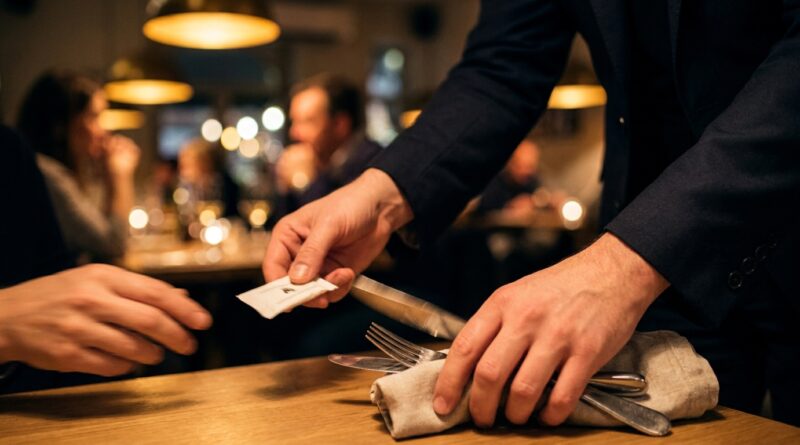
You show a sugar packet. It goes into a loosely folded napkin. While “making sure it stays inside,” you really retain the packet and leave a folded note or prediction. This works because nobody knows the exact shape of a bundled napkin from memory.
Borrowed ring to napkin corner
This one needs more care because rings are personal and reflective. You display the ring, wrap it in a napkin corner for “safety,” and during the tightening and regrip, the ring is retained while a previously folded corner or small object takes its place. Then the ring appears elsewhere.
Do not start here. Start with objects nobody is emotionally attached to.
Receipt to business card
You borrow a receipt, fold it once, then “write a prediction” or “keep it safe.” During the squaring action, it becomes your business card. This is practical for restaurant work because the magic and your contact info become the same moment.
Why this switch is angle-safe
Angle-safe does not mean invisible from every possible seat. It means the move is protected by body position, object shape, and timing, so side viewers see a normal adjustment instead of a secret action.
Here is what makes this kind of switch hold up:
The dirty work happens in motion
A static palm is often more suspicious than a moving adjustment. Folding and straightening create natural blur without looking flashy.
The cover object is ordinary
A napkin, receipt, or packet gives you a reason to touch, square, and reposition. That is much stronger than random hand waving.
The audience does not know the exact outline
A coin has a very obvious shape. A folded paper bundle does not. That gives you room.
How to practice it without fooling yourself
A lot of sleights feel solid in the mirror and awful at a real table. So practice this in layers.
Phase 1: learn the traffic pattern
Do the motions with two pieces of folded paper. No reveal. No script. Just show, fold, adjust, switch, relax.
Phase 2: add a side-angle camera
Not head-on. Side angle. That is where restaurant spectators live.
Phase 3: add speech
If the move only works in silence, it is not ready. Talk while doing it. Ask a question. Make eye contact.
Phase 4: test object families
Try flat-to-flat first. Receipt to card. Packet to packet. Napkin bundle to note. Then move to ring work later.
If you already like visual changes, you may also enjoy From One Coin To Real Reactions: Build One Pocket‑Ready ‘Hybrid Change’ That Fools Both Live And On Camera. It covers the same big lesson from another angle. One flexible move is often worth more than ten flashy one-offs.
Common mistakes that kill the illusion
Showing the object too many times
Beginners think extra proof helps. It usually hurts. Display once, clearly, and move on.
Using an unmotivated cover
If you pick up a napkin for no reason, people feel the reason. The cover has to belong in the scene.
Rushing the reveal
After the switch, let the object exist for a beat. Confidence makes things look fair.
Starting with borrowed valuables
Do not learn this with someone’s wedding ring. Use paper objects until your fingers know the route.
A simple drill you can start tonight
Grab these:
One sugar packet. One folded blank slip of paper. One napkin.
Now run this sequence ten times.
Show the sugar packet. Wrap it in the napkin. Adjust the bundle once. Secretly retain the packet and leave the folded slip. Place the bundle down. Wait one beat. Open it and show the change.
Your goal is not speed. Your goal is that the wrap and the switch look like the same action.
Once that is smooth, change the objects. Keep the same skeleton.
When to use this in paid work
This shines in loud environments because it does not depend on a long script. It also resets fast if you build it around common table items.
For strolling gigs, this kind of switch works best as a middle beat, not the opener. First, get them on your side with something direct. Then use the everyday object moment to make the magic feel personal and impossible.
For social clips, the same move plays well because it looks organic. It does not scream “camera trick” when the objects are familiar and the handling is calm.
At a Glance: Comparison
| Feature/Aspect | Details | Verdict |
|---|---|---|
| Best object type to learn on | Flat or soft items like receipts, folded slips, napkin corners, or sugar packets | Best starting point |
| Angle safety | Strong when hidden inside a fold, wrap, or natural adjustment instead of a static display | Very practical for tables and walk-around |
| Real-world value | Works with borrowed or found objects, resets quickly, and adapts to social and paid settings | High value foundational move |
Conclusion
You do not need a giant catalog of bar bets, ring tricks, packet moves, and napkin stunts to look ready in the real world. You need one dependable everyday object switch sleight of hand that makes sense at a table, from the side, under pressure. Right now the feeds are full of table-side magic, strolling gigs, and everyday object clips because that is where real demand is. People are hiring performers who can create strong magic in noisy, crowded rooms, not just under perfect conditions. If you build this one switch and drill it until it feels like normal handling, you give yourself a tool that upgrades restaurant work, casual videos, and paid walk-around sets all at once. Start tonight with paper and a napkin. Keep it simple. Then let that one move grow into ten real moments.