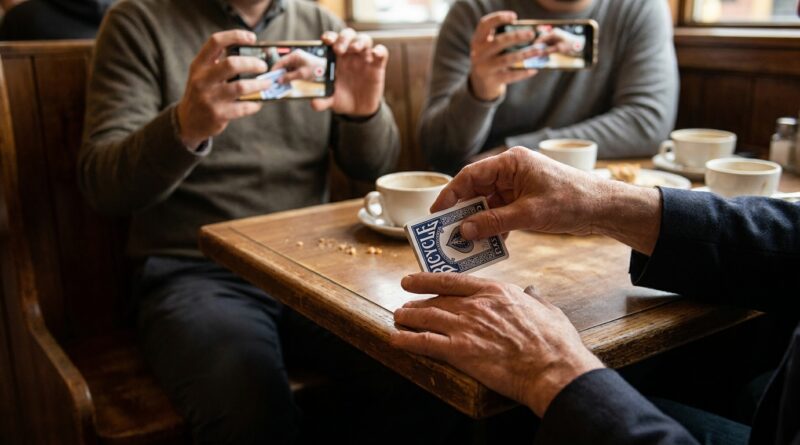
From Shaky Hands To Camera-Ready Miracles: Build One ‘Ultra-Slow Sleight’ System That Survives HD Replays
Your hands feel fine until the phone comes out. Then suddenly every tiny finger twitch looks guilty, every grab looks rushed, and that move you swear kills live starts to fall apart the second someone scrubs the clip back in slow motion. That is the real pain behind modern close-up magic. Spectators do not watch like spectators anymore. They watch like editors. They pause, zoom, replay and share. If you want to know how to make sleight of hand invisible in slow motion, the answer is not to get faster. It is to build one repeatable system that makes every beat calmer, cleaner and easier to believe. Think of it like image stabilization for your handling. You are not hiding bad technique with cuts. You are designing the move so the secret happens in a moment that still looks natural in HD, at full speed or half speed, live or on a screen.
⚡ In a Hurry? Key Takeaways
- To make sleight of hand invisible in slow motion, slow the whole routine down and hide the method inside a justified action, not a fast action.
- Use one “Ultra-Slow Sleight” system: set the picture, relax the hands, separate the dirty work from the magical moment, and rehearse on phone video at 0.5x speed.
- If a move only works with jump cuts or panic speed, it is not camera-ready yet. Fix the structure before posting it.
Why speed is usually the thing exposing you
Most magicians first try to solve scrutiny by moving quicker. That works for a live glance. It fails on a phone.
Slow motion is brutal because it removes your old cover. A burst of speed does not look magical under replay. It looks like something happened there. Even non-magicians can feel it.
The better goal is simple. Make the secret action look like the least interesting, most ordinary thing in the sequence.
That is the core of an Ultra-Slow Sleight system. You do not race past the method. You bury it inside normal behavior.
The Ultra-Slow Sleight system
Here is the framework. Use it on cards, coins, bills, small objects, almost anything.
1. Freeze the effect picture first
Before you work on the move, decide what the audience should remember. One clean image. A coin at the fingertips. A card shown fairly. An empty hand resting naturally.
If the picture before and after the method is strong, the middle can be quieter. That matters. People forgive a lot when the visual story is clear.
2. Give every hand a job
Idle hands look suspicious on replay. Busy hands look worse if the busyness has no reason.
Ask two blunt questions:
- Why is this hand moving now?
- Would a normal person move this way if no trick were happening?
If you cannot answer both, the move needs surgery.
3. Separate the secret from the magic moment
This is the big one. The dirty work should not happen at the exact moment you want the audience to feel astonishment.
Do the method early, casually, on an offbeat. Then let the effect register later.
That gap is gold. When the reveal comes a beat after the work, replays become much less helpful. People are rewinding the wrong moment.
4. Build in soft, not sharp, cover
Sharp cover is a quick snap, jerk, flick or squeeze. It reads like a cover-up in HD.
Soft cover is better. A hand settles. Fingers relax. An object rotates a few degrees. The wrist turns because the audience needs a better view. Those actions survive replay because they look normal at any speed.
5. Keep the grip readable
Strange tension is one of the easiest tells in close-up magic. If your thumb clamps down like it is holding state secrets, viewers notice.
Try this test. Mute your practice clip and watch only your fingertips. If your grip changes right before the method, that is where suspicion starts.
6. Let the object do some of the work
Coins, cards and bills can create natural shade lines, edges and angles. Use them. Do not depend only on finger speed.
A small tilt, a partial overlap, or a brief moment where the object blocks the exact point of method is often cleaner than trying to outrun the camera.
The three-beat timing pattern that works on video
When people ask how to make sleight of hand invisible in slow motion, they usually expect a move. What helps more is timing.
Use this simple three-beat pattern:
Beat 1. Show
Give a clear, stable picture. Hold it a hair longer than feels comfortable. This tells the audience, “You saw it.”
Beat 2. Shift
Make one motivated action. Turn the hand. Pick up the object. Adjust the display. This is where the method lives.
Beat 3. Rest
After the secret action, stop. Let the hands go quiet. Then reveal.
That rest beat is where many magicians panic. They rush because silence feels dangerous. But on camera, stillness reads as honesty.
What “camera-ready” actually looks like
Camera-ready does not mean flashy. It means boring in the best possible way.
Your handling should look as if nothing sneaky could have happened, even though something did.
Here are the signs a move is ready:
- No sudden acceleration at the method point.
- No fingertip squeeze that appears from nowhere.
- No eye dart toward the dirty hand.
- No extra finger curl after the object should be gone or changed.
- No reveal that lands on the same beat as the secret.
If you want a related example of building for both real people and a lens, From One Coin To Real Reactions: Build One Pocket‑Ready ‘Hybrid Change’ That Fools Both Live And On Camera tackles the same issue from the effect design side.
How to rehearse for HD replays without losing your nerve
You do not need a studio. You need your phone, decent light and honesty.
Record at normal speed first
Do ten takes. Watch them once at full speed. If the move already looks rushed, slow motion is not the problem. Structure is.
Then watch at 0.5x
This is where the truth comes out. Look for the exact frame where your body says, “Something happened.”
Not just the hands. Your shoulders, chin and eyes can expose the move before the fingers do.
Turn the sound off
Patter can hide timing issues. Silent playback cannot. If the move still looks innocent with no words helping it, you are getting somewhere.
Crop tighter than you like
Phones zoom. Viewers pinch in. Practice with a tighter frame than your planned post. That way you are testing the worst case, not the best case.
Use a “ten rewind” rule
If you can watch the same three seconds ten times and the method does not jump out, the move is strong enough to share.
Common mistakes that make slow motion your enemy
Doing the move at the moment of attention
If all eyes are on the exact place and time the work happens, you are asking too much from technique alone.
Confusing slowness with stiffness
Slow is good. Robotic is not. Natural rhythm matters more than reduced speed by itself.
Adding fake fairness
Extra displays, repeated showing and suspiciously clean proving actions often create the very heat you wanted to avoid.
Using the camera angle as a crutch
If a move only survives from one narrow angle, it may work as a shot. It is not yet a system.
Practicing only the fingers
The whole body sells innocence. Breathe. Blink normally. Do not stare at your own method point like it owes you money.
One practical drill you can use tonight
Pick one move you already do. Not your dream move. The one in your current set.
- Perform it as usual and record it.
- Write down where you think the heat is.
- Now remove all speed. Do it 30 percent slower.
- Add one justified action before the method.
- Insert a full rest beat after the method.
- Record again.
- Compare only one question: which version looks less interested in itself?
That sounds odd, but it matters. The cleanest sleight of hand often looks completely uninterested in proving anything.
Live magic and social clips should help each other
The nice thing about this system is that it works both ways. Better live timing gives you cleaner clips. Better camera discipline gives you calmer live handling.
That is why the strongest creators are moving away from pure hyper-cut eye candy. Viewers are smarter now. They know when editing is doing the trick.
If your goal is trust, not just views, then clean structure beats frantic visuals every time.
At a Glance: Comparison
| Feature/Aspect | Details | Verdict |
|---|---|---|
| Fast handling | Can fool in the moment, but replays highlight sudden motion and tension changes. | Weak for HD scrutiny |
| Ultra-Slow Sleight system | Uses justified actions, delayed reveals, soft cover and rest beats to hide the work naturally. | Best long-term approach |
| Editing-dependent magic | Looks strong online at first, but does not build trust or transfer well to live performance. | Fine for a stunt, poor for a real system |
Conclusion
If your move falls apart only when slowed down, that is frustrating, but it is also useful information. It means the answer is not more nerve or more speed. It is better design. Creators keep sharing flashy visual changes, but the underground talk in sessions right now is about moves that still look clean after the clip is scrubbed back ten times. A structured way to slow every beat of your sleight down without exposing the work gives our community something they can use tonight: stronger close up sets, more honest-looking social clips and a clear path from fast and nervous to calm and impossible in the spectator’s memory. It also future-proofs your material as platforms push higher frame-rates and better zoom on every new phone.