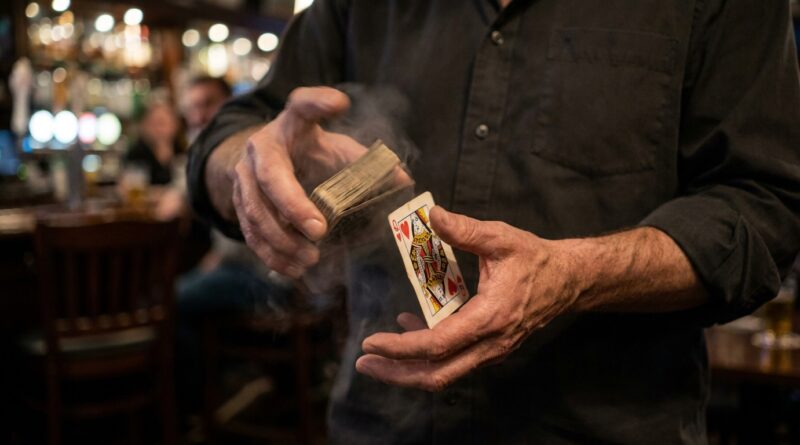
From Viral ‘One-Handed Cuts’ To Real-World Magic: How To Build One Pocket‑Ready Deck Vanish You Can Use Anywhere
You know the feeling. You spend a week learning a gorgeous one-handed cut from a reel, hit it three times in your bedroom, then a real human hands you their deck and everything suddenly feels shaky, angle-heavy, and weirdly pointless. That is the gap a lot of magicians are stuck in right now. Social clips have trained people to expect fast, visual, one-handed impossibilities. Real-world performances still demand control, clarity, and something that survives bad lighting, dry hands, and a borrowed pack. The good news is you do not need to choose between flashy and usable. You just need one pocket-ready sequence that looks like modern cardistry magic but functions like real sleight of hand. A practical one handed deck vanish sleight of hand can do exactly that. Not a stunt for your camera roll. A worker. Something you can carry into strolling gigs, bar sets, or that awkward “show us something” moment without needing a table, a jacket, or a second chance.
⚡ In a Hurry? Key Takeaways
- A strong one handed deck vanish sleight of hand should look flashy but be built on simple grips, natural timing, and a clean offbeat.
- Start with a false one-handed cut, then use body turn, eye contact, and pocket management to turn the flourish into a real vanish.
- If the move only works for your phone camera and not for a spectator standing to your left, it is not ready yet.
The Real Problem With Viral Card Magic
Most viral moves are optimized for one thing. A tiny rectangle on a screen.
That means perfect angle, perfect take, perfect lighting, and no drunk spectator burning your hands from six inches away.
In person, the rules change. A move needs to survive interruption. It needs to make sense. And it has to feel like magic, not finger exercise.
That is why so many one-handed cuts get applause online but silence in a live set. They are skill displays, not effects.
If you want a one handed deck vanish sleight of hand that people actually remember, the vanish has to be the point. The flourish is just the wrapper.
What A Pocket-Ready Deck Vanish Actually Needs
Before talking method, it helps to define the job.
It must work standing up
No table. No close-up pad. No careful reset area.
It must survive a borrowed deck
Not every pack will fan nicely or feel soft in the hand. Your sequence should still function with a slightly clunky deck.
It must read instantly
The audience should understand the effect in one sentence. “The deck was in his hand, then it was gone.”
It must hide its dirty work inside a visual action
This is where the modern style helps. A one-handed cut or swivel action gives you movement, cover, and a reason for the hand to look active.
A Simple Structure You Can Use Tonight
You do not need a knuckle-busting move list. You need a sequence with a beginning, middle, and vanish.
Phase 1: Show the deck clearly
Hold the deck in dealing grip. Relax your shoulders. Let them see a normal pack. This sounds obvious, but many performers rush the display and lose the effect before it starts.
Phase 2: Do a one-handed cut that looks like flourish, not procedure
Use the cut you can already do at 90 percent without stress. A charlier-style action is enough. You are not entering a cardistry battle. You are creating a visual beat that says, “I can manipulate this deck in one hand.”
Phase 3: Close the packets and hit the offbeat
This is the secret hinge. The vanish should happen as attention shifts from the moving packets back to your face, your words, or the spectator. The cut creates motion. The close creates cover. The offbeat creates invisibility.
Phase 4: The deck vanishes into a pocket, servante alternative, or body load
For a real-world worker, the easiest option is a pocket steal or pocket dump timed under the completion of the one-handed action. If you are standing naturally, the hand drops for a fraction of a second, the deck is released, and the now-empty hand comes up as if nothing happened.
That is the whole idea. You are not vanishing the deck during the flashy part. You are vanishing it right after, when people think the hard part is over.
Why This Works Better Than A Pure Flourish
A flourish says, “Look how well I handle cards.”
A vanish says, “That should not be possible.”
Put them together and you get the visual language people now expect online, but with an actual magical payoff.
This is the same larger lesson behind new gadget talk in magic. A lot of the future is not about replacing sleight of hand. It is about making impossible moments feel more natural. That is part of what makes From Lab Tech To Living Room Miracle: How MIT’s Ultrasound Wristband Points To The Next Era Of ‘Hands‑Free’ Sleight of Hand so interesting. The big idea is not the gadget itself. It is the push toward hidden method and effortless-looking effect. Your vanish should aim for that same feeling, even with nothing more than practice and a pocket.
Hand Position Matters More Than The Secret
This is where many good methods go bad.
Keep the wrist neutral
If your wrist locks up or bends oddly, people sense that something is happening. A relaxed wrist sells innocence.
Do not claw the deck
Grip pressure is a dead giveaway. Hold firmly enough to control the packets, lightly enough to look casual.
Use the fingers to frame the action
Your fingers should not look like they are hiding something. They should look like they are managing the cut. There is a big difference.
Bring the hand back into view quickly
Once the load or ditch is done, the empty hand should return to the visual field right away. Empty space is your best friend after a vanish.
How To Frame It For Real People
Patter is not there to decorate the trick. It helps direct attention and justify movement.
Try something simple.
“People think one-handed cuts are just showing off. Fair. But if the cards get too comfortable in one hand, they stop acting like cards.”
That line does a few useful things. It acknowledges the flourish. It gets a laugh. And it gives you a reason to do something impossible next.
Use your eyes well
Right before the vanish, look at the spectator, not at the deck. Many performers stare at the move they fear. Spectators follow the eyes.
Use the spectator’s deck as a feature
If someone says, “Do that with mine,” smile. That is not a challenge. It is a gift. Borrowed objects raise the stakes and lower suspicion.
How To Rehearse So It Feels Natural
Here is the part most people skip. They practice the flourish until it looks smooth, then barely practice the vanish timing at all.
Step 1: Practice the cut alone
Ten clean reps. No rush. No vanish. Just get the action soft and steady.
Step 2: Practice the ditch or load alone
Stand in front of a mirror and work only on the moment the deck leaves the hand. Watch your shoulder, elbow, and wrist. Tension leaks method.
Step 3: Stitch them together slowly
Do the cut. Pause. Complete the action. Ditch the deck. Raise the empty hand. Slow practice is where the rough edges show up.
Step 4: Add speech
If the move falls apart the second you talk, it is not learned yet. Real performance includes words, breathing, eye contact, and interruption.
Step 5: Test on bad conditions
Try it with a stiff deck. Try it when your hands are dry. Try it standing at a kitchen counter with people on both sides. If it only works in ideal conditions, keep working.
Common Mistakes That Kill The Effect
Making the cut too long
If the flourish feels like an exhibition, the vanish becomes an afterthought.
Rushing the reveal of the empty hand
Ironically, speed can make people suspicious. Calm is stronger than fast.
Choosing a move beyond your current level
The best practical sequence is often built on a simple one-handed cut, not the fanciest one in your feed.
No follow-up
After the vanish, have somewhere to go. Produce the deck from a pocket, under a spectator’s arm, or from another impossible location. A vanish is good. A vanish with resolution is better.
Turning Trends Into Workers
This matters beyond one trick.
Every month, short-form magic pushes a new visual style. A spin change. A packet toss. A one-finger spring. Most of it is disposable. But hidden inside those trends is a useful question.
What part of this looks impossible to normal people?
Once you answer that, you can strip away the extra noise and build a routine around the visual moment. That is how you stop copying clips and start making performance pieces.
Your goal is not to look like the algorithm. Your goal is to borrow its visual grammar and then make something sturdy enough for the real world.
At a Glance: Comparison
| Feature/Aspect | Details | Verdict |
|---|---|---|
| Visual impact | A one-handed cut followed by a clean vanish feels modern and reads fast, even on first viewing. | Excellent for phone-camera moments and live reactions. |
| Practicality | Works best when built around a simple cut, a relaxed pocket ditch, and strong audience framing. | Very usable if you keep the method simple. |
| Learning curve | The flourish part is easy to overpractice. The real challenge is timing, body language, and naturalness. | Moderate. Easier than it looks if rehearsed in layers. |
Conclusion
Short-form cardistry magic clips are changing what people expect a magician to look like. That is just the reality now. If you do not have at least one hyper-visual, one-handed, no-table effect ready to go, you can feel a little out of step the moment someone points a phone at you. The fix is not learning ten flashy cuts that never leave your bedroom. It is building one strong one handed deck vanish sleight of hand that looks current and plays anywhere. Start with a cut you can already do. Hide the method in the moment after the flourish. Rehearse the body language as hard as the fingers. Frame it clearly. Then test it in the wild tonight. If you do that, you will have more than a trick. You will have a blueprint for turning tomorrow’s visual trends into real-world workers that still feel magical when the camera is off.