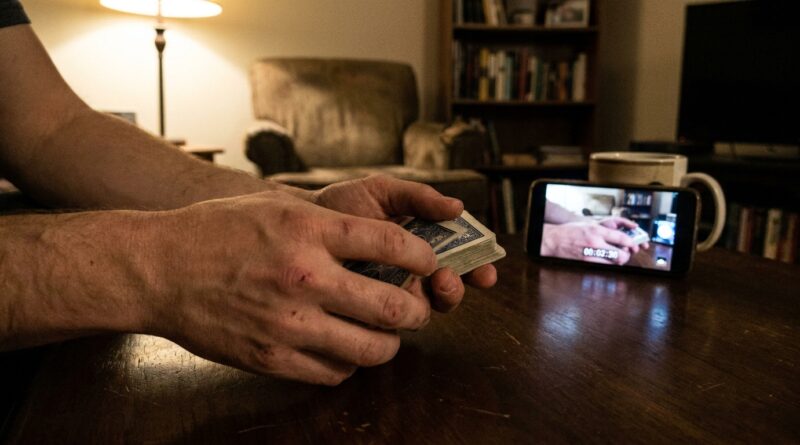
From Angles To Algorithms: Build One Camera‑Proof Card Control That Survives AI Replay
You can feel it when a move that kills in person suddenly looks guilty on video. Someone slows your reel to 0.25x, pinches to zoom, and there it is. A knuckle flash. A weird packet shift. A moment that was “covered by timing” in the room, but not to a lens that never blinks. That is frustrating, especially if you have put years into getting a pass or undercut smooth. The fix is not to move faster. It is to build a control that is clean by structure. If the camera can replay everything, your method has to survive replay. A good camera proof card control sleight of hand should look the same at full speed, slow speed, and frame by frame. That means fewer exposed edges, less packet travel, and a rhythm that gives the eye nothing dramatic to chase.
⚡ In a Hurry? Key Takeaways
- Use a spread insertion to jog to swing cut control. It is more camera-safe than trying to outrun the lens with a pass.
- Keep the deck level, the hands relaxed, and the selection’s trip to the top hidden inside normal squaring actions.
- This is practical for live work and social clips because it relies on structure, not speed, harsh angles, or edits.
Why old controls get exposed on modern cameras
A lot of classic controls were built for human attention, not machine replay. That is not a criticism. It is just the truth.
At a table, spectators blink. They react. They look at your face. A phone camera does none of that. It stares, records, and invites people to inspect every beat later.
That changes the game. Fast packet shifts that once felt invisible can look noisy under slow motion. Big hand movements read as “something happened here.” Even if they cannot name the move, they sense the method zone.
So the goal in 2026 is simple. Build controls that look boring on replay. Boring is your friend. If nothing seems to change, there is nothing exciting to investigate.
The control to build: Spread Insertion to Jog, then Swing Cut Control
If you want one practical camera proof card control sleight of hand to start using tonight, make it this one.
It is not sexy. Good. That is why it works.
The spectator returns a card into a spread. You outjog it slightly as you close the spread. Then, under the natural action of squaring and a casual swing cut, you bring the selection to the top. To a viewer, it reads as fair placement, clean squaring, and ordinary handling.
No sudden deck dip. No full-deck choke grip. No “heat moment” where the whole trick seems to pause so your fingers can do surgery.
What the audience sees
They see their card go into the middle. They see it remain visible for a beat as an outjog. Then they see you square the deck and casually cut. That is all.
What actually happens
The outjog gives you a known break point. The closing action hides the setup. The swing cut transfers packets in a way that looks standard, while secretly carrying the selection into top position.
The important thing is that the control happens inside actions that already make sense.
Why this survives replay better than a pass
A pass asks a lot from timing and cover. This control asks more from choreography.
That is a better trade for video.
1. The packet travel is smaller
Large packet movement creates visual events. Visual events invite scrutiny. Here, the deck mostly stays in one place.
2. The moments are motivated
You are not doing a move because “a move must happen now.” You are closing a spread and squaring a card. That feels normal, even when replayed.
3. The control is distributed
Instead of one suspicious instant, the work is spread across a few harmless beats. Replay is less useful when there is no single flashpoint.
4. It reads the same from different distances
This matters more than many card workers think. If you also perform standing or for larger groups, the same design principle shows up in From Table Hops To Arena Shows: Build One ‘Parlour-Size’ Sleight System That Survives Any Room. A move should not only fool. It should read clearly and innocently across conditions.
How to do it cleanly
Step 1: Spread with a flat, calm deck
Do not angle the spread toward yourself like you are protecting state secrets. Keep it open and easy. Let the insertion look fair.
Step 2: Accept the card and leave it outjogged
Only a little. About a half inch is plenty. Too much looks staged. Too little makes the next beat cramped.
Step 3: Close the spread around the jogged card
This is where many people get guilty. They tense up. Do the opposite. Close slowly enough to look casual, but not so slowly that each finger action becomes visible.
Step 4: Establish the break during squaring
Your hands should look like they are doing one job only. Squaring. If your thumb digs or your pinky pops, the camera will find it later.
Step 5: Swing cut naturally
The cut should look like a thing you would do even if no trick were happening. If you never swing cut in ordinary handling, start using it more often so it belongs to your style.
Step 6: Settle, then move on
Do not celebrate the control. Do not freeze. Ask a question. Make eye contact. Continue the trick. The less you underline the moment, the less replay has to latch onto.
Three rules that make it camera-proof
Keep the deck horizontal
Tilting the deck creates shadows and glimpses. A level deck gives the camera less information.
Use soft hands
Tension is visible. It reads as effort. Effort reads as method. Relaxed hands look honest.
Never rely on speed as the secret
Speed can polish a move, but it should not be the engine. If the move falls apart in slow motion, it was never really hidden. It was only hurried.
Common mistakes that ruin this on video
Over-proving the fairness
If you stare at the inserted card too long or display the middle too aggressively, you create a challenge moment. Just let it be seen and move on.
Making the cut too neat
Funny enough, perfect cuts can look suspicious. Human handling has a little mess to it. Not sloppy. Just alive.
Changing your rhythm at the secret beat
This is the big one. If your cadence suddenly slows, the replay crowd knows where to start digging.
Practicing only from your own eyes
Your point of view is the least useful one. Practice with your phone at chest height, table height, and slightly off-center. Then watch it back muted. If the move still looks innocent without patter, you are getting somewhere.
A simple drill for tonight
Try ten reps with no script. Then ten reps while saying your usual lines. Then ten reps while asking the spectator a question during the square-up.
Film all thirty.
Now review them at normal speed, 0.5x, and frame by frame. Not to torture yourself. To find where the handling stops looking like normal card use.
Look for this question. “At what exact moment would a skeptical viewer say, ‘Something happened there’?” That is the moment to smooth out.
When to use this control, and when not to
Use it when you want a believable, repeatable top control that can live in both live work and social clips. It is ideal for ambitious card phases, sandwich routines, transpositions, and any effect where “lost in the middle” matters.
Do not use it when the routine already has too much cutting. Also skip it if your character never handles cards casually. A camera-proof move still has to fit the person doing it.
What this teaches beyond one move
The bigger lesson is not “here is the best control forever.” It is this. Start designing sleights by what the lens can prove, not by what your timing can hide.
That shift matters. It keeps ungimmicked card work strong even when viewers can replay everything. And it nudges you toward methods that are cleaner in real life too.
At a Glance: Comparison
| Feature/Aspect | Details | Verdict |
|---|---|---|
| Replay resistance | Method is hidden inside normal spread closing, squaring, and a casual cut, with no single explosive secret moment. | Strong for reels and phone video |
| Difficulty | Moderate. More about rhythm, touch, and naturalness than finger-busting speed. | Practical for working magicians |
| Angle safety | Deck stays fairly level, packet travel is small, and exposed edges are limited compared with many classic controls. | Better than speed-based controls |
Conclusion
You do not need to beat the camera with faster fingers. You need to give the camera less to find. That is why this spread insertion to jog, then swing cut control is worth building. It is practical, repeatable, and designed for a 2026 audience that assumes everything can be replayed, slowed down, and picked apart. Use it tonight in real performances. Use it tomorrow in reels. The win here is not just one stronger control. It is a better way to think. When you focus on how a move reads to the lens, not just the front row, you future-proof your material, keep real sleight of hand ahead of tech, and get back that quiet confidence that skill can still beat frame-by-frame analysis.