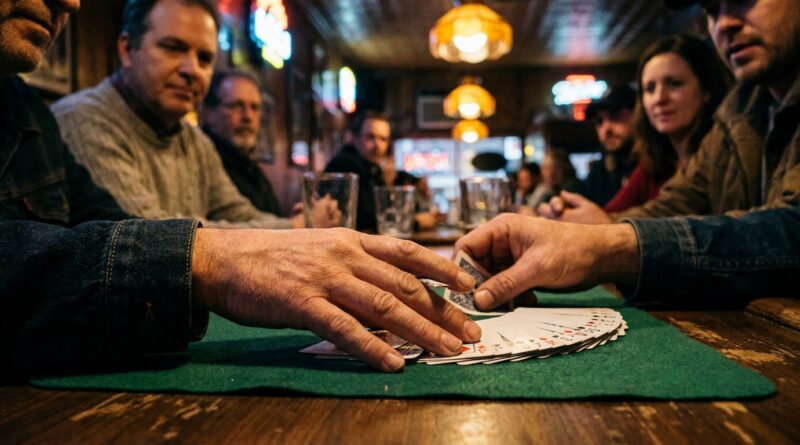
From Viral ‘Table Edge’ Clips To Real-World Miracles: How To Build One Invisible Off‑The‑Table Card Steal You Can Use In Any Routine
You know the clip. A card rides the table edge, the hand relaxes, and somehow the card is gone. On Instagram it looks like science fiction. In real life it often looks like you dropped something and hoped nobody noticed. That is the frustration. The move is built for one lens, one height, one perfect line. The moment a real spectator leans forward, stands up, or glances at the tabletop, the whole thing feels risky.
The good news is you do not need a camera-only solution. You need one invisible table edge card steal that respects live angles, normal body posture, and the fact that people move. If you already know your controls, false shuffles, and basic palms, this is the missing bridge. The goal here is simple. Build one off-the-table steal you can drop into ambitious card, sandwich effects, transpositions, or clean-up work, and make it hold up for actual humans standing around you tonight.
⚡ In a Hurry? Key Takeaways
- The best invisible table edge card steal for real audiences is not a fast snatch. It is a soft edge drag into relaxed hand cover timed to a natural reason for the hand to leave the table.
- Rehearse from spectator eye level, not from your own view or a phone on a tripod. The table line is where flashes happen.
- If the steal needs a perfect angle or frozen audience, it is not ready. Build it around body position, timing, and a believable offbeat.
Why viral table edge steals fail in the real world
Most of the viral versions cheat in three ways. First, the camera is low and fixed. Second, the action happens in a tiny frame where your hand can block everything. Third, there is no social pressure. No one is interrupting, breathing down the side, or shifting left half a step.
Real people do all of that. They also look exactly where you do not want them to look. Down at the deck. Down at the table line. Down at the hand that suddenly got busy.
That is why speed alone does not save you. In fact, trying to make an invisible table edge card steal by moving faster usually makes it worse. The hand gets tense. The shoulder joins in. The wrist looks guilty. Spectators may not know the method, but they can smell effort.
The steal we are building
The version worth learning is a controlled edge drag steal. The card is secretly jogged or positioned near the outer edge of the table. Your hand approaches for an innocent reason, the fingers contact the card at the edge, and the card is drawn into a palm or clipping position as the hand leaves the table in a relaxed, ordinary motion.
Nothing jerky. Nothing flashy. No fishing at the edge.
This matters because the off-the-table moment is where live deception happens. The audience does not remember a grab. They remember that your hand simply moved away and the card was no longer where they thought it was.
What makes an invisible table edge card steal actually invisible
1. The table edge does part of the work
You are not plucking a card out of space. You are letting the edge help buckle, separate, and guide the card into your hand. Think less “steal” and more “collect.” That change in mindset cleans up your motion right away.
2. The hand needs a reason to travel
The hand should be going somewhere anyway. To pick up a pen. To square a packet. To move a glass. To gesture toward a spectator. If the hand only goes to the edge to do secret business, the move gets lonely and suspicious.
3. The audience sees shape before detail
People notice a clawed hand faster than they notice a hidden card. Keep the fingers loose. Keep the thumb calm. A natural empty-looking hand beats a technically perfect grip that screams tension.
4. The steal happens on the way out
This is the big one. The method begins at the edge, but the effect of concealment finishes as the hand leaves. If you try to complete everything while parked at the table line, you invite heat.
Set-up options that do not scream set-up
You need the target card near the edge, but you do not need to make that look important. There are several easy ways.
- A slight outjog during a spread square-up.
- A card placed on the table as a “marker” or supposed indifferent card.
- A controlled card dealt to a small tabled packet nearest your working hand.
- A spread on the table that is casually narrowed toward the edge.
The cleaner route for most people is a single card resting near the outer edge with a millimeter or two available for contact. Not hanging off. Just available.
Step-by-step handling
Stage 1: Park the card where the edge can help you
Place or leave the card at the table edge nearest your dominant hand. The long side can be parallel to the edge, or the short side can point toward you depending on your palm style. Most magicians will find the long-side approach easier for a first working version.
Important detail. Do not make the card the lowest object on the table. If possible, have a packet, box, coin, or another card nearby so the eye does not isolate that one edge card as special.
Stage 2: Approach with an innocent task
Your hand comes in flat and easy. Maybe you are reaching to square a packet, take back a selection, or clear space. The fingers should look like they are about to touch several things, not like they are hunting one hidden target.
The contact point is usually the pad of the third finger and fourth finger, with the thumb staying relaxed and the first finger not jutting out like an antenna.
Stage 3: Use the edge drag
As the hand passes the target card, the fingertips pull it slightly against the table edge. The edge gives you the tiny separation you need. That lets the card begin to curl into the hand without a visible pinch.
Do not yank. This is where social media handling goes wrong. A quick tug creates a visible hitch. Instead, think of dragging a napkin an inch toward you. Soft. Almost lazy.
Stage 4: Leave the table naturally
Once the card has started into the hand, keep going. The hand leaves the tabletop because it was always meant to leave the tabletop. This is where the card settles into gambler’s cop, a light palm, or a side-clipped hold depending on the next phase of your routine.
Most people will do best with a simple cop-like position because it keeps the hand loose and low. You do not need a museum-grade classic palm if the hand is just going to rest at your side for a beat.
Stage 5: Do not freeze
Nothing attracts attention like a hand that suddenly becomes a statue. If you have stolen the card, keep living. Gesture with the free hand. Ask a question. Turn your torso a few degrees. Pick up the deck. The body should say, “We are moving on.”
The angle secret most tutorials skip
The danger line is not straight ahead. It is slightly above the table edge from the spectator’s viewpoint. That is why a move that looks covered from your eyes can still flash badly for someone sitting opposite you.
Practice with your phone at spectator height, not magician height. Put it low, where a real person’s eyes would be if they were seated or leaning in. Then put it to your left. Then your right. Then stand and repeat. You will learn more in ten minutes than from fifty perfect front-facing takes.
This same gap between “tech looks cool” and “live looks natural” shows up in other corners of magic too. If that idea interests you, From Lab Tech To Living Room Miracle: How MIT’s Ultrasound Wristband Points To The Next Era Of ‘Hands‑Free’ Sleight of Hand is a good reminder that clever methods still have to survive real human watching.
Best hand positions for beginners
Gambler’s cop style
This is the friendliest option for an invisible table edge card steal. The card lands along the base of the fingers and rides in a low, relaxed hand. Good for standing work, card-to-pocket, and delayed reveals.
Loose side clip
Useful if your next action involves turning the hand palm down near the deck. Harder to keep casual at first, but strong when you need the palm to look empty in motion.
Shallow palm
Good if the card must be brought immediately into another sequence. Riskier for beginners because tension shows fast.
Where to use it in actual routines
This steal is not just a stunt. It is a utility move. That is what makes it worth your time.
- Ambitious card clean-up, where a duplicate or indifferent card must vanish from the table.
- Card to pocket, with the offbeat created by asking the spectator to name the card again.
- Transpositions, where one tabled card secretly becomes available for loading or switching.
- Multiple selection routines, where one out-of-play card has to disappear without a suspicious pickup.
- Stand-up close-up sets, when lap steals are not available.
Misdirection that does not feel like misdirection
Forget “Look over there.” That is theater-school misdirection, and it often lands hard in close-up.
Better options are built from conversation and task changes.
Ask for a memory beat
“You could have picked any card, right?” While they answer, your hand leaves the table. Their brain switches from seeing to confirming.
Move the plot forward
“Put your hand on the deck.” This gets a spectator involved and shifts attention to the new job.
Use object choreography
As your stealing hand leaves, the other hand squares the deck or points to a card box. Two events at once are stronger than one guilty event alone.
Three common mistakes that give the game away
1. Starting too exposed
If too much card is available at the edge, you may think the steal gets easier. Sometimes it does. It also gets easier to spot. Keep the working margin tiny.
2. Practicing only from your own eyes
This is the classic trap. From your stance, the card looks hidden. From theirs, it flashes for a full beat.
3. Treating the move as the trick
If the whole room’s attention is on the edge card, you are already in trouble. The steal should solve a problem inside a routine, not become the headline moment by itself.
A practical rehearsal drill for tonight
Here is a simple way to make the move usable fast.
Drill 1: Silent reps
Do 25 steals without any script. Focus only on smooth contact and leaving the table without a hitch.
Drill 2: Add a line
Now do 25 reps while saying one sentence every time. Something simple. “Most people change their mind at this point.” If the line makes the hand tense, slow down.
Drill 3: Add a task
Steal the card and immediately pick up the deck with the other hand, or gesture toward a spectator. This teaches your body not to freeze after the method.
Drill 4: Change viewing height
Film seated, standing, left side, right side. Watch in silence first. If the hand looks guilty with the sound off, the audience will feel it too.
How to know when it is ready for people
Your invisible table edge card steal is ready when three things happen.
- You can do it at one speed only. Normal speed.
- Your hand looks the same before, during, and after the steal.
- You can talk through it without your eyes dropping to the edge.
If you still need to glance down, you are using your eyes as training wheels. Keep working.
At a Glance: Comparison
| Feature/Aspect | Details | Verdict |
|---|---|---|
| Camera-friendly snatch | Fast, flashy, often depends on one low front angle and heavy hand cover | Looks great online, weak for live 360 degree work |
| Edge drag into relaxed cop | Uses the table edge for separation, hides the method inside a natural leaving motion | Best all-around choice for real-world use |
| Rehearsal method | Phone at spectator height, side angles, spoken script, immediate follow-up action | Essential if you want the move to survive actual audiences |
Conclusion
The best invisible table edge card steal is not the one that gets likes. It is the one that does not look like a steal at all when a real person is breathing two feet away from your hands. That is why this kind of breakdown matters right now. So much of what is trending in magic is built for a locked camera frame, and that leaves serious students stuck with methods that fall apart the second the audience moves. If you build this one steal around soft edge contact, a real reason for the hand to travel, and honest rehearsal against live eye lines, you will have something far more useful than a disposable stunt. You will have a practical tool you can road test tonight, in routines that matter, in front of people who are not watching through a phone screen.