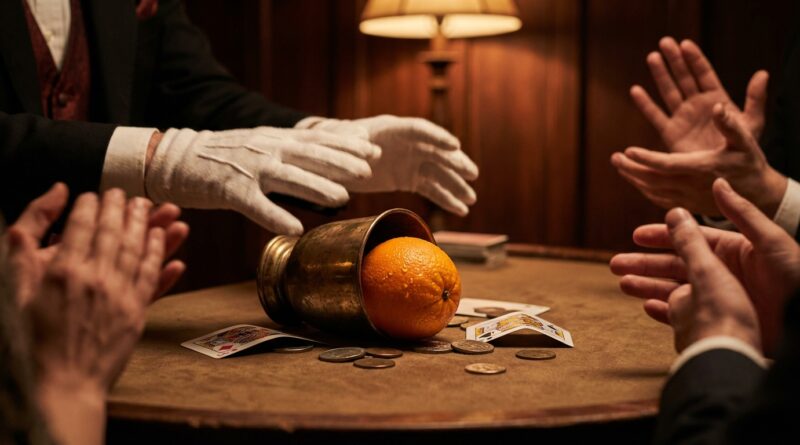
From Viral Fruit Surprise to Real‑World Miracle: How To Build A Worker Around The ‘Orange Reveal’ Plot
You have probably seen the clips. A hand waves. A vanish happens. Then, out of nowhere, an orange appears and the comments lose their minds. It is a great visual. It is also maddening if you actually perform for living, breathing humans. A camera can hide dead time, awkward steals, angle issues and editing beats. Real tables, real spectators and real paying gigs do not. That is why so many magicians watch these viral orange reveal moments and think, “Lovely. Now what do I do with it?” The good news is that the fruit itself is not the trick. The trick is the structure around it. Once you stop treating the orange as a random stunt and start treating it as a hard, motivated final load, it becomes useful. You can attach it to cups, coins, cards, ring flight plots, signed object routines and even a borrowed bill sequence, if the story and timing make sense.
⚡ In a Hurry? Key Takeaways
- The fastest way to turn a viral orange reveal into a real world routine is to use it as a final load that answers a clear question, not as a random visual.
- Start with a strong routine you already do well, then add the orange only after you have built a reason for the audience to care about where the vanished object ends up.
- Practicality matters. Pocket space, reset, fruit condition, venue rules and spectator distance will decide whether your miracle plays like gold or feels like a social media imitation.
Why the viral clip works, and why it often fails live
The social clip hits fast. It gives the eye one simple surprise. Small object, gone. Fruit, here. That is clean. It is easy to understand even with the sound off.
But live performance asks harder questions. Why an orange? Why now? Where did it come from? Why should anyone care more about the fruit than the vanish that came before it?
If you cannot answer those questions, the reveal gets a quick laugh or gasp and then dies. It feels like a puzzle piece from a different box.
That is the core idea if you want to know how to turn viral orange reveal magic trick into a real world routine. You need a plot, a reason and a path.
Stop thinking “orange trick.” Start thinking “orange ending.”
This is the shift most performers need.
The orange should usually be the ending, not the whole effect. In other words, the fruit is your exclamation point. It is not the sentence.
That means your routine needs three things before the reveal:
1. A clear object of interest
A signed card. A coin. A ring. A borrowed bill. A marked sugar packet. Something the audience can track.
2. A convincing loss
The object must seem fairly gone. Vanished, impossible to reach, or proven absent from where it should be.
3. A justified destination
The orange is not just “there.” It is where the object impossibly ended up, or it is the final impossible transformation after a running gag or premise.
That is how the thing goes from TikTok eye candy to actual worker.
The easiest real-world frame: use the orange as a final load
If you already do cups and balls, chop cup, coin through table, ambitious card, ring and string, or any vanish-and-recovery plot, you are closer than you think.
The simplest frame is this:
- Introduce a small object everyone remembers.
- Build repetition so the audience learns the game.
- Break the pattern.
- Produce the orange as the impossible finish.
This works because spectators enjoy escalation. They think they know the shape of the trick, then you hit them with a bigger impossibility.
Three practical routining models that actually work
Model 1: Chop cup to orange
This is the cleanest home for the plot. It already has history, logic and built-in rhythm.
You show a ball. It appears, vanishes and comes back. The audience gets the rules. Then you go one step beyond. The final load is the orange.
Why this works:
- The audience already accepts that objects can gather under the cup.
- The final load feels bigger, not random.
- The orange reads well from a short distance.
If you want a modern feel, do not present it as “classic magic prop business.” Present it as a game of impossible location. “If I keep making this little thing miss, eventually it has to overshoot.” Then reveal the fruit.
Model 2: Signed card to orange
This is stronger than many magicians think, if you handle the logic carefully.
The danger is obvious. A card inside fruit can feel disconnected if there was no path to get there. So you need a middle beat. For example, the signed card repeatedly rises or escapes, then vanishes completely, then fails to appear in your wallet or pocket where spectators expect it. Only then do you move to the orange.
The important point is that the orange should feel like the last place anyone would look, not the first weird thing you happen to be carrying.
Model 3: Coin routine with surprise fruit kicker
This one is less common, which makes it interesting. Imagine a coins across or one-coin sequence where a coin keeps appearing back in your hand. You build the idea that metal refuses to stay where it belongs. On the final phase, the coin vanishes and the orange appears. If you want to go further, the coin can later be found inside the fruit for formal close-up or parlor.
This gives a familiar coin plot a memorable last image. That matters. Many strong coin routines are admired in the moment, then forgotten. A fruit reveal gives the audience a snapshot to remember.
What is actually new here?
Usually, not the method. That is worth saying plainly.
The new part in many viral clips is the framing, the speed and the confidence of the visual beat. Social media has pushed magicians to trim the fat. One clean setup. One vanish. One impossible object. Bang.
That is useful. It teaches economy.
But if you are building a paid routine, the better lesson is not “copy the clip.” It is “borrow the compression.” Keep the reveal clear. Keep the handling motivated. Get to the point faster.
How to build your own worker step by step
Step 1: Pick a routine you already trust
Do not start with a fruit production and then go hunting for a trick to glue onto it. Start with a routine that already gets reactions.
Ask yourself:
- What do I already perform smoothly under pressure?
- What has a vanish or impossible location built into it?
- What can spare one extra minute for a stronger ending?
Your best candidate is usually the one you can perform while talking to real people, not the one that only works in silence for a camera.
Step 2: Decide what the orange means
This sounds small, but it fixes a lot.
Is the orange a container? A surprise transformation? A callback to a joke? A “wrong destination” gag that turns impossible? Pick one.
Examples:
- Container: “Your signed card has ended up somewhere impossible.”
- Transformation: “The tiny object has become something absurdly larger.”
- Callback: You have joked about healthy snacks, groceries or color throughout the set.
- Wrong destination: “I said it would travel. I did not say it would stop where I wanted.”
Step 3: Build a reason to look away from the load moment
This is the working pro part. A good orange reveal is not just about secret handling. It is about attention. You need a natural moment where the audience cares more about the story beat than your body position.
That can come from:
- A spectator checking a hand or pocket
- A moment of laughter
- A false ending
- A line that makes everyone look at the wrong object on purpose
If the only cover for your load is “people are dumb,” you do not have a worker yet.
Step 4: Make the reveal legible
Do not rush the money shot.
Pause. Show the space empty first, if that helps. Then reveal the orange cleanly. Let them react before speaking again.
One of the biggest mistakes with social-media-inspired magic is speed. Online, speed looks slick. Live, speed often looks suspicious.
Step 5: Decide whether the routine ends at the appearance or continues
Both can work.
If the fruit itself is the surprise, stop there. Let the image land.
If the fruit contains the vanished object, then the appearance is not the end. It is the setup for a second hit. This can be huge, but it also adds mess, props and reset concerns. Use it only if the venue supports it.
Best venues for this plot, and worst ones
Best fits
Stand-up close-up or parlor: The fruit is visible, and you have a little body cover and staging room.
Table hopping with jacket pockets: Possible, if your load is practical and your reset is simple.
Formal close-up shows: Great, especially if the orange leads to a second revelation.
Tough fits
Walk-around in very tight spaces: If people are shoulder-to-shoulder, you may fight angles and pocket management.
Restaurants with strict cleanliness rules: If you plan to cut fruit, think twice.
Fast sets with no reset time: If you cannot reset in seconds, your miracle may hurt the whole gig.
The practical stuff nobody mentions in the viral clip
Pocket space
An orange is not a coin shell. It takes room. It prints. It changes how your jacket hangs. Test it in your real performance clothes, not your bedroom mirror.
Fruit condition
Freshness matters. So does firmness. A too-soft orange can betray you. A too-large one can look ridiculous for your frame or prop size.
Clothing
The routine that works in a hoodie on camera may be a disaster in a fitted vest at a wedding.
Reset
If the reveal uses an ordinary orange with no cut-open phase, reset can be easy. If it ends with a signed object inside fruit, reset can be a project. Be honest with yourself.
Cleanliness
If you are cutting fruit, carry what you need and think about drips, sticky hands and venue rules. Great magic should not create staff problems.
A sample routine skeleton you can adapt tonight
Here is a practical shape, especially for chop cup or vanish-based close-up:
Phase 1: Establish the object
Show a small ball, coin or folded signed card. Make it appear in an impossible place once.
Phase 2: Repeat with variation
Do it again, but cleaner or farther away. The audience now understands the pattern.
Phase 3: Raise the stakes
Let the spectator hold the cup, close the hand, or guard the impossible location.
Phase 4: False solution
Act like the object has probably gone to your pocket, wallet or other expected place. This creates a mental destination.
Phase 5: Break the frame
Show that expected destination empty or wrong.
Phase 6: Orange reveal
Now produce the orange. Pause. Let the image register.
Optional Phase 7: Final impossibility
If the venue and method support it, reveal the signed object inside.
That is a full routine shape. Not a clip. A routine.
How to script it so it does not feel cheesy
You do not need a long speech. You need one simple idea that ties the ending to the beginning.
Try lines built on cause and effect:
- “Every time it misses, it comes back somewhere worse.”
- “Small mistakes get bigger.”
- “If I lose this completely, we stop looking in normal places.”
These lines help the audience accept the jump from tiny object to absurd final load.
What you want to avoid is saying nothing, then suddenly pulling out fruit like you are doing a different trick.
Mistakes that turn a strong idea into a weak one
Making the orange appear too soon
If there is no build, there is no payoff.
Using a weak vanish
The stronger the disappearance, the stronger the load. If the audience half-believes the object is still in your hand, the ending shrinks.
Forcing the theme
Not every routine needs fruit. If it looks bolted on, the audience will feel that even if they cannot explain why.
Copying camera timing exactly
Live audiences need breathing room. They need to track the logic. Slow down a little.
Ignoring venue reality
A miracle that ruins your pocket management for the next forty minutes is not really practical.
At a Glance: Comparison
| Feature/Aspect | Details | Verdict |
|---|---|---|
| Best use of the orange | As a final load or impossible destination for an object the audience already cares about | Strongest and most practical choice |
| Best routine types to adapt | Chop cup, signed card, vanish-and-recovery plots, selected coin sequences | Ideal if the routine already has structure and escalation |
| Biggest real-world concern | Load management, reset, angle safety and whether the reveal fits the venue | Solve the practical issues first, then worry about style |
Conclusion
The orange reveal is not just a flashy social media beat. It can be a real worker, but only if you treat it like an ending with purpose instead of a random visual surprise. Right now social feeds are full of eye-candy fruit productions that look amazing on camera but leave working magicians wondering what is actually new and how to use any of it in a paid set. The answer is to reverse-engineer the thinking, not simply copy the clip. Start with a routine you already trust. Give the vanish meaning. Make the orange the payoff. If you do that, you bridge the gap between viral magic and strong, repeatable performance pieces that are worth the practice time. And that is the whole game, turning a cool moment into a routine that earns its keep in the real world.