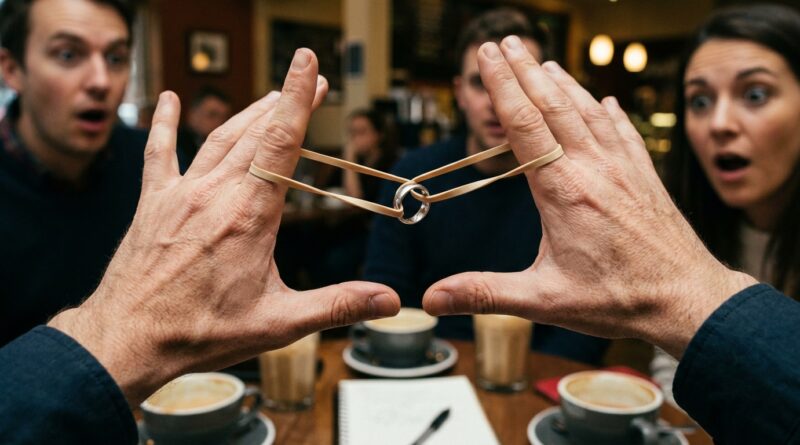
How to Turn Viral Rubber Band Magic into a Killer Everyday Sleight‑of‑Hand Routine
You know the feeling. A rubber band trick looks effortless on your phone, then you try it in real life and your fingers turn into wooden sticks. The move flashes. The timing feels wrong. Worst of all, someone says, “Do that again,” and the whole thing falls apart because what looked like a miracle online was really just one pretty moment with no structure around it. That is the real problem with most viral rubber band magic. It teaches a move, not a routine. If you want a rubber band sleight of hand routine that actually works for real people at real distances, you need a simple beginning, a stronger middle, and a clean ending. The good news is you do not need ten phases or knuckle-busting technique. One solid penetration, one clear escalation, and one impossible finish is enough to turn a social media stunt into something you can use at a table, at work, or during walk-around.
⚡ In a Hurry? Key Takeaways
- Build your rubber band sleight of hand routine around 3 beats. An intro, one repeatable miracle, and one stronger finish.
- Use only 1 to 2 core moves and change the effect, not just the handling, so each phase feels new.
- Pick bands that are comfortable and reliable. Snapping bands and cramped fingers kill confidence fast.
Why most rubber band routines feel flat
A lot of magicians learn rubber band magic backwards. They start with the flashiest move, usually Crazy Man’s Handcuffs, then try to glue extra bits onto it later. That often creates a demo reel, not a routine.
A routine needs shape. The audience should feel like the magic is building. If every phase is just “the bands melt through again,” people stop being surprised and start looking for the method.
The fix is simple. Give each phase a job.
- The first phase proves the premise.
- The second phase makes it cleaner, fairer, or more impossible.
- The last phase changes the conditions or leaves them with a memory they will talk about.
The best structure for a rubber band sleight of hand routine
Phase 1: Start with something easy to read
Your opener should be visual and quick. People need to understand the effect in about two seconds. Two bands are linked around your fingers. They melt apart. Done.
This is why Crazy Man’s Handcuffs is still around. It is not overused because it is bad. It is overused because it is good. The mistake is making it the whole act.
Use it as your “hello.” Not your entire conversation.
Phase 2: Repeat the plot, but change the conditions
Now that they understand the basic effect, make the second phase feel more impossible. You can slow it down. You can let them burn your hands. You can move the penetration to a different finger position. You can have a spectator hold one band.
The important thing is that the audience feels a difference. If the second phase looks like the first phase from a slightly different angle, it will not land as hard as you want.
A good question to ask is this. “What changed?” If the answer is “not much,” cut it.
Phase 3: End with a different effect, not just another unlink
This is the part most people skip. They do the same penetration three times and stop. A stronger routine ends with a related but different effect.
Good endings include:
- A band jumps from two fingers to two different fingers.
- A band penetrates onto a spectator’s finger.
- A broken band is restored, if that fits your style.
- A band vanishes from one hand and appears wrapped around another object.
This gives the routine a final sentence. It feels finished.
A practical 3-phase routine you can actually use
Phase 1: Standard penetration
Show two ordinary bands. Place one on your first two fingers and the other on the opposite hand. Interlock them clearly. Perform your cleanest visible penetration.
Keep the script short. “Rubber bands are funny. They either snap, stick, or do this.” Then go right into the melt.
Phase 2: Slow-motion penetration
Reset and frame it differently. “The fast version looks like camera editing. Let me do it slower.” Now perform a version that feels more open, even if it is technically the same family of move.
This phase is where you earn trust. They think they know what they saw before. Then you make it look even fairer.
Phase 3: Band jump or spectator moment
Finish with a band-through-fingers jump, a band that pops from index-middle to ring-pinky, or a spectator-held penetration. If you work close-up, spectator involvement is gold here because it turns a visual trick into a shared memory.
That gives you a full rubber band sleight of hand routine in under 90 seconds. Short enough for real life. Strong enough to repeat for the next group.
How to make the routine feel natural instead of “move, move, move”
Use one simple theme
Pick a premise and stick to it. Bands pass through each other. Bands jump. Bands escape. Do not switch from pseudo-science to comedy to mind reading in 45 seconds.
A single theme keeps the routine feeling clean.
Give each beat a reason
Try this simple script logic:
- “Let me show you something weird.”
- “That was fast. Here is the fair version.”
- “Now let’s make it happen in your hands.”
That is enough. You do not need a TED Talk about elasticity.
Build in a clean reset
Rubber band magic shines in walk-around because it resets fast. Protect that advantage. Avoid endings that leave you fumbling for a fresh setup unless the payoff is worth it.
If the trick takes 20 seconds and the reset takes a minute, it is not a worker. It is a hobby piece.
The little details that make a big difference
Use the right bands
Not all rubber bands handle the same. Some are too chalky. Some are too stiff. Some roll badly and bite into the fingers. Test a few sizes and stick with one type.
For most close-up work, you want bands that are visible, soft enough to stretch comfortably, and strong enough not to snap during a repeat performance.
Practice the display, not just the secret move
Most flashes happen before or after the magic, not during it. Practice how you show the bands, how you square them, and how you relax after the effect. Those moments matter more than people think.
Film yourself at spectator distance
Phone footage lies in both directions. Some tricks look better on camera than in person. Others feel weak on video but kill live. Record yourself from chest height, from slightly off-center, and from the distance a real spectator would stand.
If the effect only works from one perfect angle, you need to know that before your next gig.
What to do when someone says, “Do it again”
This is where routines beat isolated tricks.
If someone asks to see it again, do not repeat the exact same phase right away. Move to phase two or phase three. That way you are giving them more, not just rewinding the method.
A simple line helps. “Sure, but this time watch even closer.” Then change the conditions.
That keeps control in your hands and protects the secret.
Common mistakes to avoid
Too many phases
Three is usually enough. Four can work. Six is almost always too much unless each beat is dramatically different.
Starting too small
If people cannot tell what is supposed to happen, they will not react. Make the initial condition crystal clear.
Ignoring comfort
If your fingers are straining, the audience can see it. Choose handling that looks relaxed. Smooth beats fancy.
Practicing only at full speed
Fast hands hide sloppiness in rehearsal. Slow practice exposes it. If you cannot do the setup smoothly at half speed, it is not ready.
How to know your routine is ready for the real world
Run this checklist:
- Can a spectator explain the effect in one sentence?
- Can you perform it standing, with no table?
- Can you reset in a few seconds?
- Do the phases look different from each other?
- Do you have a plan if someone asks to see it again?
If you can say yes to all five, you are close.
At a Glance: Comparison
| Feature/Aspect | Details | Verdict |
|---|---|---|
| Routine Length | Best at 2 to 3 phases, usually under 90 seconds for walk-around use | Shorter is stronger |
| Move Selection | Use 1 to 2 core sleights and change the conditions or effect between phases | Consistency beats variety for its own sake |
| Audience Impact | Stronger when the final phase involves a spectator or ends with a different effect | Finish with a memory, not just another repeat |
Conclusion
The sweet spot with rubber band magic is not collecting ten clever moves. It is turning one or two strong ideas into a routine you can trust. That matters right now because rubber band magic is trending again in short-form video, and audiences expect close-up miracles with nothing more than office supplies and bare hands. If you can offer a tight, repeatable rubber band sleight of hand routine instead of a single exposed move from a feed, you will get better reactions, handle repeat requests with more confidence, and stand out in walk-around settings. Keep it clear. Keep it short. Make each phase earn its place. Do that, and a couple of humble rubber bands can feel like one of the strongest pieces in your pocket.